
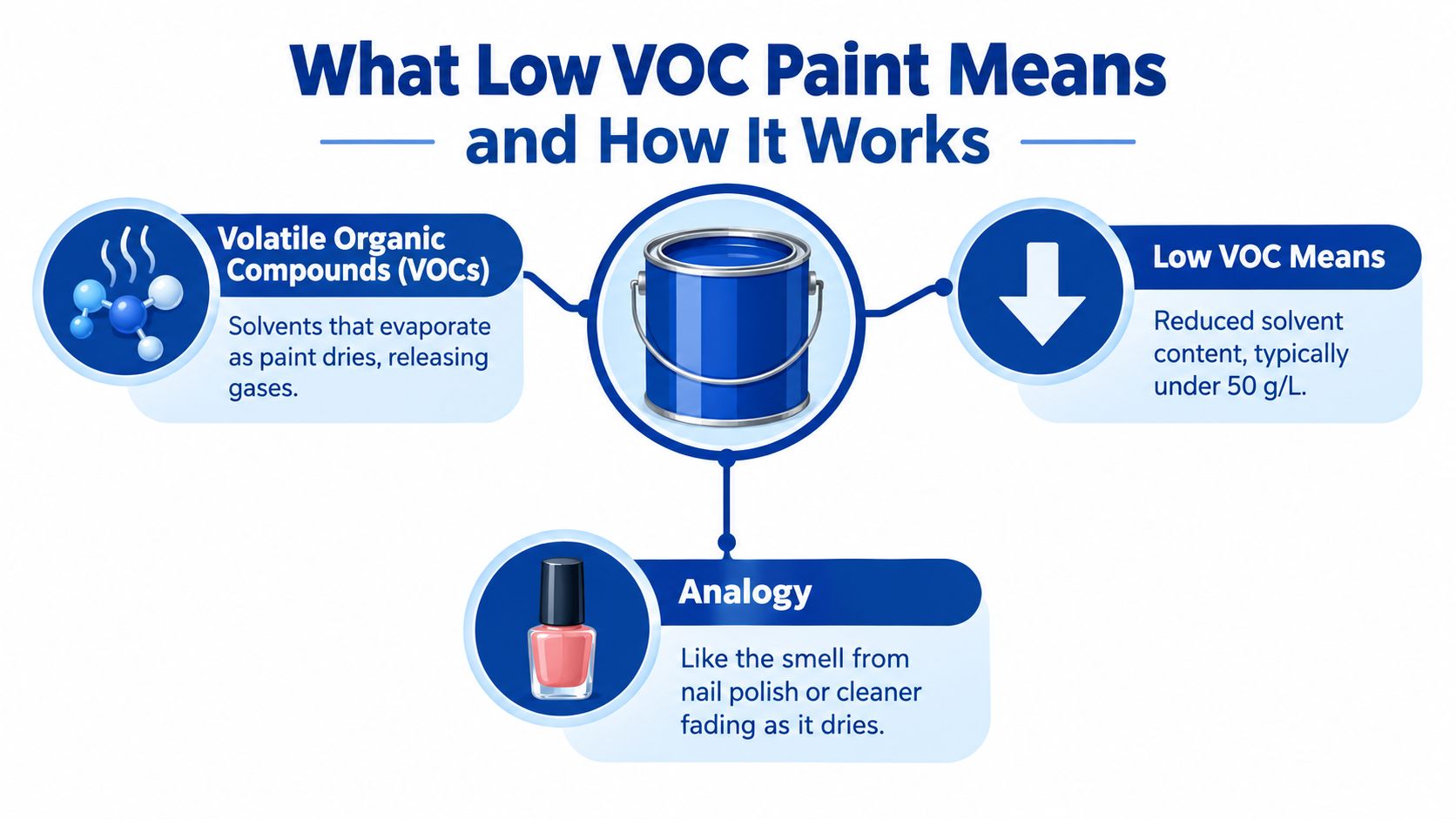
Low-VOC paint is formulated to emit far fewer volatile organic compounds, measured in grams per litre. Under the NZ Eco Choice system, the cap is around 50 g/L for flat and low-sheen paint, while ultra-low products can sit below 1 g/L.
You've chosen the colour, moved the furniture, and finished the first coat. The room looks fresh, but the paint smell hangs around longer than expected. Perhaps someone develops a headache, a child needs to sleep elsewhere, or your office can't comfortably return to normal use. On Auckland's North Shore, that situation is common in bedrooms, living areas, rentals, schools, and workplaces where opening every window isn't always practical.
Low-VOC paint can reduce the amount of solvent released as the coating dries and cures. It isn't automatically chemical-free, odour-free, or suitable for every surface, but it gives you a more controlled option when indoor air quality and re-occupancy matter.
This guide explains what low VOC paint means, how New Zealand limits are measured, what labels can and can't tell you, and how to choose a product without relying on vague claims. It also covers performance, preparation, ventilation, and timing, so you can balance a healthier interior with a durable finish. For broader choices around furnishings and lower-toxin interiors, Comfort Pure for eco-friendly homes provides useful context beyond the paint itself.
Introduction to Low VOC Paint for Healthier Spaces
A North Shore repaint may start with a simple request: make the room lighter, cleaner, and easier to live in. A family could be updating a bedroom in Milford, a landlord preparing a Glenfield rental, or a business refreshing an office in Takapuna between trading periods. The colour change is immediate. The coating's emissions are harder to see, yet they can influence odour, comfort, and how soon occupants can use the room normally.
That is why homeowners ask, “What is low VOC paint?” They usually want practical answers. Will it smell less? Can children or sensitive occupants return sooner? Will choosing it affect washability, coverage, or durability?
A practical definition
VOC means volatile organic compounds. In paint, these compounds can evaporate into the air while the coating dries and continues curing. A low-VOC product contains less of these volatile components than a conventional alternative, usually described in grams per litre, or g/L.
The g/L figure helps, but it does not describe the entire coating. Final VOC content can vary with the product type, sheen, formulation, and tinting. Water-based acrylic paint may still contain VOCs, so water-based does not automatically mean low emission.
NZ Building Performance guidance advises checking the label for VOC content or hydrocarbon solvent percentage rather than assuming a product is harmless because water is its main carrier. NZ Building Performance guidance supports a more careful reading of product information. For broader choices around furnishings and lower-toxin interiors, Comfort Pure for eco-friendly homes offers useful context beyond paint.
Why the situation matters
Lower-VOC paint has greater value when people need to stay close to the work area. Bedrooms, nurseries, home offices, classrooms, medical spaces, rentals, and occupied commercial interiors have less flexibility for extended odour or curing periods. Ventilation and surface preparation still affect the result, while a lower-emission coating reduces one part of the indoor-air burden.
The best choice depends on the occupants, substrate, finish, and schedule. In a vacant room with good airflow, low VOC may be a preference. In an occupied home, school, or workplace where re-occupancy timing matters, it can be a practical specification decision. North Shore painters can then match the coating to the surface and expected wear, rather than treating the label as the whole answer.
What Low VOC Paint Means and How It Works
A freshly painted bedroom can smell strong on the first evening, especially with windows closed. That odour comes from volatile organic compounds, or VOCs, which are organic chemicals that turn into vapour relatively easily. Paint makers may use volatile ingredients to help a coating flow, level, adhere, or dry. As the wet film dries, some of these compounds leave the coating and enter the surrounding air.
Nail polish and household cleaner provide a familiar comparison. Their smell is strongest during use, then fades as liquid evaporates. Paint has different chemistry and film formation, but the basic process is similar. Some ingredients leave the wet coating during drying, while binders and pigments remain to form the solid painted surface.
Reading the g/L figure
VOC content is recorded in grams per litre. A lower figure generally means less volatile material in the product, but it does not describe every possible emission or the coating's complete toxicity profile. For a broader explanation of VOC chemistry and indoor-air considerations, see this complete guide to VOCs.
Low VOC does not mean no chemicals. Likewise, “no added VOC” does not guarantee that the final tinted paint contains no measurable VOCs. Colourants and other ingredients can change the finished formulation, so the figure for tinted paint may differ from the untinted base.
Low VOC is better understood as a range:
- Lower-emission products: Formulated to keep VOC content below the relevant product limit.
- Ultra-low products: Made for sensitive or occupied interiors, with some NZ products rated below 1 g/L or below 0.5 g/L.
- Water-based acrylics: Often suitable for indoor use, but they may still contain VOCs. Check the declared content rather than relying on the word “water-based”.
Gloss level also affects the formulation. A flat wall paint and a hard-wearing gloss enamel may have different VOC levels, so compare the figure for the exact finish being purchased. In a North Shore home, that detail helps match lower emissions with the room's use, drying conditions, and re-occupancy plan.
Understanding VOC Limits and Labels in New Zealand
A paint tin marked “eco” or “low odour” does not tell you how much VOC the coating contains. In New Zealand, Eco Choice Aotearoa sets different limits for different product types, because a flat wall paint, semi-gloss finish, varnish, primer, and tinting product each has its own formulation requirements.
The relevant limits are listed in the Eco Choice Aotearoa paint criteria:
| Product Type | Maximum VOC g/L |
|---|---|
| Low-sheen and flat paints | 50 g/L |
| Semi-gloss paints | 60 g/L |
| Gloss paints | 65 g/L |
| Stains and varnishes | 85 g/L |
| Several primers and sealers | 45 to 50 g/L |
| Tinters | 5 g/L |
These are product-specific caps, rather than one universal definition for every coating. The criteria also set a 1% by weight limit for certain restricted VOC substances, equivalent to about 11 to 15 g/L in finished paint based on typical paint density. The NZ approach therefore combines a total VOC limit with tighter controls for particular substances.
What to check on the tin or data sheet
Find an explicit VOC declaration in g/L. Words such as “natural”, “low odour”, and “eco-friendly” describe positioning, not a measured result. If the figure is missing, request the technical data sheet and check the exact product, finish, and colour base.
Tinting can change the finished formulation, so a tinted paint may not match the untinted base. The same applies to finish. A hard-wearing gloss enamel can have a different VOC figure from a flat wall paint, even within the same brand.
Check the hydrocarbon solvent percentage as well. Water-based acrylic paint can still contain VOCs, while Eco Choice Aotearoa licensing allows no more than 20% hydrocarbon solvents by weight, as explained in Dulux Trade's NZ low-VOC guidance.
For commercial specifications, documentation affects more than product selection. NZ Green Star guidance awards points when at least 95% of internally applied paints, adhesives, sealants, and carpets meet total VOC limits. Homestar guidance has required at least 50% of paint by volume to be ECNZ low-VOC or waterborne paint. On a North Shore project, treat VOC records as part of procurement and review the painting safety and compliance standards before application and re-occupancy are scheduled.
Health and Environmental Benefits You Can Expect
A North Shore bedroom repainted in the morning may still smell by evening. Low-VOC paint can reduce that lingering odour, but smell is only a rough guide. A mild-smelling coating may still release VOCs during drying and curing, so the declared g/L figure remains more useful than your nose.
Lower emissions can suit children's rooms, bedrooms, home offices, and areas used by people who react badly to strong fumes. It can also help when a commercial space needs to reopen promptly. The coating does not replace ventilation, safe application, or the manufacturer's re-entry instructions, but it can reduce the amount released while the film dries.
Where the environmental benefit fits
VOCs can enter outdoor air and contribute to chemical reactions involved in smog formation. A coating with less volatile solvent content can reduce that contribution, especially when many interior surfaces are being painted across a commercial project.
Product selection also matters beyond the room itself. Eco Choice Aotearoa criteria assess VOC content alongside limits on particular substances and hydrocarbon solvents. Green Star specifications use measurable thresholds, so documented products can support indoor-environment targets more reliably than an unverified “green” label. For North Shore offices, retail spaces, and other occupied premises, those records can also help coordinate ventilation and re-occupancy.
The trade-off is about selection
Lower-VOC formulas may require different working conditions. Some need longer between coats, and available colours or sheens may vary by product range. Those differences are manageable, but they should be confirmed before painting starts, particularly where rooms must return to use on a tight schedule.
Practical rule: A lower declared emission level is more useful for sensitive occupants and faster re-occupancy planning, while ventilation and curing still determine when the room is ready.
Some NZ products are rated below 1 g/L, providing a stronger option where reducing interior emissions is a priority, as recorded in NZ low-VOC painting guidance. For a North Shore home, that may make sense in a bedroom or nursery. In a lightly used area, a different product may be suitable if its finish, application requirements, and documented limits meet the project brief.
A short visual summary can help compare benefits and limitations:
Performance Trade Offs and How Modern Formulas Compare
Low-VOC paint isn't automatically weak paint. Earlier low-emission products sometimes created concerns about coverage, touch-up quality, or washability, but modern interior systems can deliver practical durability when the surface has been prepared correctly and the product suits the room.
The coating still needs to match the job. A bedroom wall, a busy hallway, a bathroom ceiling, a kitchen, and an exterior weatherboard all place different demands on paint. A lower VOC figure doesn't compensate for using an interior wall coating on an exposed exterior or skipping the primer required for a porous or repaired surface.
Preparation protects performance
Most visible paint failures begin before the topcoat. Dust, chalking, grease, loose coating, glossy patches, and unsealed repairs can prevent a new film from bonding evenly. Washing, scraping, sanding, filling, spot priming, and masking create the conditions a low-VOC coating needs to perform.
That's why the product should be assessed as part of a complete system:
- Surface condition: A sound substrate reduces adhesion problems and uneven sheen.
- Primer selection: Porous repairs and difficult surfaces may need a compatible primer.
- Room conditions: Temperature, humidity, and airflow affect drying and recoating.
- Finish choice: A washable sheen may suit a hallway better than a flat finish.
- Final tint: Confirm the VOC content after tinting where the schedule or occupant sensitivity is important.
Avoiding the “zero means instant use” mistake
“No added VOC” and “zero VOC” claims need careful reading. They may refer to a base product before tinting, and they don't guarantee that a room can be occupied immediately after application. Paint still needs time to dry and cure, and the space needs suitable airflow.
Modern Resene and Dulux systems offer lower-emission options across interior applications, but the correct choice depends on the technical data sheet, surface, colour, and finish. Ask for the final product documentation rather than choosing solely from a front-label claim.
A lower-emission system may cost more at purchase or require more careful application, but the value is clearer when the room must remain comfortable, the finish needs to last, and disruption has a real operational cost. Good preparation closes many performance gaps that buyers wrongly attribute to VOC content alone.
How to Choose Certified Low VOC Paint With Confidence
The right choice depends on who will use the room, how soon they must return, and how much fresh air the space receives. A guest room used occasionally has different requirements from a child's bedroom, a rental awaiting new tenants, or an occupied office being painted in stages. Certification and clear product records become more valuable as occupant sensitivity, limited ventilation, and time pressure increase.
A four-part buying check
Verify the certification. Look for an Eco Choice Aotearoa licence or recognised emissions documentation. A label such as “eco paint” does not confirm that the coating meets a defined cap.
Check the exact g/L rating. Compare the figure with the product type and sheen. Eco Choice Aotearoa sets a 50 g/L cap for flat paint, while gloss coatings have a different limit.
Read the technical documents. Request the technical data sheet and safety data sheet. Check VOC content, hydrocarbon solvent percentage, tinting conditions, preparation requirements, drying information, and ventilation guidance.
Confirm the tinted finish. A base described as no added VOC may not represent the final colour. Ask the supplier or painter to record the VOC figure for the actual colour and complete system.
Match the specification to occupancy
In a family home, low-VOC paint usually brings the greatest practical benefit in bedrooms, nurseries, living areas, and home offices. For a rental, it can make handover more comfortable when new occupants arrive soon after painting. Commercial managers should plan staged work, after-hours application, and ventilation because a low VOC figure does not remove drying or re-occupancy time.
Learning spaces need tighter scheduling. NZ Building Performance guidance states that 90% of paints in new or upgraded learning spaces must meet recognised VOC limits. It also specifies a minimum one-week bake-off period after interior painting, followed by regular purging during the first 8 weeks. The coating choice therefore affects the project programme, not only the label.
For North Shore homes, apartments, and occupied commercial premises, environmentally friendly painting options provide a useful starting point for discussing emissions alongside durability. Ask the contractor to list the product, sheen, tint, preparation system, ventilation plan, and expected re-occupancy timing in the quote. This record makes it easier to compare products and confirm that the coating selected matches the room's actual use.
Choosing Low VOC Paint for Your Next Project
Low-VOC paint is most important where people sleep, learn, work, or spend long periods indoors. That includes nurseries, bedrooms, home offices, schools, offices, retail spaces, and occupied apartments with limited airflow. Ultra-low products deserve particular consideration when sensitive occupants need to return promptly, although the room still needs ventilation and curing time.
A standard exterior system may be appropriate when the main challenge is weather exposure rather than indoor occupancy. North Shore homes face coastal moisture, strong sunlight, salt-laden air, and varied substrates, so the exterior specification should prioritise adhesion, flexibility, water resistance, and compatibility. A low-VOC label doesn't make an unsuitable exterior product perform well.
The most reliable process is preparation-led:
- Inspect the substrate and identify failing or contaminated areas.
- Wash, scrape, sand, fill, and prime where required.
- Choose the paint by room use, sheen, substrate, and exposure.
- Confirm the final VOC figure after tinting.
- Plan airflow, drying time, and re-occupancy before the first coat.
- Record the product and technical documentation in the quote.
If you're unsure how much preparation your walls need, this guide to how to prep walls for painting explains why repairs and cleaning affect the finished result as much as the topcoat.
Low-VOC paint isn't a universal replacement for every coating. It's a practical specification choice when indoor air quality, occupant sensitivity, green-building requirements, or a controlled return-to-use schedule matter. With the right product and preparation, you can reduce unnecessary emissions without treating durability as an afterthought.
Painters North Shore can assess your rooms, recommend suitable Resene or Dulux low-VOC systems, document the product details in your quote, and schedule interior or commercial work around occupancy. Visit Painters North Shore to request an assessment and discuss a healthier, durable finish for your North Shore property.


