Three quotes sit open in your browser tabs and they don't describe the same job. One is a number on a single page. Another runs to four pages and mentions a moisture meter, masking tape and a two-coat system. The third undercuts both and says "paint and prep included" without naming a product. Compare those three on the bottom line and you'll probably pick the worst of them, because the cheapest headline figure is usually the least comparable: the money it saves sits in the preparation, access and variation terms it left out. A painting quote is a scope-and-contract document before it is a price, and reading it that way is the whole skill.
Every Item a Painting Quote Should Show
Read every quote against the same twelve items, in the same order, because that's roughly the order problems surface once work starts. Tick each one before you look at the total, and note which ones the painter answered without being asked.
| Item | What a good quote says | Red flag |
|---|---|---|
| Pricing basis | Fixed quote or estimate, label stated prominently | No label, or both terms used |
| GST | Included or excluded, stated clearly | GST not mentioned |
| Scope of work | Room by room or surface by surface | Lump sum with no scope |
| Surface preparation | Washing, sanding, filling, priming and masking listed | "Paint and prep included" with no detail |
| Products and coats | Named product lines, number of coats and sheen | No product named |
| Labour and access | Crew size, days and scaffolding listed separately | Access missing on a two-storey home |
| Timeline | Start window and completion date | No dates given |
| Exclusions and assumptions | Named in plain words | Silent on exclusions |
| Variations | Who approves changes, and unit rates for extras | No variation process |
| Payment milestones | Tied to progress and completion criteria | Large upfront payment |
| Warranty and insurance | Written workmanship warranty and public liability cover | Neither stated |
| Validity and acceptance | Validity period and written acceptance record | Open-ended price |
If you're asking yourself what should a painting quote include, that table is the short answer. A missing line isn't automatically a bad quote. It's a question with a yes or no answer, and the answer usually tells you more about the painter than the price does.
Inconsistency is what sinks comparisons. One quote prices a full prime, the next assumes the substrate is sound. One lists scaffolding as a line, the next calls access "as required". The totals look like a gap of several thousand dollars, and the difference is two definitions.
The test I apply: if two documents can't be compared line by line, they aren't two quotes for the same job. They're two different jobs with prices attached.
Send the same written scope to every painter you're considering and ask each one to price against it. That single step removes most of the fog before anyone lifts a brush.
Fixed Quote or Estimate and Why the Label Matters
Two prices arrive for the same exterior. One is lower and called an estimate. The other is higher and called a fixed quote. The cheaper headline is often the least comparable, because it leaves preparation, access and variation terms out of the document. A painting quote is a scope-and-contract document, not just a price.
A fixed quote is a price for a defined scope. An estimate is a forecast of what that scope might cost. The two create different obligations, and the paperwork should say which one you are holding before you read the total.
The MBIE guidance on your rights before building work starts describes a quote as a price based on detailed specifications and generally the amount payable for completing the agreed work, subject to agreed variations or matters outside the contractor's reasonable control. An estimate is only an informed approximation. It can move as the scope becomes clearer.
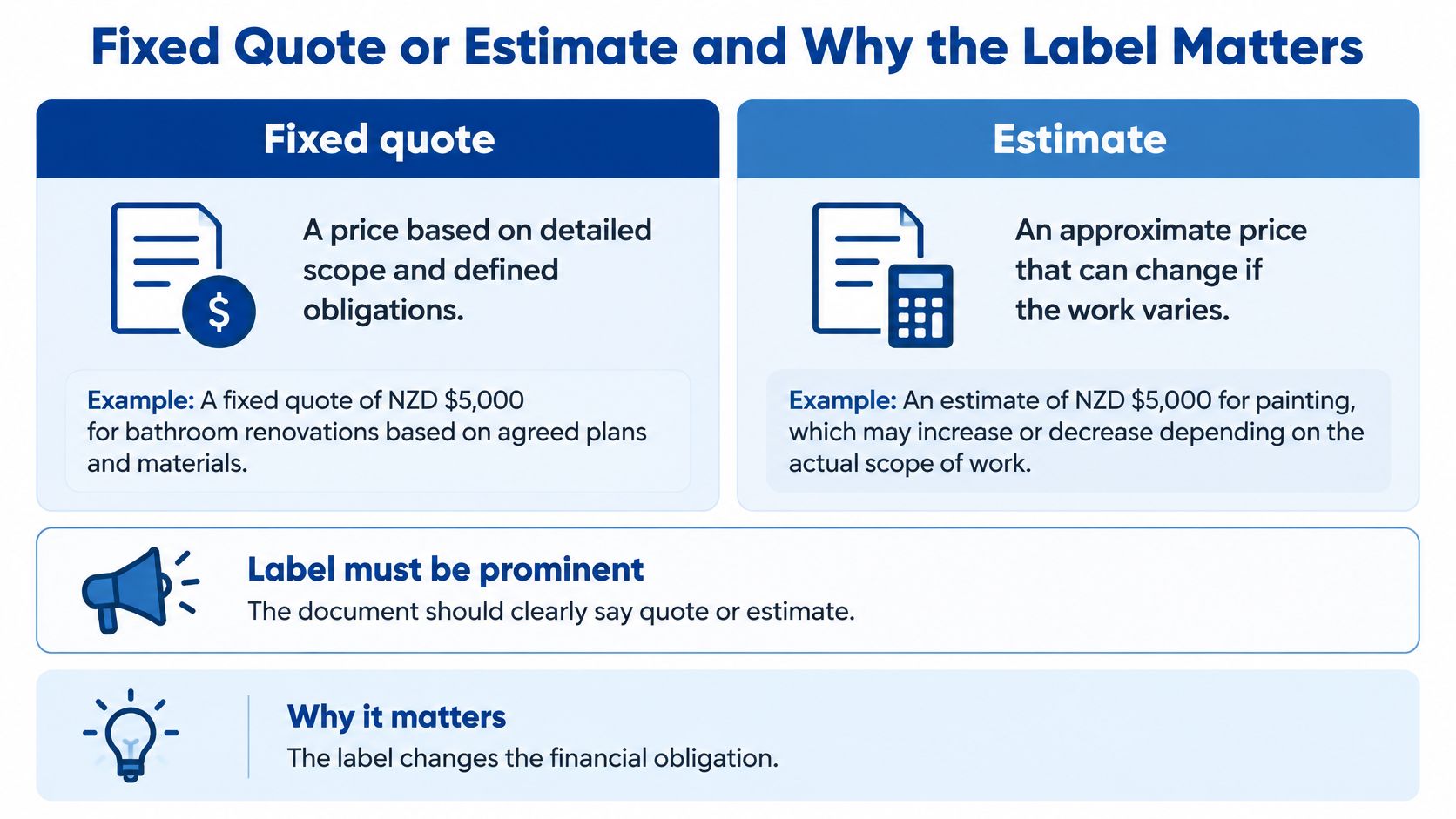
Once you accept a quote, the painter generally cannot charge more than the agreed amount unless you approve additional work or the job's scope changes. That limit is why the label matters more than the arithmetic. I read an unlabelled figure as an estimate until the painter states otherwise in writing.
| Feature | Fixed quote | Estimate |
|---|---|---|
| Basis | Detailed specifications and an agreed scope | Informed approximation of the work |
| Price after acceptance | Generally the agreed amount; extra cost needs your agreement to extra work or a scope change | An approximation that can move as the scope changes |
| Changes | Priced through a written variation process | Confirm how and when the figure will be firmed up |
| GST | State whether GST is included | State whether GST is included |
| Check before accepting | Variation terms, validity period, assumptions | How the estimate was calculated and when it becomes final |
What the document must state either way
Whichever label is used, the document should say whether GST is included, how changes will be priced and approved, how long the price holds, and which assumptions produced it. The assumptions sentence does the heavy lifting. "Assumes sound substrate and clear access to all elevations" is a different offer from silence on those points.
Exterior repaints show the difference fast. Concealed timber damage, a failing window flashing, or a bank that needs scaffolding can appear once preparation starts, and the label decides how that next conversation is priced. If the document does not say which type it is, ask before you accept it.
Scope, Surface Preparation and Materials Explained
Scope is the first place a quote goes vague, and vague scope is where the arguments live. "Paint the house" isn't a scope. A weatherboard exterior carries body cladding, trim, fascia, eaves, soffits, window reveals, doors, the garage door and downpipes, and each one takes a different amount of time per square metre.
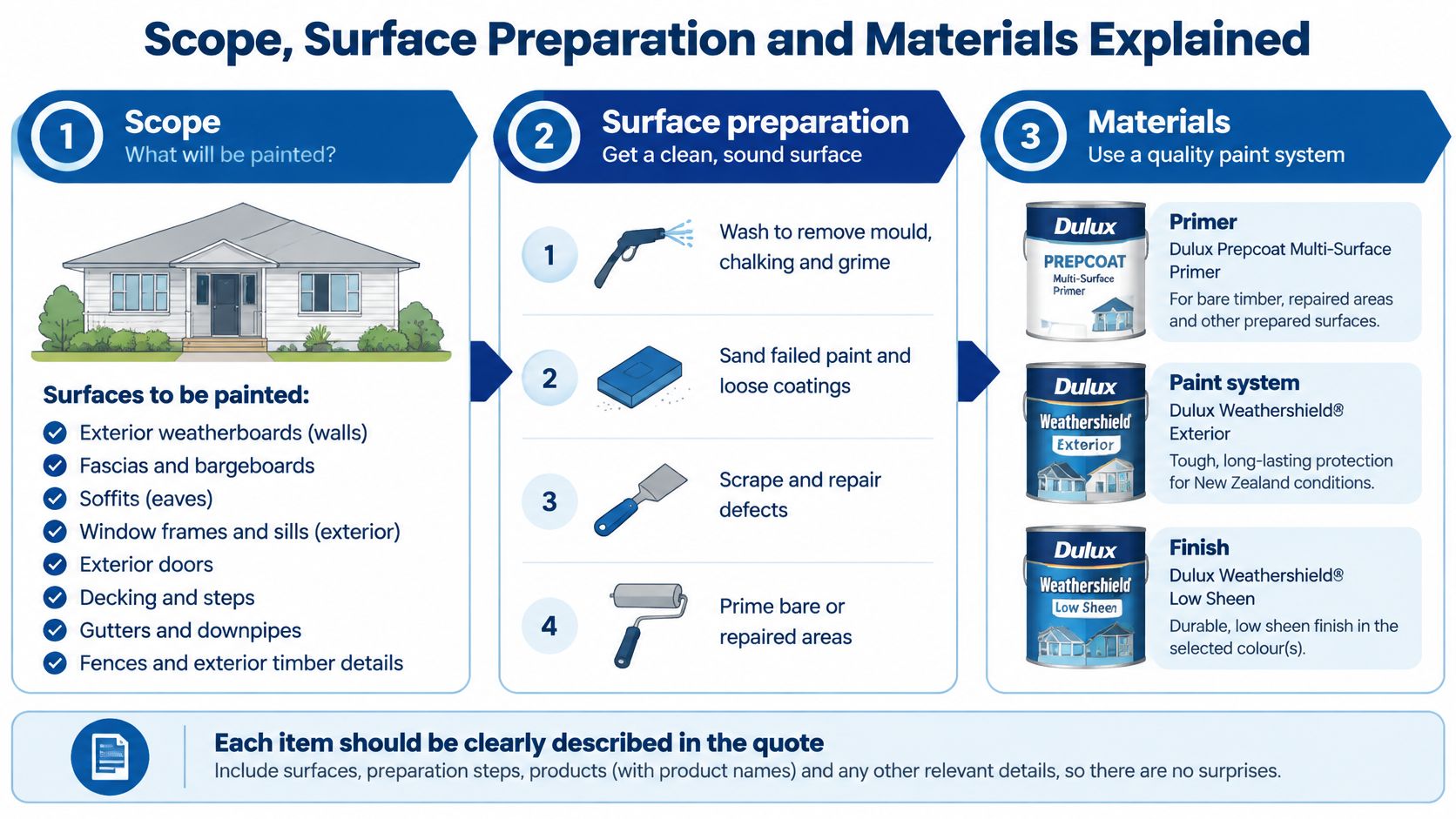
Scope is a list of surfaces
A sound quote names each surface and what happens to it. Body cladding gets washed, scraped, spot-primed and two coats. Trim gets sanded and a coat of enamel. The garage door might be sprayed rather than brushed. Once those lines exist, you can see whether a cheaper quote covers the same surfaces or skipped the eaves.
The preparation sequence, in order
- Wash. Remove mould, chalk and grime so the coating bonds to the substrate rather than to dirt. Skipping this is the fastest way to early failure on a coastal exterior.
- Sand and feather. Scrape failed paint back to a sound edge and feather it, so the repair doesn't telegraph through the new topcoat.
- Fill and fair. Patch cracks and holes with a filler matched to the substrate. The wrong filler shrinks, cracks, or shows as a dull patch under a gloss finish.
- Spot-prime. Bare timber, plaster repairs and knots need primer. Unsealed filler drinks the topcoat unevenly and the repair stays visible.
- Mask and protect. Windows, gutters, paths, light fittings and garden beds. Poor masking leaves overspray on glass and concrete that's slow and expensive to remove.
- Apply the system. Brush, roller or spray, chosen for the surface and stated in the quote.
One coat is a decision, not a saving. Two coats is the standard for a repaint, and a single-coat line should arrive with a reason attached to why the surface doesn't need the second.
The materials block
The materials section names the product line, the primer type, the number of topcoats, the sheen and whether a low-VOC option applies. Our own preparation covers washing, sanding, filling cracks, priming and masking before any coating goes on, and the chosen product goes on by brush, applicator or spray with back-brushing, with two coats as standard. Ask which product and why, especially on cedar or a west-facing wall that takes the weather. A sheen choice isn't cosmetic; it changes how the surface cleans and how long it lasts.
Labour, Material and Price Ranges to Expect
Two quotes for the same two-storey weatherboard can read $16,500 and $24,000 and still not be the same job. The cheaper headline is often the least comparable, because preparation, access and variation terms never made it onto the page. A painting quote is a scope-and-contract document, not a price. Use the ranges below as a sanity check, then go back and read the scope line by line. Figures are indicative and exclude GST unless stated.
| Job or charge | Typical range or rate | What to confirm |
|---|---|---|
| Full exterior of a two-storey weatherboard or villa | $15,000 – $30,000 excl GST | Prep level, scaffolding, number of coats |
| Exterior spray of main body cladding | $30 – $55 per m² excl GST | Measured area and surface condition |
| Full interior of a 2-bedroom unit or townhouse | $5,000 – $8,000 excl GST | Ceilings, trims, doors and feature walls included |
| Building levy on building work over $65,000 incl GST | $1.75 per $1,000 incl GST | Whether it applies and is shown separately |
What a range can't tell you
Size, height, substrate condition and access decide where a job sits inside a band. A double-storey villa that needs heavy scraping costs more than a sound weatherboard house of the same footprint, and no table captures that difference. Cladding priced per square metre should show the measured area the rate was multiplied by, not the rate alone. I would not treat a low total as a bargain until those three items are written down.
Separate labour from materials
Split labour and materials lines show where the money goes. A crew-size and day-count line also lets you compare timelines without guessing. If one painter quotes six days with two people on site and another quotes three days with an unnamed crew, ask what changed: fewer coats, less preparation, or access the second quote never priced. Materials should name the product, the primer and the number of topcoats, so a cheap materials line is not just a thinner specification.
Statutory charges get their own line
From 1 July 2024 the building levy is $1.75 including GST per $1,000 of building work, and it applies when the project value exceeds $65,000 including GST, according to the Ministry of Business, Innovation and Employment building levy guidance. It will not touch most residential repaints. On a large commercial job, confirm whether it applies and see it as its own line rather than buried in a subtotal.
If a quote sits far below these ranges, look first for missing preparation, scaffolding, or a second topcoat. Interior jobs follow the same logic: compare each quote's room-by-room scope, ceilings, trims, doors and feature walls against the interior range above, and against published interior house painting prices, before you decide the figure is reasonable.
Reading a Sample Itemised Painting Quote
Take an illustrative exterior quote for a three-bedroom weatherboard house, with figures used for illustration only. Read it from the top down and challenge each row on its own terms.

| Line item | What it must state |
|---|---|
| Site assessment and colour consultation | Measured areas and agreed palette |
| Preparation: wash, sand, fill cracks, mask | Surfaces and repair method |
| Primer and two topcoats | Named product, number of coats, sheen |
| Labour and crew | Crew size and number of days (2 painters, 6 days) |
| Access: scaffolding hire | Listed separately and removable if not needed |
| Subtotal excl GST | Fixed quote or estimate label stated |
| Contingency: rotten timber | Unit rate per board or per metre |
Where to push back
Say the fixed portion comes to about $18,400 excluding GST, with a timber contingency at a rate per metre rather than a guessed lump sum. That contingency sits outside the total on purpose: it's work nobody can see until the cladding is exposed, and pricing it as a unit rate keeps it honest in both directions.
Check the preparation figure against the labour days. If six crew days are quoted and preparation is a token amount, preparation isn't really in there. Check that the materials line names a product. Check that scaffolding appears on a two-storey home and that it can be removed if the crew works off ladders and a mobile tower instead.
Ask this before you sign: which part of this price is fixed, and what would have to happen for it to change?
Two quotes can show different totals and be identical once you align the lines. Add the contingency to one, add the scaffolding to the other, and the gap often closes. If you're the one issuing documents rather than reading them, billing guidance for solo painting contractors covers invoice templates and milestone wording that match the quote you sent.
Exclusions, Variations, Warranties and Insurance
Scaffolding goes up, a board that looked sound splits, and the timber behind it is rotten. Or a window has no flashing tape. The invoice then climbs past the quote, and both sides argue about what was included. That argument is already lost if the document never said what happens when the wall is opened. A painting quote is a scope-and-contract document. The lowest headline figure is often the least comparable, because it leaves preparation, access and variation terms off the page.
Exclusions named in plain words
Name what the price does not cover, in words a homeowner can test: rotten timber replacement, lead-paint testing and removal, weather delays past an agreed number of days, colour changes after the first coat, and repairs to concealed damage found during preparation. Plain exclusions show the price was built on a real scope. Leave them out and the cheap number is usually carrying work nobody has priced.
The variation clause that stops the argument
New Zealand's Consumer Protection guidance on quotes and estimates treats a quote as an offer to perform work for a specified price, and warns that a quote is not a contract and may not explain how variations or disputes will be managed. The quote, or the agreement attached to it, has to name who can authorise a change, how each extra is priced, and whether work stops until that approval is in writing. An email reply is enough if both sides treat it as the record.
Unit rates for the extras you can already foresee (substrate repairs, timber replacement, extra coats, access equipment and weather delays) turn the argument into arithmetic. Put payment in the same clause. Milestones tied to progress, with completion criteria you can walk around and check, beat a large sum paid before a brush is lifted.
I would not sign a headline price that has no written path for a change. If the only number on the page is the total, you cannot tell what moves it.
Warranty and insurance are separate promises
A workmanship warranty covers the labour. The product warranty covers the coating. They are rarely the same length, and a verbal promise to stand behind the job is not either of them. Get the workmanship term in writing. Painters North Shore backs all work with a written workmanship guarantee and carries full public liability insurance, the cover that matters when a ladder or a spray gun is near a neighbour's car. Ask for evidence of that cover, not a verbal assurance, and get your certificate of currency so you know what a current one looks like. The house painting warranty sets out what the guarantee covers.
Occupied homes and the written contract
For an occupied home, the quote should state ventilation, dust containment, protection of possessions and waste handling, plus any exclusion zones while coatings are wet. Larger residential building jobs should have a written contract, not a text message and a deposit. After handover, ask for maintenance requirements, the written warranty and the insurance documentation in the same pack as the final invoice.
Extra Lines for Rental and Commercial Quotes
Peeling paint is a symptom, and repainting over it is a short-term fix with a predictable failure date. Bubbling and flaking usually mean moisture is arriving through the substrate, a drainage fault, or an insulation and ventilation problem. The paint is telling you where the water is going, not causing it.
New Zealand's Healthy Homes standards cover heating, insulation, ventilation, moisture ingress and drainage, and draught stopping, and all rental properties were required to comply from 1 July 2025. The 2025 HUD monitoring report on the Healthy Homes Standards Guarantee Act surveyed about 1,400 renters and 750 landlords, and nine in ten landlords reported their properties already met the standards or would by the deadline. Compliance paperwork is now routine portfolio management.
What a rental quote should carry
A rental repaint quote earns its keep when it records the condition and compliance interface: observed dampness, bubbling or peeling room by room with photos, the likely moisture source, the specialist diagnostic or building work recommended, and whether painting waits until the substrate is dry and repaired. It should also state what the painter is not certifying, including Healthy Homes compliance, weathertightness, insulation performance and mould remediation.
For commercial premises, add after-hours or staged scheduling, safe access for staff and customers, and a plan that limits downtime.
Will repainting fix the cause of peeling paint? No, not unless the moisture or substrate problem is identified and resolved separately. A quote that says so is worth more than one that stays quiet.
Compare Three Quotes Before You Sign
Build one grid from the checklist in the first section: a row per item, a column per quote, and a mark for present, unclear or missing. Request written quotes from at least three providers, each priced against the same scope, the same named products and the same preparation, so the totals are comparable.

Read the grid, not the total
A quote that's cheapest and missing preparation or variation terms isn't the best value; it's an incomplete offer with a low headline. A higher quote that names its exclusions, carries unit rates and ties payment to milestones usually carries less risk, because you can see where the money goes and what happens when something unexpected turns up.
Put every unclear line to each provider in writing and compare the answers, not just the documents. The painter who replies with specifics is showing you how the job will be run. For a wider view of what separates a solid contractor from a polished one, our guide to how to choose reliable painting contractors in Auckland covers the checks worth making before signing.
The order to do it in this week
- List the items your project needs, using the checklist as the template.
- Request three written quotes against that same list.
- Fill the comparison grid, marking each item present, unclear or missing.
- Ask in writing about every unclear line and keep the replies with the quotes.
- Sign only when the pricing label, variation terms and payment milestones are clear.
The single next step is to send your scope list to the providers you're considering and ask for written quotes against it. A painter who balks at pricing a defined scope is telling you something useful.
Painters North Shore answers quote requests within 24 hours, and the process starts with a free, no-obligation visit where we assess the scope and talk through colour options before anything is priced. Call 021 446 716 or submit an enquiry at paintersnorthshore.co.nz/contact with your scope list, and we'll come back with a written quote you can hold against the other two.
A detailed quote you can read line by line is the difference between comparing prices and comparing jobs. Painters North Shore provides free, no-obligation on-site assessments across Auckland's North Shore, with detailed, transparent estimates that name the products, the preparation and the exclusions, plus a free colour consultation on residential work. Send your scope list through and we'll put a written figure against it so the comparison is real. Visit Painters North Shore to request your quote.