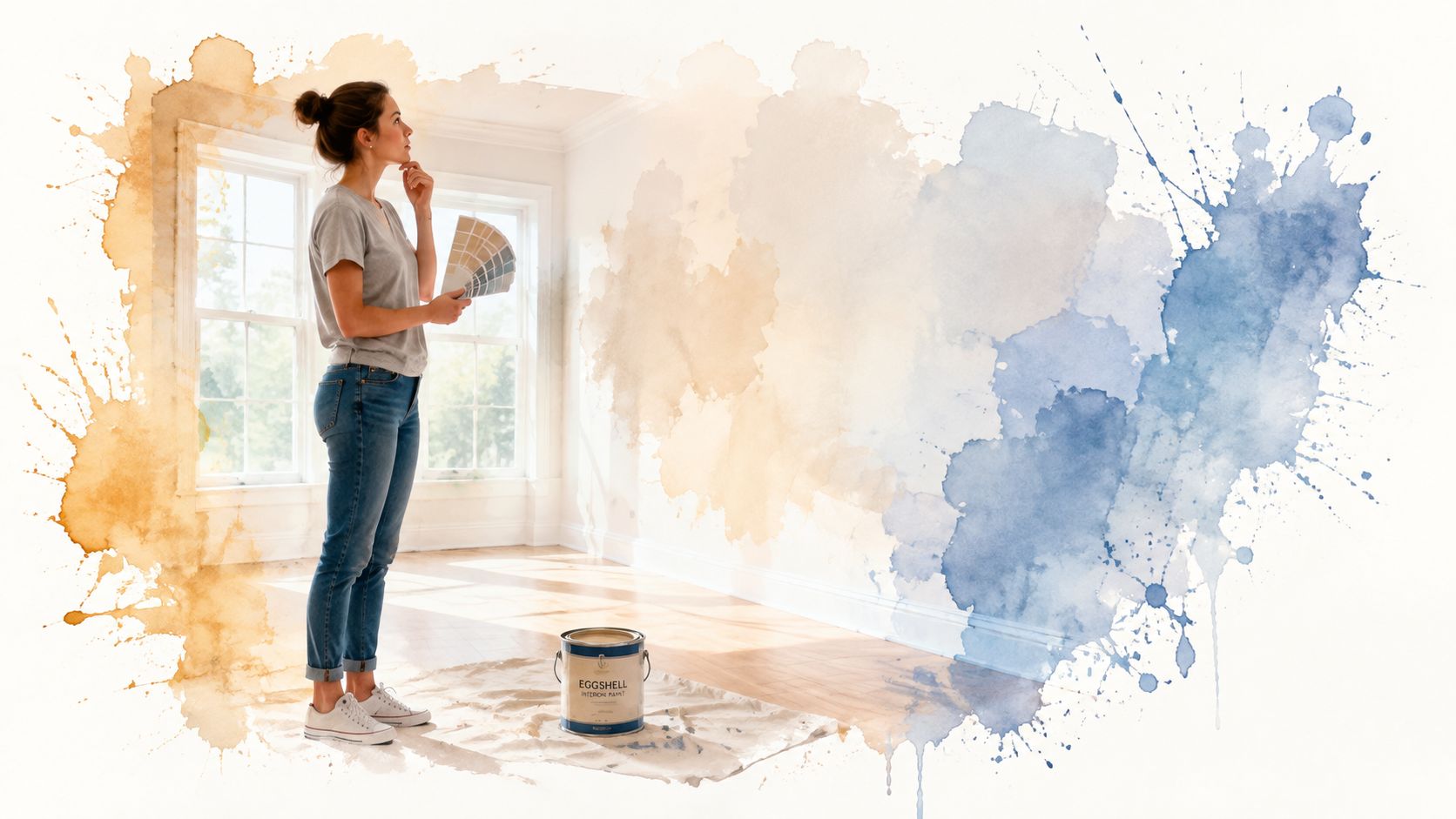
You're standing in the living room with colour cards in one hand and paint tins marked flat, low-sheen, satin and eggshell in the other. The walls look sound from across the room, but daylight from the windows exposes every small repair, while the nearby kitchen and family traffic mean the finish must cope with regular wiping. For most North Shore interiors, eggshell paint for walls offers a sensible middle ground, provided the surface and product system are chosen properly.
Coastal homes add another layer to the decision. Humidity, salt-laden air and strong reflected light can make poor preparation or an unsuitable coating show sooner than standard advice suggests. Eggshell can work beautifully, but it isn't a magic coating, and the result depends as much on the wall beneath it as the sheen on the tin.
Why Eggshell Is the Go-To Finish for Living Spaces
A homeowner recently choosing a finish for an open-plan lounge faced the usual conflict. Flat paint gave the soft appearance they wanted, but they worried about cleaning marks around the hallway and dining area. Satin looked more hard-wearing, yet its extra reflection made every patch and sanding line stand out under side light. Eggshell offered the compromise: a restrained lustre, practical wipeability and less visual glare than a higher-sheen coating.
Why the balance matters
Living rooms, family rooms and connecting hallways need more than a purely decorative finish. Walls collect fingerprints near switches, dust along circulation routes and occasional scuffs from furniture. Eggshell's low-to-mid sheen gives the surface some cleanability without turning the wall into a reflective plane.
It also suits the way many North Shore homes are lit. Large windows, glazed doors and pale coastal interiors can throw light across walls at a shallow angle. A high sheen exaggerates uneven filling, while a completely flat coating can look dull or mark easily depending on the product. Eggshell softens that contrast.
- For living rooms: It gives colour a gentle depth without an obvious shine.
- For hallways: It handles routine wiping better than a very flat finish.
- For family spaces: It provides a practical surface while retaining a residential appearance.
- For budget-conscious decorating: Finish selection can support stylish rooms on a small budget, especially when one versatile wall coating works across connected rooms.
Eggshell isn't automatically the toughest wall paint available. A washable matt product may be a better fit where the homeowner wants minimal reflection, while satin can be the stronger choice for demanding cleaning conditions. Still, for a typical living area with sound preparation, eggshell remains a well-judged starting point.
What Eggshell Paint Means in New Zealand
The term eggshell describes a coating's appearance, not one universal product specification. In New Zealand, compare the label with the measured sheen system used alongside AS/NZS 2311:2017, the Building Ministry's guide for painting buildings. The guide applies to domestic, commercial and industrial painting practice. (Building Ministry AS/NZS 2311:2017 guide)
Read the label as a sheen description
New Zealand gloss naming commonly groups coatings by measured gloss units at a 60-degree angle:
| Finish group | Gloss level at 60° |
|---|---|
| Flat | Under 5 |
| Low-gloss or low-sheen | 5–20 |
| Semi-gloss | 20–50 |
| Gloss | 50–80 |
| Full gloss | Above 85 |
These ranges explain why suppliers may use different terms for similar-looking products. The standard does not prescribe eggshell as one standalone finish name. An imported paint may carry “eggshell” on its label, while a New Zealand technical discussion may place a comparable appearance within the low-sheen family.
For North Shore coastal homes, that distinction matters. Salt air and high humidity make surface preparation, product selection and cleaning demands more important than the name printed on the tin. A labelled eggshell may not perform like another product with the same label.
New Zealand practice commonly places eggshell as a low-to-mid sheen wall finish around 10–20% gloss at 60°, above flat in reflectance and generally below satin. (New Zealand finish guidance for choosing wall paint)
Communicate the result, not just the name
Tell the painter how the room is used, how much moisture and salt-laden air it receives, and what cleaning it will need. Ask for the product data sheet and a sample applied to the prepared wall. Check it in daylight and under the room's normal lighting. This prevents a mismatch between a manufacturer's “eggshell,” a painter's “low-sheen,” and the reflectance you expect after drying.
The Real Pros and Cons of Eggshell Walls
Eggshell's appeal comes from balance, but balance means compromise. It reflects enough light to give a wall a subtle natural lustre, yet not so much that it resembles trim paint. On a well-prepared interior wall, that restrained finish can look calm, polished and forgiving.
Where eggshell earns its place
The practical advantages are strongest in rooms where appearance and moderate maintenance matter equally.
- Gentle appearance: The low reflection avoids the hard, shiny effect that can make a wall feel commercial.
- Useful washability: A sound acrylic eggshell surface can cope with careful cleaning better than a fragile flat finish.
- Good visual balance: It gives colour a little lift without drawing attention to the coating itself.
- Suitable for regular living areas: It works well in lounges, bedrooms, dining rooms and many hallways when the product is made for interior walls.
Eggshell can also disguise minor application irregularities better than a glossier finish, although it won't hide poor filling, dents or broad sanding defects. Its slight sheen still catches side light, particularly in a coastal home with bright windows.
Where it falls short
The limitations matter more in wet rooms and heavily handled areas. Eggshell generally won't tolerate aggressive scrubbing as well as a suitable semi-gloss or a product specifically tested for demanding cleanability. Touch-ups can also flash if the replacement paint is applied over a dirty surface, with a different batch or with a noticeably different method.
Practical rule: Choose eggshell for its appearance and moderate maintenance, not because the word itself guarantees maximum durability.
High-moisture rooms need a coating system designed for those conditions, plus ventilation and appropriate priming. In a North Shore bathroom, the product data sheet matters more than the finish name. The same applies to kitchens, laundries and walls close to frequently opened doors where damp air and surface contamination can combine.
How Eggshell Compares to Other Wall Finishes
A finish decision becomes clearer when the options sit together rather than on separate paint tins. The table below uses New Zealand's common 60-degree gloss groupings as a practical guide. Exact product performance still depends on formulation, substrate and preparation.
| Finish Type | Gloss Level at 60° | Cleanability | Best Use Cases |
|---|---|---|---|
| Flat | Under 5 | Lowest visual reflectance, gentle cleaning required | Ceilings, quiet rooms and walls where glare must be minimised |
| Low-sheen | 5–20 | Moderate, depending on product | General interior walls and understated spaces |
| Eggshell | Around 10–20 in typical NZ practice | Better than very flat finishes, but product-specific | Living areas, bedrooms, dining rooms and moderate-traffic halls |
| Satin | Above eggshell and below semi-gloss | Generally easier to wipe than eggshell | Busy family spaces, kitchens and some bathrooms |
| Semi-gloss | 20–50 | Stronger resistance to repeated cleaning | Moisture-prone areas, trims, doors and hard-working surfaces |
Eggshell sits in the middle because it avoids the extremes. Flat and matte coatings minimise reflection but can demand gentler cleaning. Satin and semi-gloss provide more resilience and light bounce, though they expose surface defects more readily and can look too bright on broad walls.
Use the room's purpose to decide. A smooth, busy kitchen may justify satin, while a lounge with imperfect plaster and strong afternoon sun may look better in eggshell. For a wider discussion of sheen behaviour, see this guide to matte vs gloss paint.
Surface Preparation and Application Tips for Eggshell
Eggshell rewards preparation and punishes shortcuts. Its moderate sheen can reveal dents, ridges, roller inconsistencies and sanding scratches when light travels across the wall. A wall that looked acceptable under diffuse light can look uneven once the first coat starts reflecting window light.
Prepare the wall in sequence
Fill and sand: Remove loose material, fill nail holes and dents with a compatible filler, then sand the repairs so their edges disappear into the surrounding surface. Use a sanding block rather than relying only on folded abrasive paper, because it keeps pressure more even.
Clean thoroughly: Dust, cooking residue, hand oils and salt particles interfere with adhesion. Wash the wall with a suitable mild cleaner, rinse where required and allow it to dry fully before coating.
Prime where necessary: Spot-prime repaired areas, stains, porous plaster or incompatible existing coatings. On coastal homes, don't assume a fresh-looking wall is uncontaminated. Salt and humidity can remain around windows, doors and poorly ventilated rooms.
Use suitable tools: A quality roller matched to the wall texture helps maintain an even film. Keep a good brush for corners and cutting in, and don't overload it. Spraying can produce a consistent finish, but it demands careful masking and back-rolling or a controlled system suited to the product.
Apply even coats: Work in manageable sections, maintain a wet edge and avoid repeatedly brushing or rolling paint that has started to tack. Thin, consistent coats are safer than one heavy coat, which can create texture, lap marks and uneven sheen.
The wall preparation guide covers the repair and cleaning decisions that determine whether the final finish looks uniform. Always follow the product's recoat instructions and application guidance rather than treating every acrylic eggshell as identical.
A short visual demonstration can help clarify roller control and edge management:
Check the wall from several angles before declaring the job finished. North Shore interiors often have strong daylight from one direction and cooler artificial light after dark, so a consistent result must hold up under both.
Cleaning and Maintaining Eggshell Walls
A painted wall lasts better when cleaning is gentle and localised. Start with a clean, damp microfibre cloth and mild soapy water. Wring the cloth well, work from the least visible edge of the mark and dry the area with a separate cloth so water doesn't sit on the coating.
Avoid abrasive cream cleaners, scouring pads, strong solvents and aggressive rubbing. These can burnish the sheen, leaving a shiny patch that catches light differently from the surrounding wall. Test any cleaner in an inconspicuous place first, particularly on darker colours.
Deal with common marks carefully
- Fingerprints: Use mild diluted soap and a soft cloth, then rinse lightly if the product instructions call for it.
- Scuffs: Lift surface transfer gradually instead of scrubbing hard. A melamine sponge may alter the sheen, so use it only with great caution.
- Crayon or greasy marks: Remove the contaminant before repainting. If the mark has penetrated, clean, dry and spot-prime with a stain-blocking primer recommended for the surface.
- Dust: A dry microfibre cloth or soft brush prevents a film building up around corners and fittings.
Touch-ups work best when the wall is clean, the same product and colour are used, and the repair is feathered lightly into the surrounding finish. Even then, eggshell can show a touch-up because the new film reflects light differently. If the wall has widespread marks, inconsistent sheen or repeated repairs, a full repaint from corner to corner usually produces a more even appearance than scattered patches.
In humid rooms, inspect areas around windows, extraction fans and exterior-facing walls. Peeling, bubbling or persistent discolouration points to a moisture or adhesion problem, not a cleaning problem. Resolve the cause before applying another coat.
Coastal Durability and Low-VOC Options for North Shore Homes
A North Shore home may be protected from direct weather, yet coastal conditions still influence interior painting. Salt air can settle on surfaces brought in through open windows and doors, humidity can slow drying, and intense daylight can make uneven sheen or fading more noticeable. These conditions don't automatically rule out eggshell, but they make the coating system and preparation more important than a generic finish recommendation.
Choose a water-based acrylic eggshell made for interior walls, and check its technical information for recommended rooms, substrate compatibility, cleaning performance and ventilation. Resene and Dulux both offer broad interior coating systems, but the right choice depends on the specific product, existing paint and room conditions. A painter should assess whether the wall needs a sealer, stain-blocking primer, adhesion primer or a moisture-suitable system before selecting the topcoat.
Use low-VOC options thoughtfully
Low-VOC development matters in occupied homes, especially bedrooms, nurseries and open-plan areas where people spend extended periods. Porter's Paints NZ describes its Eggshell Acrylic as a premium low-VOC acrylic with a low-reflective finish and subtle natural lustre. The range has achieved Global GreenTag GreenRate Level A Certification, described as the highest rank available within that system. (Porter's Paints Eggshell Acrylic information)
ArchiPro's 2023 coverage connected the certification with considerations including toxicity, durability, greenhouse gas accounting, material extraction and indoor air quality. That makes the product relevant to homeowners who want the visual character of eggshell alongside a documented sustainability focus. (ArchiPro's coverage of Porter's eggshell certification)
Heritage North Shore homes need particular care. Older wall assemblies may require breathable products and compatible preparation, rather than a sealed coating chosen only for its sheen. In a damp or salt-exposed setting, a painter should prioritise a complete compatible system, ventilation during application and enough drying time between coats.
Get Professional Results with Painters North Shore
Eggshell finish shows every shortcut on a wall. Dust, poorly feathered repairs and uneven roller pressure can remain visible, especially in North Shore homes with strong coastal light. Before choosing the sheen, assess the existing coating, possible moisture entry, side light and the way the room will be cleaned. Those details may point to eggshell, low-sheen, satin or another system.
Painters North Shore follows a preparation-first process that can include washing, sanding, filling, priming and careful masking before the finish coats. The team works with Resene and Dulux systems and can specify low-VOC options where required. Residential work covers walls, ceilings, trims, doors and feature walls, with colour consultation included in residential quotes. (Painters North Shore interior painting services)
What to expect from a properly assessed project
A useful estimate should identify the rooms, repairs, preparation, coating system and finish. It should also allow for access, furniture protection, drying conditions and the homeowner's preferred sheen, rather than presenting one unexplained total.
A preparation-led assessment matters more in salt-air conditions. Surface contamination, humidity and slow drying can affect adhesion and the final appearance, so the coating system and application schedule should suit the property rather than follow a generic wall-painting formula. The contractor should explain any moisture-related repair before painting begins.
Painters North Shore is a division of Above Board Interiors and serves residential and commercial properties across Auckland's North Shore. The business has a 99% NoCowboys rating with 80+ verified reviews and provides a written workmanship guarantee. (Painters North Shore customer rating information)
If you're planning eggshell paint for walls in a North Shore home, Painters North Shore can assess the surface, recommend a suitable Resene or Dulux system, and prepare the walls before application. Request a detailed, itemised estimate with residential colour consultation included.