The most popular advice about spray painting is also the easiest to misuse: buy a decent mask and get on with it. A spray painting mask isn't a universal safety solution. The right decision starts with the coating, the way you'll apply it and whether you can control exposure for everyone around the work.
On a North Shore property, that might mean changing the paint, moving cabinet doors to a suitable workshop, postponing exterior spraying or choosing a contractor rather than buying more elaborate respiratory equipment.
Why a Spray Painting Mask Is Not Enough
A respirator protects its wearer only within the conditions it was selected for. It doesn't isolate an occupied kitchen, capture spray at its source or stop another tradesperson walking into the application area. Treating the mask as the entire safety plan leaves those problems unresolved.
The practical starting point is a coating-specific exposure assessment. Identify what's in the product, what happens when you spray it, how contaminants will be controlled and who could enter the affected area. Price, appearance and how substantial a mask feels aren't reliable selection criteria.
Different equipment serves different purposes
Disposable particulate masks, cartridge respirators, powered air-purifying respirators and supplied-air systems aren't interchangeable. A particulate mask addresses a different problem from vapour protection; powered equipment still depends on its approved configuration; supplied-air equipment requires a suitable air supply and associated controls. 3M New Zealand's industrial painting guidance provides relevant context for matching respiratory equipment to painting hazards.
Spray Painting Mask Decision Snapshot
| Work situation | Main concern | Control priority | Mask decision |
|---|---|---|---|
| Water-based coating in a domestic room | Airborne coating and shared space | Assess the product and isolate the work | Don't select from “water-based” alone |
| Solventborne coating | Mist and solvent vapour | Control emissions and provide suitable extraction | Confirm protection against the identified contaminants |
| Isocyanate-containing coating | Hazardous exposure requiring specialist controls | Assess a controlled spraying setup | Don't assume cartridges are adequate |
| Exterior spraying near other people | Drift beyond the application area | Manage access, weather and neighbouring exposure | The painter's respirator doesn't protect bystanders |
Plan beyond the person holding the gun
Allow for cleanup and the period after spraying, not just trigger time. With isocyanate-containing products, the absence of visible mist isn't evidence that exposure has ended, as WorkSafe's coating guidance discussed below explains.
Practical rule: Identify the substance and process first. Select the controls and respiratory protection afterwards.
For a homeowner, this changes the useful question from “Which mask should I buy?” to “Can I carry out this particular spraying job under controlled conditions?” Sometimes the responsible answer is to change the method.
Choose the Right Respirator for the Coating
Put the product label and safety data sheet, or SDS, beside the proposed application method. Check the coating, hardener and any other products involved. Don't choose a respirator for the topcoat while overlooking a different hazard introduced during mixing or cleaning.
WorkSafe identifies spray painters using isocyanate-containing products as being at high risk of occupational asthma. Its guidance explains that fine spray mist can enter the body through inhalation, that airborne isocyanates and solvent vapours may remain after visible mist disappears, and that properly maintained supplied-air respirators provide better protection than cartridge respirators against these contaminants. See WorkSafe's hazardous-substances guidance for collision-repair workshops.
Start with the coating, not the mask illustration
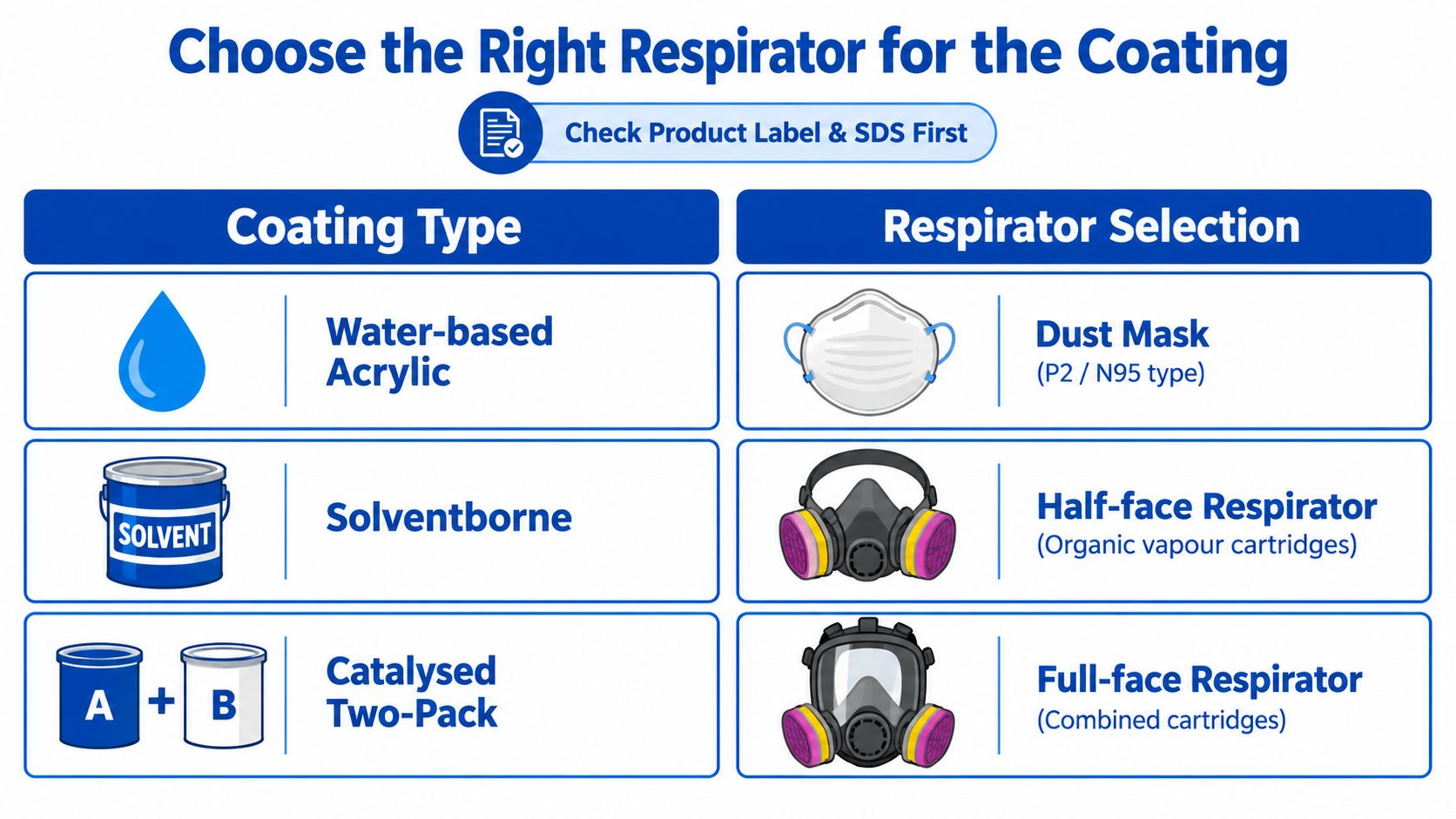
Water-based acrylic is a starting description, not a respiratory specification. Read the SDS for the actual product and spraying process rather than assuming a disposable mask is enough. Likewise, a low-VOC paint choice shouldn't replace the application-specific assessment.
For solventborne coatings, consider both the spray aerosol and the vapour hazards identified by the manufacturer. A cartridge must be suitable for the contaminants involved, and the whole respirator configuration must suit the job.
For catalysed two-pack coatings, establish whether the product contains isocyanates. Don't assume every two-pack product has identical chemistry, or that adding combined cartridges makes isocyanate spraying suitable for a domestic garage.
The following visual is a broad comparison, not an equipment-selection instruction. Its simple dust-mask and cartridge pairings must not override the SDS or specialist advice, particularly its depiction of cartridges for catalysed two-pack paint.
Respirator Types and Their Appropriate Role
| Respirator type | Best considered for | Key limitation | Key question to ask |
|---|---|---|---|
| Disposable particulate mask | Assessed particulate hazards within its specification | Not a solvent-vapour solution or a default spray-painting choice | Does the assessment expressly support this equipment? |
| Cartridge respirator | Identified contaminants with suitable approved filters or cartridges | Depends on fit, selection and replacement arrangements | Is this exact configuration suitable for the coating? |
| Powered air-purifying respirator | Assessed work using a suitable powered filtering system | A powered fan doesn't make every contaminant suitable for filtration | Are the filters, headpiece and airflow appropriate? |
| Supplied-air system | Specialist spraying requiring an appropriate supplied-air arrangement | Needs suitable air supply, maintenance and training | Can the complete system be operated correctly? |
Know when not to spray at home
WorkSafe recommends using a spray booth where possible, including for quick touch-ups involving isocyanates. Its guidance also specifies airline or other approved full-face, hood or helmet arrangements for personnel inside a booth during isocyanate spraying. Full-face coverage alone doesn't establish suitability.
For broader equipment terminology, Material Handling USA's guide to workplace respiratory safety is a supplementary resource, not a substitute for New Zealand requirements.
If the coating needs controls you can't provide, consider substitution, an appropriate non-spray method or a trained contractor with a suitable booth.
Prepare a Safe Spraying Workflow
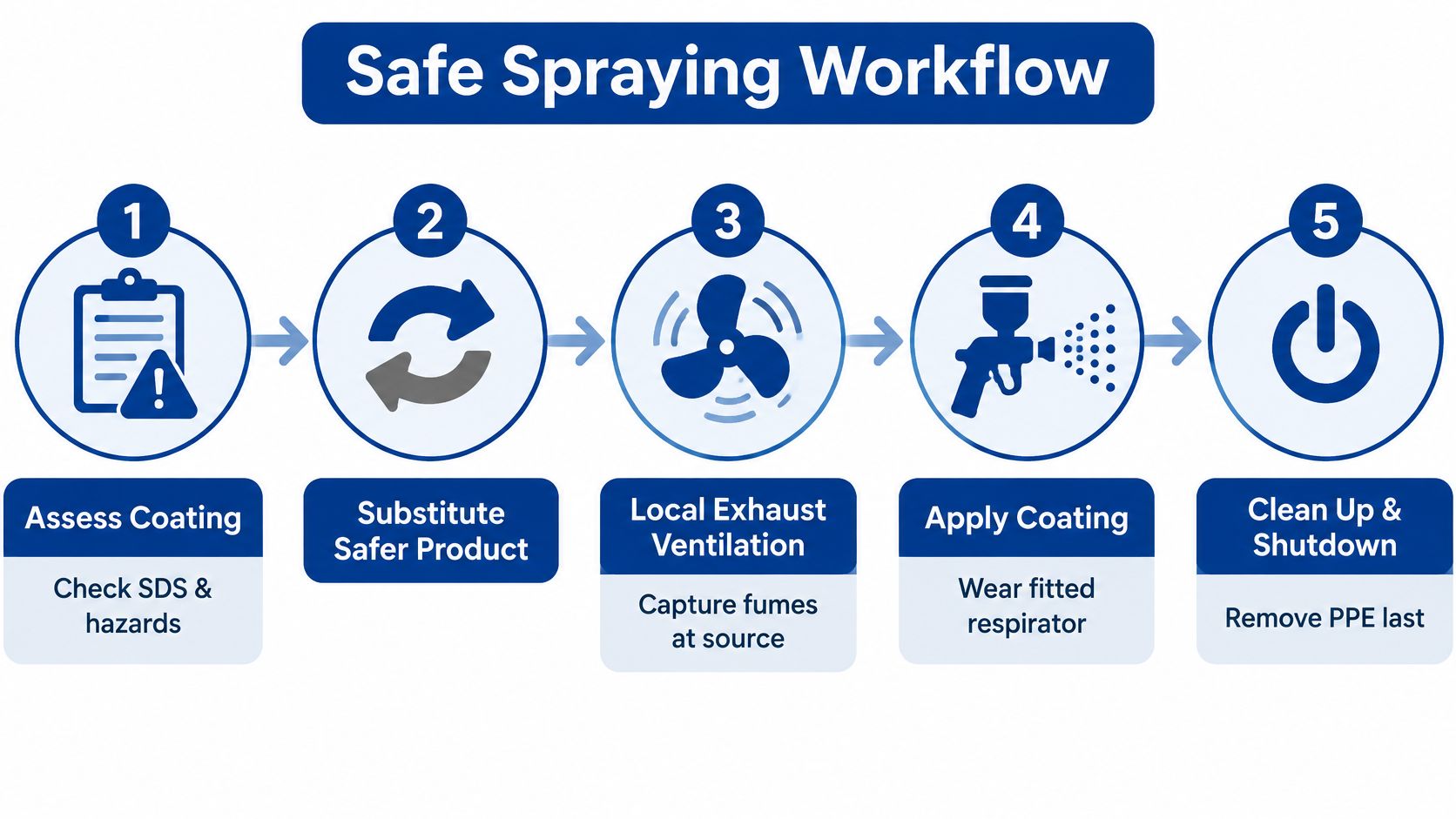
Prepare the exposure controls before opening the coating. A useful site procedure should explain what you're applying, where the contaminants will go, who may enter the area and how the work will stop safely.
For homeowners considering spray painting a house exterior, that assessment belongs alongside access, masking and weather planning. It shouldn't be left until the gun is ready.
Turn the assessment into a working procedure
- Assess and substitute: Review the SDS and ask whether a less hazardous product or different application method can meet the specification.
- Verify extraction: Confirm that spray-area extraction operates to its specification. Don't treat an open door as proof of effective capture.
- Record the selection: Document the respiratory equipment, relevant filters or air supply, protective clothing and arrangements for controlling access.
- Prepare shutdown: Decide where equipment will be cleaned, where contaminated items will go and when people can return.
Use the workflow below as a planning prompt, with the coating-specific requirements added to each stage.
Inspect before entering the spraying area
WorkSafe's coating guidance calls for ventilation and respiratory equipment to be maintained to manufacturer specifications. Build the pre-use inspection around the equipment selected, rather than using the same checklist unquestioningly for every system.
Check facepiece seals, valves, straps, filters and connections. Where applicable, check hoses, batteries, airflow indicators and supplied-air connections. Resolve missing parts, damage or uncertain service status before starting.
For compatible tight-fitting respirators, carry out the manufacturer's user seal check after donning. Negative-pressure checks involve blocking the appropriate inlets and gently inhaling; positive-pressure checks involve the specified exhalation-valve procedure and gentle exhalation. The facepiece should respond as instructed without leakage, and the formal fit-testing distinction is covered below.
Don't improvise those checks on equipment with a different design. If the instructions are missing or the check fails, stop and obtain competent assistance.
Keep the controls working through cleanup
Arrange suitable lens protection before overspray interferes with vision. Where appropriate, WorkSafe recommends clear tear-away lens sheets, rather than allowing coating to contaminate the lens or breathing system.
Keep respiratory protection in use while the assessed exposure remains, including relevant cleanup tasks. Plan removal in a clean location, separate contaminated equipment and follow the manufacturer's cleaning procedure before storage. Don't choose a universal waiting period based on how quickly the visible mist clears.
Fit Test the Mask Before You Rely On It
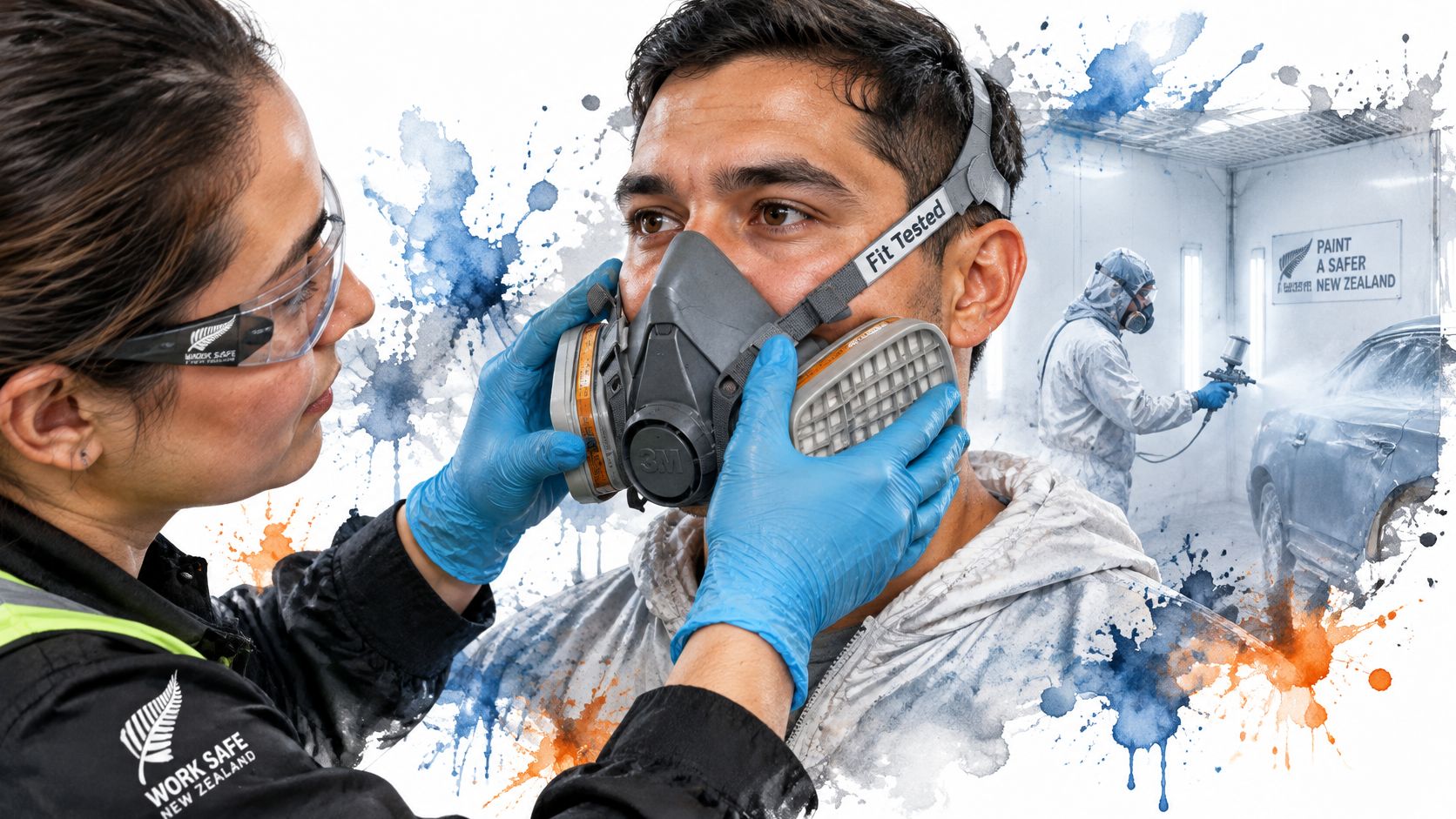
A filter label doesn't establish that a tight-fitting respirator seals to your face. The exact make, model, size and configuration need to suit the wearer, not just be available in the workshop.
A fitting session should address the facepiece and any equipment that could interfere with its seal.
Formal testing and daily checks have different jobs
New Zealand employers must arrange facial fit testing for workers using tight-fitting respiratory protective equipment. Testing can use qualitative taste or smell methods, or quantitative instruments, as explained in WorkSafe's respiratory-protection advice for businesses.
A formal test checks whether the selected facepiece fits the individual. A user seal check helps the wearer detect a problem each time they put it on. Passing a daily check doesn't replace formal testing, and a previous fit-test pass doesn't excuse skipping the pre-use check.
For negative-pressure respirators, arrange testing at least annually, and sooner when changes could affect the seal, according to New Zealand respiratory fit-testing guidance. Significant weight change, dental work or a different respirator model should prompt reassessment rather than an assumption that the old result still applies.
A more expensive respirator isn't safer if it doesn't fit the person wearing it.
Remove the common sources of leakage
- Facial hair: Keep the area where the seal contacts the face clean-shaven. Tightening straps over hair isn't a dependable correction.
- Spectacles and other equipment: Check for interference with the sealing surface and use a compatible arrangement.
- Size and strap tension: Select the correct facepiece and adjust it as instructed. Excessive tightening isn't a substitute for correct sizing.
- Component condition: Inspect valves and sealing surfaces instead of treating every leak as a fitting mistake.
Use demonstrations alongside the instructions for your own respirator, not in place of them.
Make fit a worker-specific record
If a small crew shares a respirator model, each worker still needs an individual fit assessment. Someone else's successful result doesn't establish protection for the next wearer.
Record the worker, respirator model, test method, date and pass or fail outcome. When changing equipment between jobs, check the record against the actual facepiece supplied. A loose-fitting hood may avoid the same tight-face-seal requirement, but it still needs suitable protection and correct airflow.
Maintain and Store Respiratory Equipment
A respirator that passes inspection today still needs a maintenance plan for tomorrow. Follow the manufacturer's cleaning, servicing and replacement instructions for the exact equipment, rather than treating all masks and filters alike.
The practical difficulty is keeping contaminated kit separate from ready-to-use equipment. Set up that separation before the end of the job, when people are tired and keen to pack away.
Don't estimate cartridge life from appearance
WorkSafe's coating guidance identifies cartridge service life, breakthrough, humidity, poor maintenance and heavy aerosol loading as issues that can undermine protection. The replacement arrangement therefore belongs in the documented assessment for the product and application.
Don't extend service by guesswork because a cartridge looks clean. Equally, don't invent a universal replacement interval for every coating, spraying duration and working environment.
Maintenance reminder: A clean-looking mask isn't necessarily serviceable. Check its function and maintenance status, not just its appearance.
Use the manufacturer's instructions to establish which components can be cleaned, which must be replaced and how each should be handled. Don't wash filters or apply cleaning solvents to facepieces unless the instructions expressly permit it.
- After cleaning: Inspect the sealing surfaces, valves, straps and connections before declaring the equipment ready.
- Before storage: Use the specified storage arrangement and keep ready-to-use equipment away from contaminated clothing and spray equipment.
- When defects appear: Remove the affected equipment from service until the approved repair or replacement is complete.
Maintain the complete breathing system
Supplied-air equipment needs more than a clean facepiece. Include air lines, connections and airflow arrangements in the inspection and servicing programme, following the system manufacturer's requirements.
Powered filtering equipment also needs its prescribed battery and airflow checks. Don't assume that a running motor establishes adequate operation.
Lens protection should preserve visibility without compromising the respirator. Replace suitable tear-away sheets as intended, and investigate coating contamination around breathing components rather than wiping the outside.
For a contractor moving between residential and commercial sites, a written service record makes handover clearer. The next wearer should be able to establish what was inspected, what was replaced and whether the system is ready, without relying on someone remembering the previous job.
Control People and Overspray on Site
Consider cabinet doors being sprayed in a workshop, a fence beside a neighbour's driveway and a roof above an occupied home. The painter might use similar-looking equipment, but the exposure-control decisions aren't interchangeable.
A workshop offers a defined area to assess and manage. Outdoors, wind and neighbouring activity become central considerations. In an occupied home, the inability to separate people from the work may rule out the proposed spraying method.
Cabinets and occupied interiors
For cabinet refinishing, first decide whether the work belongs on site at all. Moving removable components to a suitable controlled facility may be more practical than trying to establish an adequate spray area inside a functioning kitchen.
If the proposed coating contains isocyanates, apply the specialist equipment and booth guidance already discussed. Don't treat improvised enclosure or ventilation as permission to proceed.
Where occupants must remain, assess whether isolation is achievable. A request to stay out of the kitchen isn't equivalent to a controlled work area with managed access and a justified re-entry arrangement.
Fences, cladding and roofs
For a fence close to a boundary, consider who uses the adjoining space and how drift could leave the work area. Protecting vehicles and windows from deposited paint matters, but surface covering isn't respiratory protection for the people nearby.
Roof and cladding work require the same attention to surrounding occupants and trades. If the conditions won't support controlled spraying, postpone the application or assess another method rather than relying on the operator's mask.
New Zealand's historical Spray Coating Regulations required protection for people working within 6 metres of spraying, either through screening or equivalent protective equipment. Those regulations were revoked on 28 October 2025, so that distance is a historical benchmark, not a current universal exclusion zone, as recorded in the Spray Coating Regulations 1962.
Make access control part of preparation
Include respiratory planning alongside washing, sanding, filling, priming and masking. Preparation shouldn't stop at the surface that will receive paint.
- Define the work area: Establish where spraying and associated contaminated tasks will occur.
- Coordinate access: Tell occupants, other trades and property managers how access will be managed.
- Review changing conditions: Stop if weather or site activity defeats the planned controls.
- Plan reopening: Use the coating requirements and exposure assessment, not appearance alone.
For North Shore projects, painting safety and compliance standards belong in the scope discussion before equipment arrives. If people can't be protected while the proposed method is used, change the method or location.
Make the Final Respiratory Protection Decision
The final decision should be a documented reason to proceed, not confidence based on owning a professional-looking mask. You need a suitable coating, a controllable application process and respiratory equipment that the wearer can use correctly.
A sensible homeowner assessment may end with brushing a different product or sending components to a workshop. A professional spray-painting project may require specialist extraction, supplied air and formal site controls. Neither decision should begin with an online shopping basket.
Check whether the plan is complete
- Product and process: Can you identify the coating and relevant SDS, including hardeners and associated products?
- Environment: Can you verify the extraction or other exposure controls needed for this work?
- People: Can occupants, neighbours and other trades be kept out of the affected area?
- Equipment and wearer: Is the chosen system suitable, serviceable and supported by the required fit arrangements?
- Completion: Is cleanup, equipment removal and return to normal use planned?
These questions work together. A satisfactory answer about the respirator doesn't compensate for an uncontrolled work area.
Recognise the reasons to stop
Pause for an unlabelled product, uncertain coating hazards, failed seal checks, damaged equipment or unavailable fit testing where it's needed. Isocyanate spraying without a suitable controlled setup and an inability to prevent dangerous drift are also reasons not to begin.
Don't solve an incomplete assessment by choosing a larger mask or adding another cartridge. Obtain competent advice, change the coating or application method, or engage a contractor equipped for the process.
The right spray painting mask is the one justified by the complete job assessment. If that assessment can't support safe spraying, choosing not to spray is the practical decision.
Painters North Shore offers residential and commercial painting, including spray painting and cabinet refinishing. Visit Painters North Shore to arrange a site assessment and discuss the coating, application method, masking and access arrangements for your project before spraying begins.