In Auckland in 2026, paint house exterior cost for a typical three-bedroom weatherboard home usually lands between NZ$10,350 and NZ$21,600 when measured against painted surface area, with Auckland pricing running roughly 15–20% above national averages. That's a wide range, but it reflects the truth: the condition of the coating, access, preparation and timing matter more than the colour you choose.
You've probably seen the problem already. Two painters inspect the same North Shore weatherboard home, both appear reputable, and their quotes differ by thousands. One includes washing, scraping, spot-priming, timber repairs, scaffold and two finish coats. The other uses a lower square-metre rate but leaves several of those items vague or excluded.
That isn't necessarily dishonesty. It's often a difference in scope. A coastal home with peeling boards, shaded elevations and difficult side access can cost dramatically more than a similar-looking house with sound paintwork and clear access. The sensible way to judge paint house exterior cost is to treat repainting as a maintenance decision, not just a decoration purchase.
Two Quotes, One House, and the Question Every North Shore Owner Asks
Two painters inspect the same North Shore home. One quotes NZ$12,000. The other asks NZ$20,000. Both name reputable products and promise a professional finish, yet the difference leaves one question: who has priced the work properly?
The answer sits in the scope beneath the headline total. Exterior painting is priced from painted surface area; floor area is only an indirect clue. Walls, gables, fascias, eaves, soffits and trims all require labour and coatings. A two-storey house can have a modest footprint and still present a large, awkward exterior, particularly when scaffold platforms must be moved around the building.
Preparation usually creates the gap
North Shore coastal weather exposes poor preparation quickly. Salt spray, wind-driven rain, damp shaded walls and failed sealants can turn a repaint into restoration work. One contractor may allow time for washing, scraping, sanding, filling, priming and minor timber repairs. Another may assume the existing coating is sound and price a much shorter process.
That difference changes the final result as well as the bill. A low quote can remove the work that protects the new coating, while a higher quote may reflect access equipment and timber repairs that the house needs.
The national benchmark for a standard three-bedroom weatherboard repaint is around NZ$9,000–$18,000. Auckland projects are commonly 15–20% higher, producing an indicative range of NZ$10,350–$21,600 under the same assumptions. These figures come from New Zealand exterior house-painting cost benchmarks, but an inspection still decides where your property sits.
Practical rule: When quotes differ sharply, compare preparation and access lines before comparing paint brands.
Require each contractor to state what will be washed, scraped, sanded, primed, repaired and coated. This guide to choosing reliable Auckland painting contractors can help you assess contractors before requesting several quotes.
Carry NZ$10,350–$21,600 for a typical Auckland three-bedroom weatherboard repaint as a benchmark, not a promise. The right timing and a clearly specified maintenance scope can prevent a minor coating failure from becoming a far larger painting bill.
How Painters Actually Price an Exterior Repaint in Auckland
A professional painter doesn't start with “your house costs X”. They start by measuring the surfaces that will receive the paint system. The practical Auckland benchmark is approximately NZ$35–$80 per m² of painted exterior surface, with weatherboard commonly around NZ$35–$55 per m² and plaster or stucco around NZ$40–$65 per m². These benchmarks are summarised in Auckland exterior painting cost guidance.
Floor area is only an indirect clue. A single-storey home with broad eaves, multiple gables and detailed trims can require more work than its footprint suggests. A painter measures the exterior elevations and then adjusts for access, surface complexity and the condition of the coating.

What the measurement should include
A proper site assessment identifies:
- Wall surfaces: Weatherboard, plaster, stucco, brick or cedar areas.
- Upper sections: Gables, dormer faces and hard-to-reach elevations.
- Horizontal details: Fascias, eaves, soffits and bargeboards.
- Finish details: Window surrounds, doors, trims and other separately coated elements.
- Access requirements: Ladders, platforms, scaffold, ground protection and restricted side access.
For example, a measured 200 m² weatherboard exterior at the weatherboard benchmark produces an indicative base range of NZ$7,000–$11,000, before unusual repairs, difficult access or omitted extras are considered. That calculation is useful for checking whether a quote is broadly plausible. It isn't permission for a contractor to skip preparation.
The quote should then explain the labour behind the rate. Washing removes dirt and surface contamination. Scraping and sanding create a stable key. Filling and sealant work close defects. Primer manages exposed timber and adhesion. Finish coats provide colour and protection.
A low m² rate can be perfectly reasonable when the boards are sound. It becomes suspicious when the quote also promises full restoration, extensive repairs and difficult access without showing where those hours appear.
Trim often causes disputes because one painter includes it and another prices it separately. Ask whether the stated area covers the body of the house only, or also includes fascias, eaves, soffits, windows and doors. Aluminium window frames require their own preparation decisions, so these aluminium frame paint preparation tips can help you ask more informed questions.
Finally, check whether GST, access equipment, primer and the specified number of topcoats are included. A quote is useful only when its measured area and assumptions are visible.
The Six Cost Drivers That Move a North Shore Quote
A North Shore quote should expose six cost drivers. If they disappear inside one total, you cannot tell whether the contractor has priced the work properly or removed it.
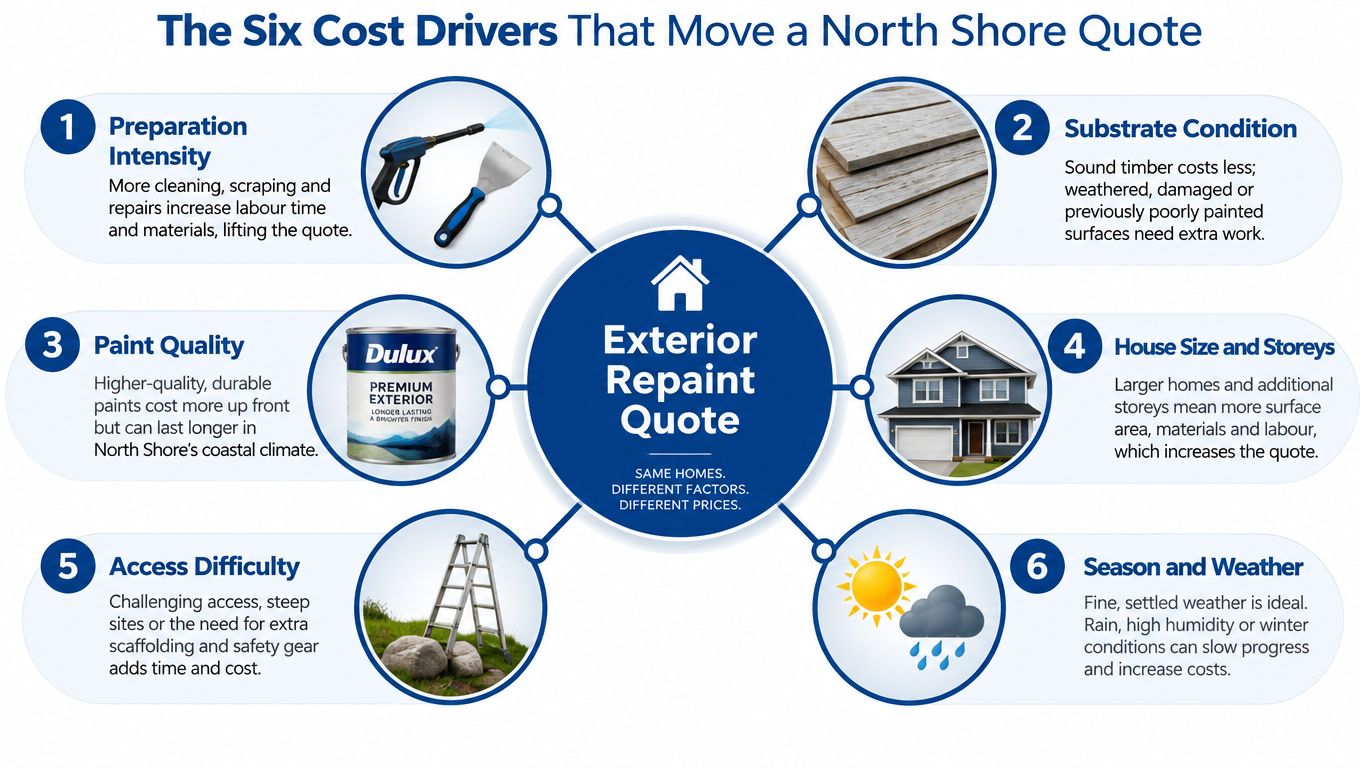
Preparation intensity
Preparation usually carries the largest labour burden. Sound paint may need washing, local scraping, sanding and spot-priming. Peeling or chalking coatings can require widespread scraping, filling, sealant replacement and full priming.
Professional painter labour is commonly benchmarked at NZ$35–$45 per hour, or about NZ$280–$360 per painter for an eight-hour day, according to New Zealand exterior painting cost guidance. Every additional preparation day changes the final paint house exterior cost.
Substrate condition
Rotten weatherboards, soft trim, cracked plaster and failed joins are building-surface problems, not cosmetic defects. Coating them without repair will not stop movement, moisture entry or timber decay. A quote that ignores substrate condition is incomplete from the start.
Access and storeys
Two-storey walls, steep sections and narrow side passages reduce productive crew time. Scaffolding for a two-storey Auckland exterior may sit around NZ$800–$2,500, while a restricted-access site can require more equipment, relocations and supervision. Treat that range as an on-site estimate, not a fixed allowance.
A cliff-edge Devonport section with no practical side access may need staged scaffold or rope-assisted access where a level driveway would take a standard mobile setup. The difference can add days to the programme and materially increase the quote. Confirm scaffold hire, setup, moves and removal in writing.
Coating system
A premium Resene or Dulux exterior system can cost more than a builder-grade product, but the product name alone proves nothing. The quote should identify the primer, intermediate product where applicable and finish coats. Cedar may need stain or oil instead of opaque paint, while plaster requires a system suited to its movement and texture.
Included surfaces
Surface scope was covered in the pricing section. Confirm it in writing here before comparing totals.
GST and overheads
Check whether GST, insurance, masking, site protection, cleanup and waste removal are included. Excluding these items makes a quote look cheaper while transferring the cost back to you.
North Shore warning: Coastal elevations and shaded walls often weather faster than the sheltered side of the same home. Salt exposure, damp conditions and limited drying time can increase preparation without changing the measured area. A uniform rate can hide very different workloads.
For a typical three-bedroom property, these drivers work together. A sound, accessible home may sit near the lower end of its range. The same home with peeling coatings, difficult access and timber repairs can move sharply upward. The cheapest quote is often achieved by removing the preparation that prevents early peeling.
Sound Timber Versus Full Strip, and Why Substrate Sets the Price
Weatherboard condition determines whether you're buying a repaint or paying for restoration. Sound timber can often be washed, locally scraped, sanded, spot-primed and recoated. Failed timber needs a slower sequence, sometimes back to bare wood, before a new coating can perform properly.
A New Zealand benchmark places sound timber weatherboards at approximately NZ$60–$80 per m² including GST, while full stripping can reach approximately NZ$105–$145 per m², according to exterior painting price guidance for New Zealand. On a 200 m² exterior, that represents about NZ$12,000–$16,000 for sound boards versus approximately NZ$21,000–$29,000 for full stripping.
| Substrate Condition | Indicative Rate (NZ$ per m²) | Estimated Range for 200 m² (NZ$) |
|---|---|---|
| Sound timber weatherboards | 60–80 | 12,000–16,000 |
| Weatherboards requiring full stripping | 105–145 | 21,000–29,000 |
The difference pays for labour, not a magical premium in the paint tin. Full stripping takes longer, creates more waste, exposes more bare timber and increases primer requirements. It can also reveal repairs that weren't visible through the failed coating.
Where cedar and masonry fit
Cedar needs a separate conversation. If the intended finish is stain or oil, the painter must assess the existing product, timber condition and colour uniformity. Covering cedar with an unsuitable system can create adhesion and appearance problems.
Plaster or stucco may sit in a different rate band because textured surfaces consume more material and require careful crack and sealant treatment. Brick doesn't automatically need painting. If the issue is mortar deterioration, brick pointing or sealing should be quoted as masonry work rather than disguised inside a paint allowance.
Cleaning method also matters before any coating is applied. This explanation of which cleaning method you need helps distinguish aggressive pressure washing from gentler approaches suited to vulnerable surfaces.
Ask this directly: “Are you maintaining the existing coating, or stripping it because the system has failed?” Those are different jobs with different labour assumptions.
For North Shore properties that need complete coating removal, request a quote that separates stripping, repairs, priming and finish coats. A specialist paint stripping service in Auckland can also clarify whether removal is necessary across the whole elevation or only in failed areas.
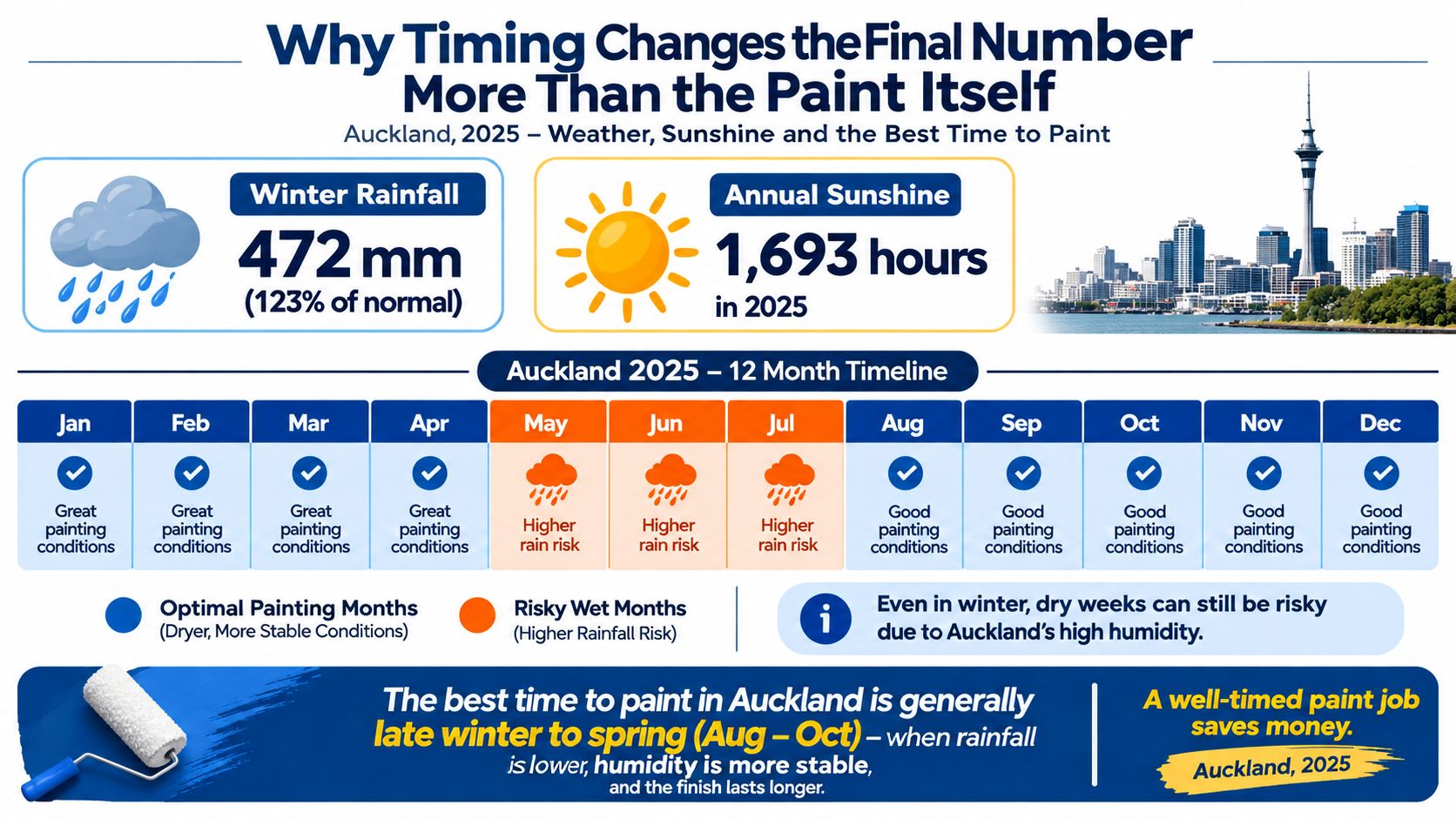
Why Timing Changes the Final Number More Than the Paint Itself
A sunny forecast doesn't guarantee a suitable painting day. Exterior coatings need a clean, sufficiently dry substrate, workable humidity and enough time to cure before rain or overnight moisture returns. Coastal walls, shaded sides and surfaces exposed to wind-driven rain can remain damp after the sky clears.
NIWA recorded 472 mm of Auckland winter rainfall in 2025, or 123% of normal, while Auckland also recorded 511 sunshine hours during that winter. The contrast matters. Sunshine can return quickly while timber, sealants and shaded cladding remain unsuitable for coating. NIWA also reported 1,693 sunshine hours during 2025 for the period covered by its climate summary, but that total doesn't tell a painter whether a particular wall will be dry at the required time. See the NIWA Auckland climate summary for the underlying weather context.
Delay has a cost
Postponing a repaint can allow chalking, cracking, peeling and failed sealants to spread. Once exposed timber absorbs moisture or substrate deterioration begins, the painter spends more time restoring the surface before applying colour.
MBIE guidance indicates that exposed timber weatherboards generally require preparation, primer and two coats of exterior-grade paint, with protective coatings carrying a minimum durability period of five years. The same guidance identifies washing, recoating, sealant replacement and repairs as normal maintenance, particularly where surfaces face wind-driven salt spray. Those requirements are set out in MBIE guidance on exterior maintenance and durability.
Early spring and late autumn can offer workable booking opportunities, but the contractor still needs to assess each elevation. Don't book solely because a calendar has a dry-looking week. Ask how the crew will check substrate moisture, handle overnight dampness and protect unfinished surfaces if rain arrives.
A cheaper booking window can become expensive if return visits, delays or rework increase. Good timing reduces the chance that a maintenance repaint turns into a substrate repair project.
Three Realistic Quote Scenarios for North Shore Homes
Three homes can receive very different exterior painting quotes, even when their floor areas look similar. On the North Shore, coastal exposure, access and maintenance timing often matter more than the paint brand. Treat the ranges below as working examples, not fixed prices. The measured area and site condition decide the final figure.
Small single-storey weatherboard
Across recent two-bedroom weatherboard repaints on the Shore, completed jobs have landed between NZ$6,000–$12,000 for a full exterior repaint. That lower end suits sound boards, open access and simple trims. A coastal elevation with widespread peeling, failed sealant or soft timber can push the job above that band.
A proper quote should state washing, scraping, sanding, filling, primer and two finish coats. It should also separate repairs from painting. A low total that excludes timber work is not a saving. It is an unfinished comparison.
Typical three-bedroom weatherboard
On a standard three-bedroom home, the gap between the cheapest and most complete quote can be substantial. One contractor may price a sound repaint with limited preparation, while another allows for more scraping, spot priming, trim work and scaffold moves. Multiple gables and restricted side access can shift the job toward the upper end of its likely range.
North- and west-facing walls usually deserve closer inspection because wind and salt exposure can break down coatings faster. Shaded elevations may hold moisture for longer. A contractor who prices every wall from one assumption is leaving room for a variation later.
Large two-storey weatherboard
A large two-storey weatherboard home is commonly placed at NZ$15,000–$28,000 for a complete exterior repaint in the broader New Zealand guide, including the range described in the New Zealand house-painting cost guide. Full stripping, timber replacement and difficult scaffold access can push the work beyond that standard scope.
Require separate allowances for access, scaffold moves, stripping, repairs, primer and finish coats. Structural or weathertightness work must sit outside ordinary repainting unless specifically assessed. A quote that combines all of it into one total hides the important maintenance decision: repair the substrate now, or pay for access and preparation again later.
How to Compare Quotes Without Losing the Plot
Put every quote through the same checklist. If one contractor answers clearly and another relies on a single total, you don't have two comparable offers yet.
- Measured area: Confirm the painted wall, gable, fascia, eave, soffit and trim areas.
- Preparation method: Ask whether washing, scraping, sanding, filling and sealant replacement are included.
- Primer specification: Check where primer is required and which product system the painter proposes.
- Finish coats: Confirm the number of topcoats and the named Resene, Dulux or other coating system.
- Access costs: Identify scaffold, platforms, ladder work, ground protection and scaffold moves.
- Timber repairs: Require rotten-board replacement and other repairs to be listed, measured or clearly excluded.
- Lead-paint controls: Ask how the contractor will manage potential lead-based coatings on older homes.
- Exclusions: Look for trims, eaves, doors, windows, gutters, brickwork, sealants, structural repairs and GST.
- Guarantee: Check whether workmanship coverage is written into the contract and what it excludes.
A suspiciously low m² rate isn't automatically wrong. It becomes a warning when the quote also uses vague wording such as “prepare as required”, omits access equipment or excludes all timber repairs. A single-line total makes it impossible to see whether the painter has priced a durable system or a quick cosmetic coat.
This advice on how to compare exterior remodeling quotes is useful because it reinforces the same principle: compare scope, materials, exclusions and responsibilities, not just the final number.
For a North Shore repaint, request a written quotation for painting a house after an on-site inspection. The quote should make the maintenance decision clear: spend on preparation while the substrate is recoverable, or accept the much larger scope that follows widespread coating failure.
Painters North Shore provides on-site exterior assessments and itemised repaint quotations covering preparation, substrate condition, access, coatings and exclusions. Visit Painters North Shore to arrange an assessment and compare a written scope before committing to the cheapest headline price.