A retaining wall that looked sound last summer can now be showing bubbles, white deposits, peeling at the base, or a dull, chalky surface. That's a common North Shore problem, particularly where a wall sits below a lawn, garden bed, driveway, or coastal-facing boundary and stays damp long after the rain has stopped. The paint may be failing, but the coating is often only revealing a drainage or substrate problem behind it.
The best paint for retaining walls isn't selected by colour card or exterior-paint label alone. The right choice depends on the wall material, how water reaches the wall, whether moisture can escape, and whether the structure and drainage meet New Zealand requirements. A breathable masonry acrylic can be an excellent finish on sound, dry concrete block, while a damp below-grade wall may need a moisture-barrier system instead. Timber retaining walls require a different approach again.
Why Retaining Walls Need Their Own Paint Decision
A 1.2 m concrete block wall behind a Takapuna property can look much like ordinary exterior masonry. Yet the same acrylic used on the weatherboards may blister within 18 months when applied to that wall without accounting for soil moisture, drainage, or alkalinity. The wall is doing structural work, not merely presenting a surface for colour.
Retaining walls hold back soil and the water within it. They also receive splashback from paths and paving, ground moisture at the base, and, on coastal sites, salt-laden air. The lower face often gets less airflow than house cladding, particularly where planting, fencing, or a narrow boundary restricts drying.
Start with the wall, not the paint tin
Before choosing a coating, answer three questions:
- What is the substrate? Poured concrete, concrete block, rendered masonry, treated timber, and older painted surfaces each need different preparation and coating behaviour.
- How is water reaching the wall? Water may be coming through the soil side, rising from the ground, entering through cracks, or arriving as surface runoff.
- Is drainage compliant and functional? Auckland Council states that retaining walls still need compliant drainage, and even consent-exempt walls up to 1.5 m must meet Building Code requirements and may need resource consent. See the Auckland Council retaining wall guidance before treating a coating as the solution.
New Zealand Building Code E2 requires exterior wall systems to prevent water entry, prevent water accumulation, and allow water to dissipate. The relevant guidance also recognises moisture thresholds and multi-coat protection for exposed exterior surfaces, rather than relying on paint alone. The Building Code E2 external moisture requirements are the right starting point for a compliance-led assessment.
Practical rule: If water pressure, blocked drainage, or structural movement is active, paint is a finishing layer, not the repair.
The rest of the decision follows that sequence. Confirm the wall and water conditions first, prepare the substrate second, then select a coating that can manage moisture movement in the North Shore environment.
How Retaining Walls Actually Fail in Coastal Conditions
Retaining-wall failures usually leave clues before the coating comes away. A careful inspection can identify whether the main pressure is coming from behind the wall, from the exposed environment, or from the surface itself.
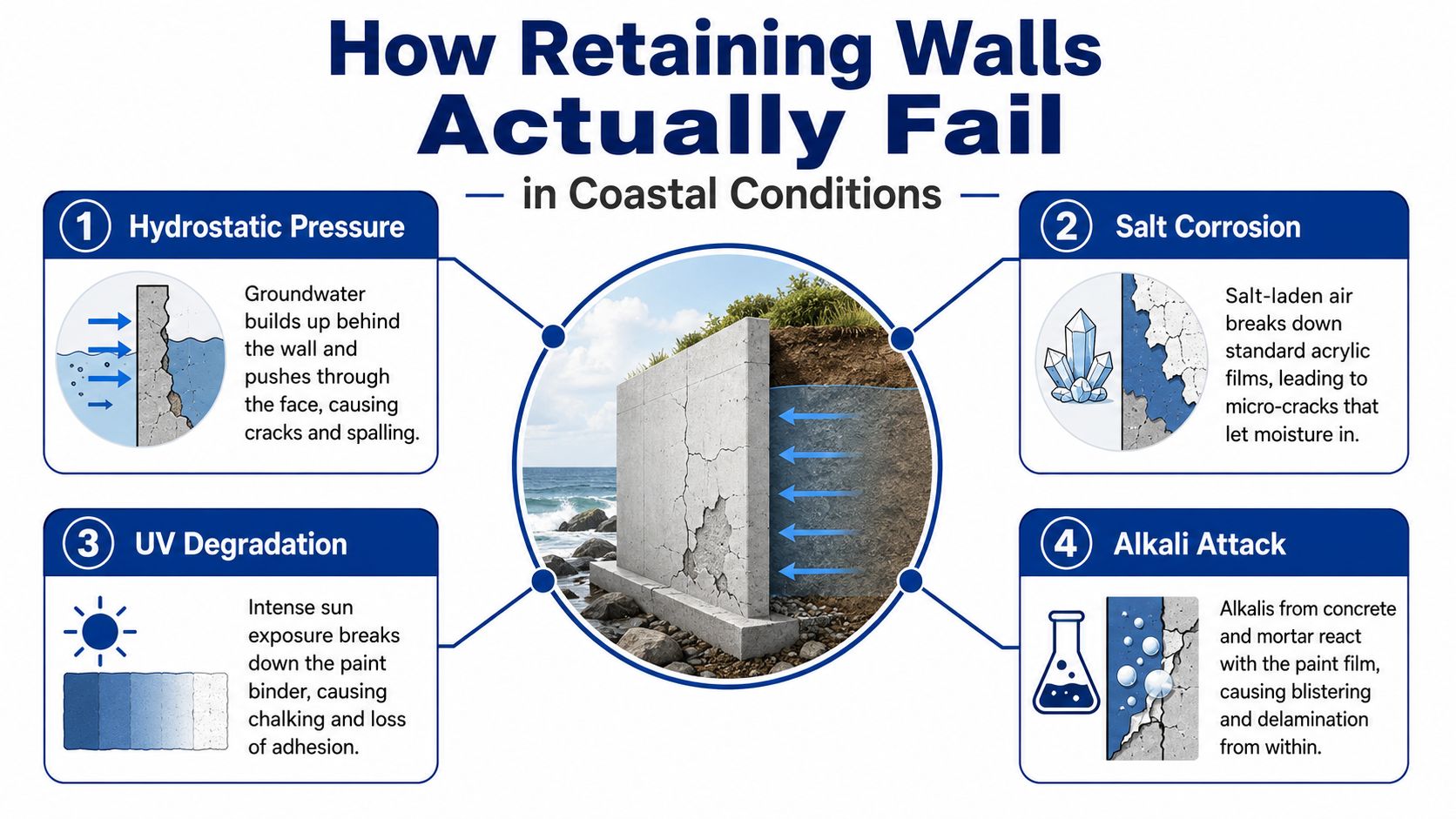
Four mechanisms to look for
Hydrostatic pressure develops when groundwater builds up behind a wall and has no effective path to discharge. Moisture then pushes through joints, pores, cracks, or weak areas. Blisters, spalling, damp patches, and recurring peeling often point to pressure that the paint film can't withstand.
Salt exposure is particularly relevant near exposed coastal properties. Salt carried in air and spray can weaken ordinary exterior films, while repeated wetting and drying creates fine breaks in the coating. Chalking, loss of colour, and small areas of peeling can appear before larger failures develop.
Splashback and capillary moisture affect the lower wall most severely. A concrete path, driveway, or hard garden edge can throw water onto the face, while porous masonry draws moisture upwards from the base. Peeling concentrated along the first section of wall is a strong warning that the bottom edge is staying wet.
Efflorescence appears as a white or pale haze when dissolved salts move through masonry as moisture leaves it. If the wall is coated before those salts are removed and the moisture source is controlled, the deposits can disrupt adhesion and push the film away from the surface.
A waterproofing coating may resist liquid water better than ordinary paint, but it won't correct a blocked drain or structural crack. Conversely, a breathable coating may be the safer choice where vapour needs to escape, but it isn't a substitute for relieving sustained hydrostatic pressure. The North Shore retaining-wall protection guidance is useful for understanding why surface preparation and moisture management need to be considered together.
Look at the pattern, not just the colour. Blistering in the centre of the wall suggests a different problem from peeling only at the base, and white deposits require a different preparation response from UV-related chalking on a fully exposed face.
The Four Coating Categories Worth Considering
Four coating families cover most retaining-wall specifications in the North Shore. They differ in how much vapour they allow through, how much film they build, and whether they are intended to resist water under pressure.
Breathable masonry acrylics
A breathable masonry acrylic is the usual choice for sound, dry concrete, block, and render with effective drainage. It forms a protective film that resists liquid water while allowing moisture vapour to move outward. That balance matters on garden-side walls where the substrate may experience normal dampness but isn't under active water pressure.
For NZ concrete and masonry retaining walls, the technical benchmark is a breathable, alkali-resistant, water-based dispersion coating applied in two or three coats, with a total dry film thickness of 180 to 250 microns, as outlined through the NZS 4229 masonry waterproofing route. The specification is about the complete system, not an unusually thick single coat.
Elastomeric high-build coatings
Elastomeric coatings contain a more flexible film that can accommodate limited movement and fine cracking. They're useful on rendered masonry where stable hairline cracks are part of the surface condition. They still need a sound substrate, because flexibility in the coating won't compensate for loose render, movement joints that are failing, or water pressure behind the wall.
The New Zealand Concrete Masonry Manual specifies a minimum dry film thickness of 180 µm for pigmented elastomeric high-build exterior coatings, using two coats, with recoating at least every five years. It also recommends coating concrete walls below 70% relative humidity, applying out of direct sunlight at 5 to 30°C, and maintaining that temperature range for the following 12 hours. These requirements are set out in the New Zealand Concrete Masonry Manual.
Cementitious and acrylic waterproofing systems
Moisture-barrier systems are intended for damp concrete, below-grade surfaces, retaining walls, and situations involving negative hydrostatic pressure. They can be appropriate where the wall needs resistance to water passing from the rear or where a masonry acrylic would fail because the substrate remains persistently wet.
They aren't automatically the best decorative finish. A sealed film can trap moisture if the wall has no route for drainage or vapour release, so the system must match the water movement.
Timber-compatible stains
Raised timber and H5 sleeper walls need penetrating protection rather than a masonry film. A compatible exterior stain or marine-grade oil can enter the timber and weather more naturally, while a conventional paint film may peel as the timber moves and releases moisture.
| Category | Primary Function | Typical Film Build | Best Fit |
|---|---|---|---|
| Breathable masonry acrylic | Resists liquid water while allowing vapour movement | Two or three coats, 180 to 250 microns total where the NZ masonry benchmark applies | Sound, dry concrete block, concrete, and render |
| Elastomeric high-build | Bridges limited hairline movement and builds a flexible protective film | Minimum 180 µm, two coats | Stable rendered walls with fine cracking |
| Cementitious or acrylic waterproofing | Creates a moisture barrier against dampness and water pressure | System-specific, applied to the manufacturer's specification | Damp or below-grade masonry and concrete |
| Timber stain or oil | Penetrates and protects timber without a brittle surface film | Penetrating finish, not a masonry film | Treated timber sleepers and timber retaining structures |
For broader cold-weather concrete maintenance principles, Ottawa winter concrete care tips provide useful context, although North Shore coating decisions still need to follow local moisture and exposure conditions.
Comparing Masonry Paint, Elastomeric, Waterproofing and Timber Finishes
The four systems don't form a simple ladder from basic to premium. Each solves a different surface problem, and the strongest product on paper can fail if it doesn't suit the wall's moisture movement.
| Coating System | Durability | Breathability | Water Resistance | Recoat Interval | Best North Shore Use Case |
|---|---|---|---|---|---|
| Breathable masonry acrylic | Strong on sound, prepared masonry | High, allowing vapour release | Good against rain and splashback | Inspect against exposure and maintenance needs | Dry concrete block or masonry in a garden setting |
| Elastomeric high-build | Good where limited hairline movement is present | Moderate to high, depending on system | Strong surface resistance | At least every five years for the cited elastomeric masonry benchmark | Rendered walls with stable fine cracking |
| Waterproofing system | Strong where the wall requires a moisture barrier | Lower or system-dependent | Designed for damp surfaces and hydrostatic conditions | Product and exposure dependent | Persistent damp, below-grade, or negative-side moisture |
| Timber stain or oil | Suited to timber movement and weathering | Penetrates rather than forming a masonry film | Helps shed water but isn't a structural membrane | Inspect and maintain according to weathering | H4 or H5 timber sleepers and raised timber walls |
Where each system wins
Breathable acrylic is usually the most forgiving decorative choice on a dry masonry wall. It can shed rain while allowing vapour to escape, which reduces the likelihood of blistering caused by moisture trapped behind the film.
Elastomeric high-build has an advantage when render contains stable hairline cracks or experiences minor surface movement. It can fail early on a soft, friable substrate, however, because the film may remain intact while the material beneath it breaks away. It also isn't a cure for a shaded wall that never dries or for water entering through the rear.
Waterproofing systems make more sense when dampness is persistent and the wall needs a barrier rather than a conventional decorative finish. They should be specified after drainage and cracks have been addressed. A waterproofing coating can't carry structural load, replace missing drainage, or stop movement from an unstable wall.
Timber finishes belong on timber. Painting a treated sleeper with a rigid masonry or standard house-paint system creates an adhesion and movement mismatch. Penetrating stains and oils are better aligned with the way retaining timber absorbs, releases, and shifts with moisture.
The trade-off: More water resistance isn't always better. On a wall that needs to release vapour, excessive sealing can move the failure from visible surface wetting to blistering beneath the coating.
North Shore exposure changes the maintenance expectation. Local exterior paint guidance places premium exterior systems generally around 7 to 10 years, with stronger systems and good maintenance reaching 10 to 15 years, while some exposed features may need repainting as early as five years, as described in this NZ exterior paint-life guidance. Retaining walls deserve earlier inspection because ground moisture, splashback, salts, and efflorescence make them harsher than ordinary cladding.
For related preparation and finishing work around outdoor timber, see the North Shore fence painting service, where the same substrate-first principle applies.
Choosing by Substrate Concrete Block Render and Timber
The substrate determines the preparation method and limits the products that can sensibly be used. Treating every retaining wall as “masonry” is how ordinary house paint ends up on damp blockwork or rigid film ends up on moving timber.
Poured concrete
New poured concrete needs time to cure before coating. Allow a 28-day cure on new pours, then check for laitance, contamination, cracks, and moisture before priming. A wall can feel dry at the surface while retaining moisture deeper in the concrete, so a proper moisture assessment is more reliable than touch alone.
Older concrete with persistent dampness may need a moisture-barrier primer or waterproofing system. If the wall has active cracking, leaking joints, or signs of movement, repair and drainage work come before decoration.
Concrete block
Concrete block is porous and alkaline. Efflorescence must be removed and neutralised, loose material brushed away, and the surface stabilised with a masonry-compatible primer. As a practical site check, aim for a concrete-block moisture-meter reading below 10% before priming, while still following the coating manufacturer's test method.
Standard exterior house paint often fails on block because it lacks the adhesion, alkalinity resistance, and vapour behaviour required by the substrate. A breathable masonry system is a better fit for sound, dry blockwork.
Rendered masonry
Render with stable hairline cracking can suit an elastomeric high-build coating. The surface still needs to be firm, clean, and dry, with cracks repaired where their width or movement exceeds what the coating can bridge. Smooth, powdery, or hollow render should be removed or repaired rather than buried beneath a flexible film.
Timber retaining walls
H4 and H5 timber sleepers need a penetrating timber stain or suitable marine-grade oil, not masonry paint. Coat all accessible faces and end grain as far as site access allows, but don't assume a finish can compensate for timber decay, poor detailing, or soil contact beyond the treatment system's intended use.
A wall may not be a painting candidate at all if it is leaning, bulging, cracking structurally, shedding concrete, or holding water without functional drainage. The comparison of timber and concrete retaining walls can help clarify the material trade-offs before you commit to a coating.
Why Breathable Acrylic Masonry Paint Is Usually the Right Answer
For most sound, dry North Shore concrete and block retaining walls, breathable acrylic masonry paint is the sensible baseline. It provides a finished colour and protective surface while allowing vapour to move through the coating, reducing the risk of moisture becoming trapped behind a dense film.
That behaviour matters on shaded garden-side walls, walls with normal residual dampness, and surfaces exposed to Auckland rain but supported by working drainage. The coating still needs correct preparation, sufficient film build, and an appropriate primer. Breathability doesn't excuse painting over efflorescence, chalk, algae, dust, or a wet substrate.
Systems that fit the brief
Resene AquaShield, Resene Concrete Clear, and Dulux Weathershield Masonry are examples of systems that may be considered for concrete and masonry conditions, subject to the substrate, moisture state, and manufacturer instructions. The product name is only one part of the specification. The primer, number of coats, application weather, and surface preparation determine whether the system can perform.
The NZ masonry benchmark calls for a breathable alkali-resistant water-based dispersion coating in two or three coats and a total dry film thickness of 180 to 250 microns. That makes a thin, rushed application a poor substitute for a properly built coating system.
Know when acrylic isn't enough
Breathable acrylic isn't the right answer for every wall. Choose a different category when:
- Water pressure is active: A moisture-barrier or waterproofing system may be needed after drainage and structural issues are assessed.
- Render is moving: Elastomeric high-build coating may accommodate stable hairline cracking more effectively.
- The wall is timber: Use a penetrating stain or oil compatible with treated retaining timber.
- The surface is unsound: Repair, remove, or rebuild compromised material before coating.
The North Shore exterior house-painting guidance is relevant because retaining walls require the same disciplined approach to primer and topcoat selection, but with more attention to below-grade moisture and water movement.
A breathable acrylic finish is therefore the default, not a universal prescription. It works when the wall is sound, the water is controlled, and the coating can release vapour rather than fighting the conditions behind it.
Matching Paint Systems to North Shore Properties
The compliance-first sequence is consistent across the North Shore, but the final coating changes with exposure and substrate.
A low concrete-block garden wall in sheltered Takapuna may only need cleaning, efflorescence removal, a masonry primer, and a breathable acrylic system if the drainage is functioning and the block is dry. A tall poured-concrete driveway wall in Browns Bay faces a harsher combination of exposure, splashback, and possible soil-side pressure. That wall deserves a closer structural and drainage assessment before an elastomeric or moisture-barrier system is selected.
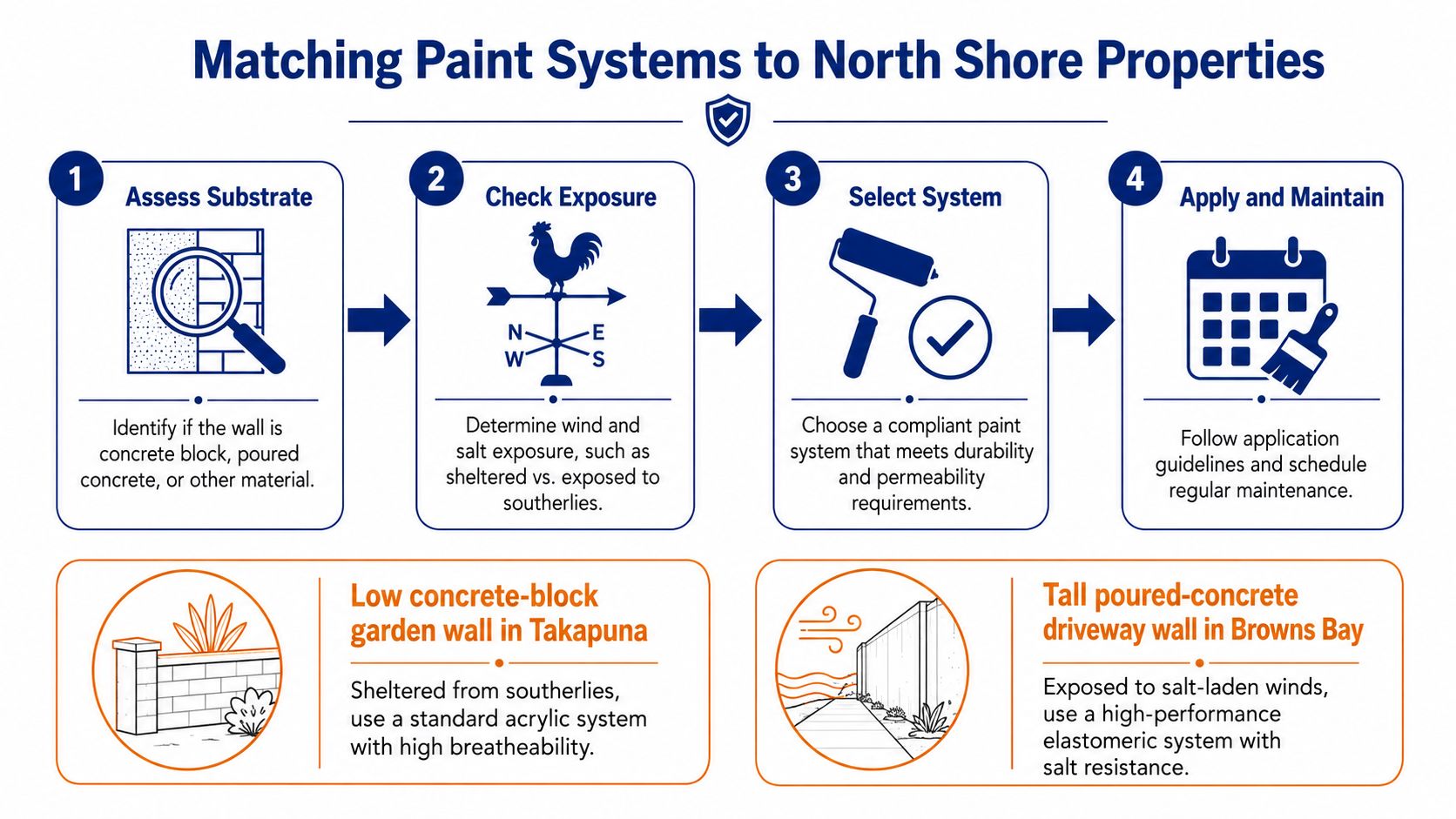
Use the sequence on real walls
A rendered masonry wall in Devonport with persistent damp at the base shouldn't receive another topcoat until the source of the moisture is investigated. If drainage is sound and the render is stable, an appropriate elastomeric masonry system may help manage fine surface cracking. If moisture is coming through under pressure, a waterproofing approach becomes more relevant.
A timber sleeper wall on a Milford slope needs a timber-compatible penetrating finish, but only after checking for decay, failed joints, and soil or water conditions that compromise the structure. Paint won't restore rotten timber or correct a wall that is moving.
Walls under 1 m may often suit a standard acrylic masonry system when the substrate is sound and drainage is effective. Walls over 1.5 m, or walls experiencing hydrostatic pressure, require more careful compliance and engineering consideration, with a waterproofing membrane potentially becoming the primary moisture-control decision rather than a decorative topcoat.
North Shore contractor rule: Never select the topcoat before confirming drainage, wall height, substrate moisture, and the condition of the wall assembly.
For readers comparing exterior preparation standards in other markets, SuperiorPRO exterior painting offers another useful reference point. The local conditions still decide the specification here, particularly Auckland's rain, humidity, coastal salt, and varied retaining-wall construction.
Painters North Shore assesses retaining walls by substrate, drainage, moisture, and exposure before recommending a coating system, with concrete painting, timber finishing, cleaning, preparation, priming, and exterior application available as part of the service. Visit Painters North Shore to arrange an assessment before the next repaint turns into another cycle of blistering and peeling.