Your premises probably still function fine. The problem is that they no longer look like they match the business you run inside them. Reception walls are marked, the exterior has lost colour depth, staff notice the wear even if they don't say it, and clients read it as neglect faster than owners expect.
Most Auckland business owners hesitate for the same reason. They're not worried about paint. They're worried about disruption. If the office closes, the shop trades poorly, or the warehouse flow slows down, the repaint starts to feel like a cost with no clear return.
That's where good commercial project management changes the decision. A commercial repaint isn't residential painting on a bigger site. It's a planned maintenance and presentation job built around operations, access, compliance, and timing. The New Zealand commercial painting market is distinct from residential work due to its scale and complexity, with total project costs ranging from $12 to $70 per square metre depending on building type and scope, and it includes major operators such as Programmed Maintenance Services, Carus Group, and JR Webb & Son, according to New Zealand commercial painting market data.
Why Professional Commercial Painting Is a Smart Investment
A tired commercial building affects more than appearance. In offices, it changes how the workplace feels day to day. In retail, it affects how clean and current the brand looks. In warehouses, deteriorated finishes can turn a building into something that feels harder to maintain than it really is.
Presentation and protection work together
Owners often split painting into two categories. One is cosmetic. The other is maintenance. In practice, commercial painting does both jobs at once.
A well-specified repaint helps you:
- Protect the asset by sealing and covering surfaces before wear becomes more expensive to fix
- Support your brand with cleaner entrances, sharper common areas, and finishes that look intentional
- Maintain tenancy appeal in offices, managed properties, and shared commercial buildings
- Avoid false economies where neglected surfaces later need heavier prep, stripping, or substrate repair
That last point matters. Cheap work often fails at the prep stage, not at the topcoat stage. If the painter rushes cleaning, sanding, patching, and priming, the site may look refreshed at handover but won't wear properly.
Practical rule: In commercial work, the value isn't just in how the finish looks on day one. It's in whether the coating system and schedule reduce future maintenance and business interruption.
It's a business decision, not a decorating decision
For Auckland owners, the smarter way to think about painting is this. You're not buying paint. You're buying a controlled outcome.
That outcome usually includes cleaner presentation, longer surface life, clearer planning, and less disruption to staff, tenants, customers, or stock movement. The contractor matters because the method matters. A crew that understands staging, access, and occupied buildings will approach the work differently from a team used to straightforward house repaints.
That's why businesses searching for commercial painters Auckland shouldn't compare quotes on price alone. The actual comparison is between two types of jobs. One is run around your operations. The other expects your operations to bend around the painters.
Matching the Service to Your Commercial Space
Not every building needs the same scope, product, or schedule. The right brief starts with how the space is used.
If you're reviewing options for commercial painting services on Auckland's North Shore, the useful question isn't “what does painting cost?” It's “what does this building need to stay functional while the work happens?”
Offices
Office painting is usually about keeping the space usable and the environment tolerable for staff. That changes product selection and timing.
Low-odour, low-emission products are often the practical choice for interiors with regular staff occupancy. So is staged work. One floor, one wing, or one meeting room zone at a time is easier to manage than trying to repaint an entire occupied workplace in a single push.
Office projects usually need attention to:
- Indoor air quality because staff return quickly after each stage
- Clean edges and detailed finishes around glass, joinery, signage, and reception areas
- Flexible timing when meetings, client visits, or shared building access limit work hours
- Consistent colour control across touch-up areas and larger open-plan spaces
A rushed office repaint tends to fail operationally before it fails technically. Desks get moved twice, meeting rooms stay offline longer than expected, and management ends up coordinating painters instead of running the business.
Retail spaces
Retail painting is driven by downtime pressure. The work often has to happen around trading hours, promotions, stock deliveries, and customer-facing presentation.
Here, durability matters as much as colour. High-contact walls, changing rooms, checkout surrounds, and storefronts all take regular knocks. Brand consistency matters too. If the business uses a defined palette, the painter needs to treat colour matching as a control item, not an afterthought.
Retail jobs usually benefit from:
- Fast staging so one section reopens while another is still in progress
- Hard-wearing finishes in corridors, display zones, and service counters
- Sharp exterior presentation because the street-facing façade does marketing work every day
- Night or weekend scheduling when daytime closure would hit revenue
The common mistake is choosing a contractor who can apply paint well but can't run a compressed programme.
A retail repaint succeeds when customers barely notice the work happened, but they do notice the space looks cleaner, brighter, and more credible.
Warehouses and operational sites
Warehouses call for a different mindset. Appearance still matters, especially in customer-access areas, but most decisions come back to wear, access, and workflow.
Large wall and ceiling areas may suit spray application. Operational sites may also need floor coatings, safety line marking, or durable systems for loading zones, plant areas, and wash-down-prone surfaces. The painter needs to work around racking, forklifts, stock access, and sometimes partial occupancy.
What works well in warehouses:
- Large-area planning rather than room-by-room thinking
- Durable systems on surfaces that take impact or frequent cleaning
- Clear sequencing around loading bays and stock movement
- Access planning early for height, lifts, and restricted zones
What doesn't work is treating a warehouse like a plain shell. If the crew blocks movement paths or underestimates prep in active zones, operations feel the pain immediately.
Choosing the Right Coating System for Auckland Conditions
Colour gets attention. Coating systems are what decide whether the job lasts.
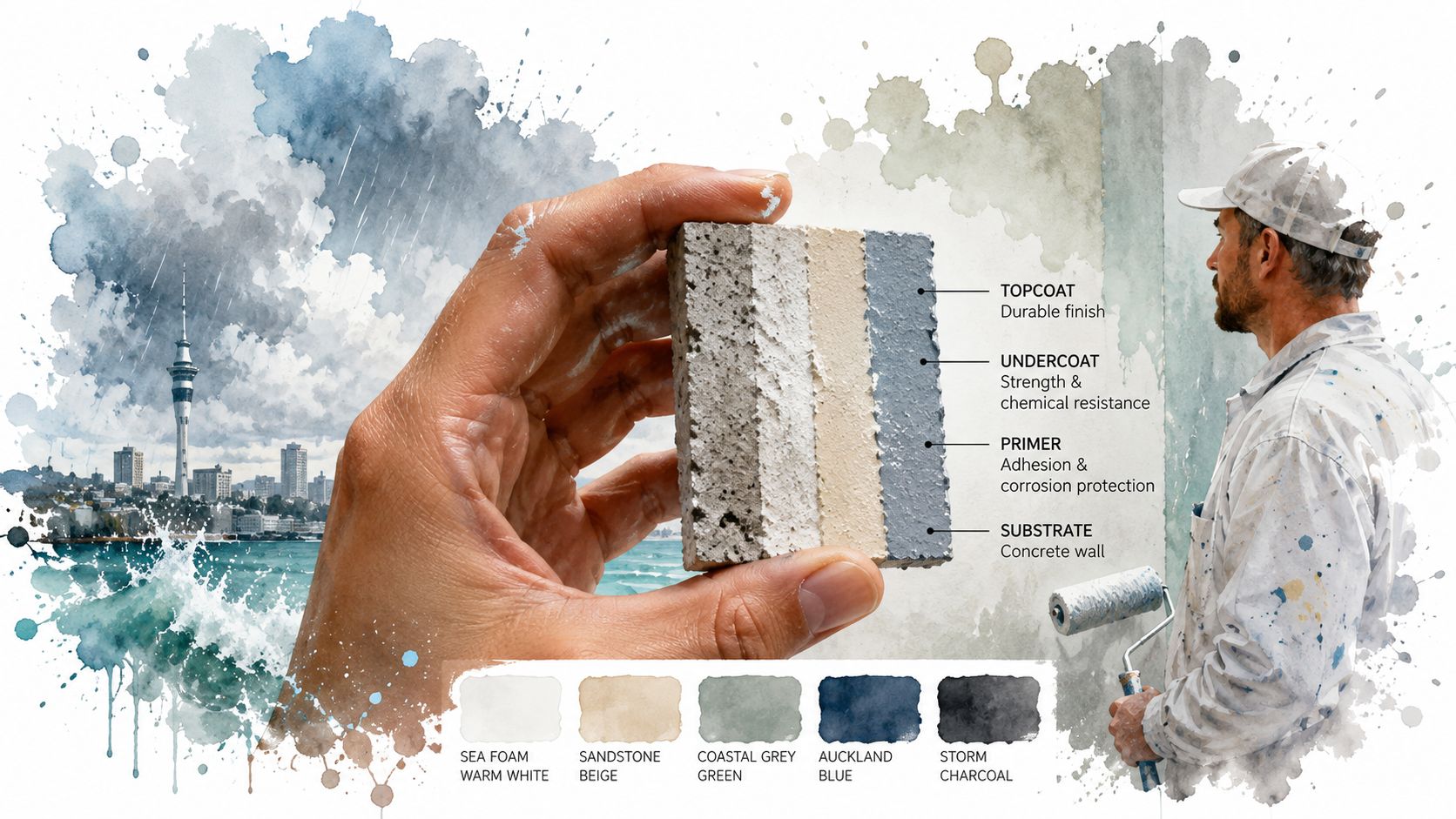
A proper commercial specification combines primer, undercoat where required, and topcoat selected for the substrate, exposure, and use of the space. On Auckland projects, that matters even more because moisture, UV exposure, salt air, and occupancy all pull the coating in different directions.
Why systems fail on coastal sites
North Shore and wider Auckland coastal properties don't give average results with average specifications. Salt-laden air, humidity, and substrate movement put pressure on exteriors and exposed common areas. That's why painters who know local conditions often favour established systems from brands such as Resene and Dulux, paired to the actual substrate rather than chosen on price alone.
The 2025 NZ Building Code update mandates low-emission coatings for high-occupancy commercial zones in coastal areas, and premium low-VOC coatings can increase material costs by 15 to 20% while reducing long-term maintenance needs by up to 30% in Auckland's humid coastal conditions, according to guidance on low-emission coastal coating requirements.
That doesn't mean every project needs the highest-spec product on every surface. It means the coating should match the risk. Reception walls, exterior cladding, food-related areas, and plant rooms rarely need the same system.
What to ask your painter
A useful quote should explain more than colour names. It should identify the coating logic.
Ask about these points:
- Substrate match. Is the system being selected for plaster, concrete, gib, timber, steel, or previously painted surfaces?
- Exposure level. Is the exterior sheltered, fully coastal, or subject to regular wash-down and UV?
- Occupancy needs. Does the building need low-emission products because staff, customers, or students return quickly?
- Specialist finishes. Do you need anti-graffiti, fire-rated, food-safe, or extra-washable coatings?
If the answer is “we use good paint”, you don't yet have enough information.
The right coating system often costs more upfront and less over the life of the building. The wrong one usually does the reverse.
Understanding Commercial Painting Costs and Timelines
Commercial painting prices in Auckland move with building type, access, prep load, and scheduling pressure. The cleanest way to read a quote is to separate the fixed painting cost from the business cost of disruption.
Ballpark rates by property type
In Auckland, commercial painting costs vary by building type. Offices range from $20 to $45 per square metre, retail spaces from $25 to $55 per square metre, and warehouses from $12 to $30 per square metre. After-hours work typically adds a 15 to 30% premium to the base rate, according to IBISWorld data on painting and decorating services in New Zealand.
| Property Type | Average Cost Range per m² |
|---|---|
| Office | $20 to $45 |
| Retail | $25 to $55 |
| Warehouse | $12 to $30 |
Those numbers are useful for first-pass budgeting. They are not a substitute for a site visit. Surface condition, staging constraints, specialist coatings, traffic management, lift access, or difficult strip-out requirements can all change the scope. If old coatings are failing, some projects also need earlier remedial work such as paint stripping for unstable surfaces.
What drives a quote up or down
The biggest pricing variables usually sit outside the paint tin.
A commercial quote is generally shaped by:
- Preparation load such as washing, sanding, patching, crack repairs, and spot priming
- Access method including whether the crew can work with ease or needs more controlled access
- Operational limits where staging, night work, or restricted windows slow production
- Coating specification when the building needs more durable or specialist products
- Protection and clean-up around stock, equipment, furniture, public areas, and occupied zones
Timelines follow the same logic. A vacant site can move quickly. An occupied one may take longer on the calendar because the work is broken into smaller windows that protect normal use.
The cost of downtime framework
This is the trade-off many generic articles ignore. Owners compare the repaint quote against their budget, but they don't compare it against the cost of lost trading or disrupted operations.
Use a simple framework:
- Estimate the revenue or operational value of each hour the affected area is unavailable
- Estimate how many hours of disruption a daytime repaint would create
- Compare that total with the premium for after-hours or staged work
- Decide which cost is lower and which risk is easier to carry
For a retail tenancy, daytime closure may be the expensive option even if the painter's quote is lower. For an office, daytime work may be fine if teams can shift floors and keep operating. For a warehouse, a blocked loading zone for the wrong half-day can create a bigger operational problem than the painting cost itself.
The important point is this. After-hours painting isn't automatically expensive. It's sometimes the cheaper business decision.
How Professionals Minimise Business Disruption
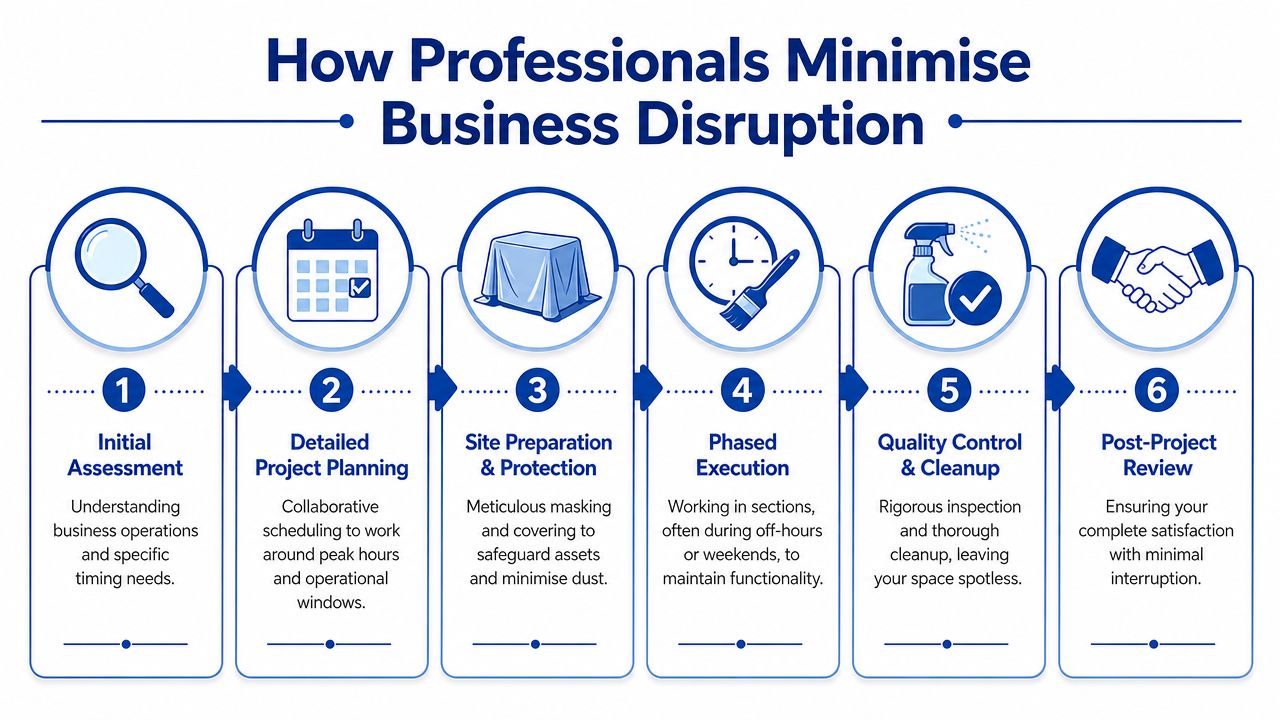
A well-run commercial repaint should feel controlled from the first site meeting to the last clean-up. Businesses don't need vague promises about “minimal disruption”. They need a clear method.
Staging the site properly
Professionals usually divide the project into zones. That might mean one tenancy area, one office wing, one bathroom block, one loading face, or one stairwell at a time. Staging keeps part of the premises live while another part is under prep or coating.
That approach works because it gives everyone certainty. Staff know where they can work. Customers know which entrance is open. Building managers know what's being handed back each day.
A practical disruption plan usually includes:
- Defined zones so the crew doesn't spread across the whole site at once
- Agreed access windows for keys, alarms, lifts, and restricted areas
- Protection measures such as masking, coverings, and dust control
- End-of-shift reset so the space is safe and presentable before normal use resumes
Scheduling around the business
Not every project needs night work. Some do. Others work better across weekends or holiday shutdowns. The right schedule depends on the building's pressure points.
An office may prioritise meeting rooms and reception after hours. A retailer may want overnight work on customer-facing areas and daytime work in stockrooms. A warehouse may accept standard-hour painting if loading, dispatch, and forklift paths remain untouched.
Good commercial scheduling protects the operation first, then builds the paint programme around it.
Communication is part of the job
Many repaint problems come from silence rather than workmanship. If the client doesn't know what's happening tomorrow, the project starts creating friction even when the finish quality is fine.
A reliable contractor should confirm:
- What zone is being worked on today
- What access is needed
- What areas will be handed back
- What changes, if any, affect tomorrow's plan
A dedicated commercial team tends to outperform an ad hoc crew. For example, Painters North Shore handles commercial painting with staged scheduling, preparation-led workflow, and low-VOC options where specified, which is the kind of service structure business owners should expect from any contractor they shortlist.
Your Vetting Checklist for Hiring Commercial Painters
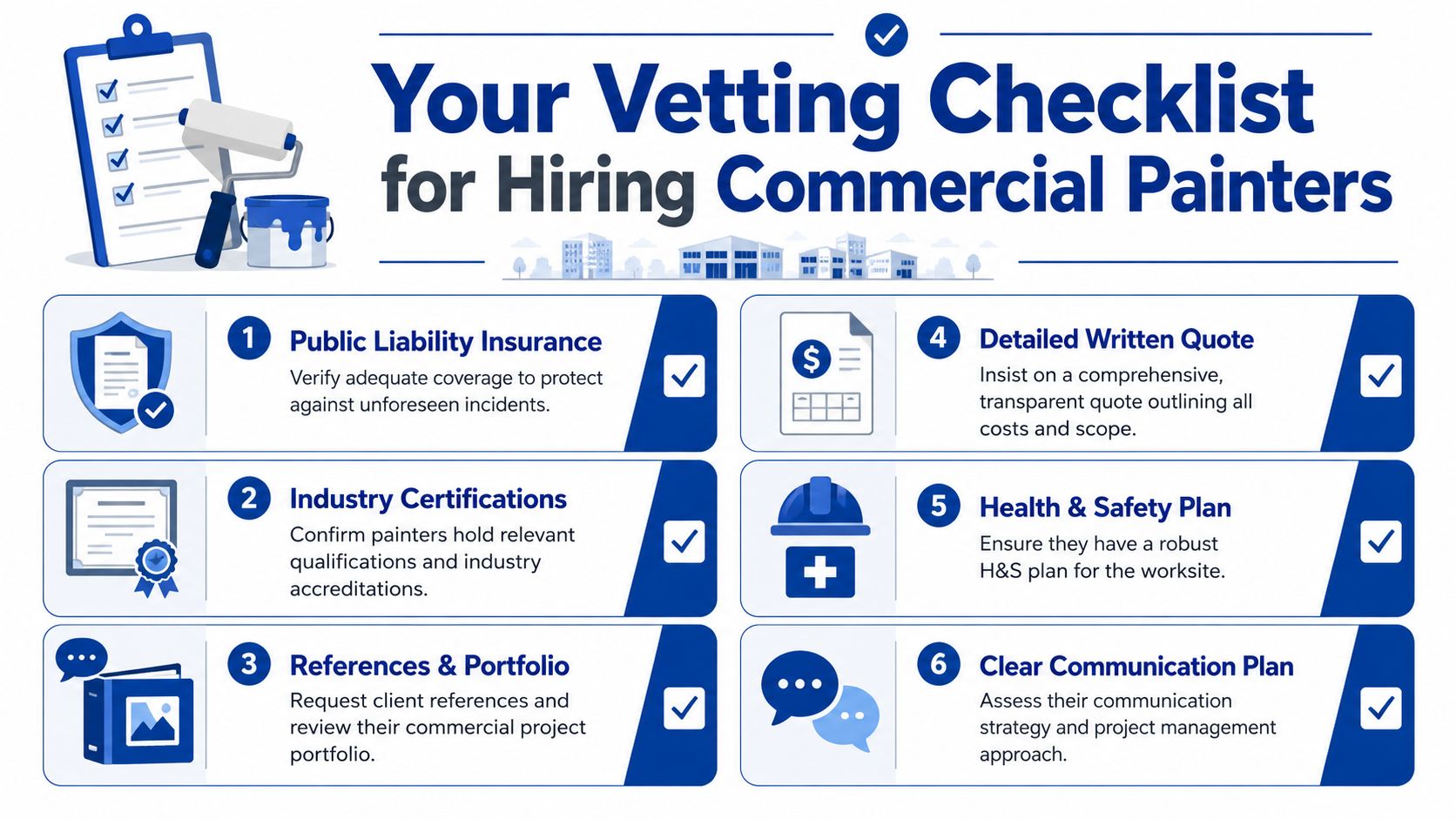
Most hiring mistakes happen before work starts. The quote looks tidy, the painter sounds confident, and nobody checks the parts that carry risk.
The non-negotiables
Start with the basics that protect you if something goes wrong.
- Insurance. Ask for evidence of public liability cover.
- Health and safety documentation. Commercial painters should be comfortable discussing site-specific controls, inductions, and occupied-site procedures.
- Detailed written scope. A one-line lump sum quote won't tell you what prep, protection, coats, or exclusions are buried in the price.
- Commercial references. Ask for examples from occupied offices, retail tenancies, warehouses, or managed properties, not only houses.
If you want a broader framework for comparing firms, this guide on how to choose reliable painting contractors in Auckland is a useful cross-check against what you hear during quoting.
Older buildings need extra scrutiny
For Auckland commercial properties built before the 1990s, lead-based paint assessment is mandatory before sanding or removal. Professional painters must use certified testing, containment barriers, wet sanding techniques, and HEPA vacuums to prevent hazardous dust exposure, according to Auckland lead paint safety guidance for commercial sites.
That requirement changes the hiring conversation. You're no longer only assessing finish quality. You're assessing whether the contractor can control a regulated risk on an occupied site.
Ask directly:
- Have you identified possible lead paint risk?
- What containment method will you use?
- How will dust be controlled and removed?
- How will occupants, neighbouring tenancies, or shared areas be protected?
A hesitant answer is a warning sign.
If a contractor treats lead protocols like an optional extra, move on.
Check how the business is run, not just how the paint is applied
Commercial projects depend on admin as much as site skill. Fast quoting, clear variation handling, documented communication, and organised follow-up all matter.
For painting businesses reviewing their own customer handling and lead response systems, tools such as Recepta.ai for painting businesses are relevant because they focus on how enquiries are managed before a project becomes a site problem. From the client side, that same principle applies. The firms that run communication well usually run the job better too.
Frequently Asked Questions About Commercial Painting
How is project duration estimated?
A proper timeline comes from the site inspection, not a guess over the phone. The painter needs to assess access, prep condition, occupied versus vacant status, drying windows, and whether the work will be staged. For commercial jobs, the calendar duration and the actual labour duration are often different because the schedule is built around your operating hours.
What's the difference between a workmanship guarantee and a paint warranty?
They cover different things. A workmanship guarantee relates to how the contractor prepared and applied the system. A manufacturer's product warranty relates to the coating itself, subject to the product being used correctly and on the right substrate. If either side is unclear, ask for it in writing.
Do we need to move furniture, stock, or equipment?
Usually, there's a shared plan. In offices, staff may clear desks, sensitive electronics, or filing areas while the painters protect floors, mask fixed items, and stage rooms in sequence. In retail and warehouse settings, stock movement often becomes part of the programme, especially where access aisles, shelving faces, or service counters are involved.
Can commercial painting happen while we stay open?
Often, yes. The key is whether the work can be zoned safely and whether the affected area can still function. Offices, retail tenancies, and warehouses all have different tolerances for occupied work. The painter should tell you early if staged work is realistic or if closure is the safer option.
What should a good quote include?
It should identify surface prep, number of coats, product system, exclusions, access assumptions, working hours, protection measures, and clean-up expectations. If those details are missing, you're comparing numbers without comparing scope.
If you're planning a repaint for an office, shop, warehouse, or managed property, Painters North Shore can assess the site, explain the operational trade-offs, and provide an itemised commercial painting quote built around your schedule, access needs, and substrate condition.