A standard three-bedroom North Shore exterior repaint commonly costs NZ$8,500 to NZ$15,000, with preparation, house size, and cladding type having the greatest effect on the final price. Homes with failing coatings, difficult access, or plaster and stucco exteriors can move well beyond that range.
You're probably looking at a faded exterior, peeling trim, or weatherboards that no longer look protected, and trying to work out whether the job will be manageable or unexpectedly expensive. A neighbour's repaint might have cost one amount, while a similar-looking villa nearby received a much higher quote.
That difference usually isn't caused by the paint tin alone. A professional price reflects washing, scraping, sanding, repairs, sealing, priming, access equipment, labour, and the coating system suited to the property. On Auckland's North Shore, salt air and exposed coastal positions can make preparation more demanding, particularly on older villas and weatherboard homes.
Your Guide to North Shore Painting Costs
A compact villa in Devonport may appear straightforward until the painter finds salt-affected timber, brittle sealant, and several layers of failing paint. A standard three-bedroom weatherboard repaint in Auckland commonly falls between NZ$8,500 and NZ$15,000 including GST, according to Auckland exterior house painting cost guidance. That range sets an expectation, rather than promising a quote.
A small, single-storey home with sound paintwork may sit near the lower end. Height, difficult access, timber repairs, and widespread coating failure push the cost higher. Across New Zealand, exterior repaints are commonly placed around NZ$6,000 to NZ$20,000 or more. North Shore properties can trend towards the upper end because older villas and weatherboard homes in suburbs such as Devonport, Takapuna, and Milford may receive regular salt-laden wind, strong sun, and moisture.
Housing type also changes the preparation required. A weatherboard bungalow around NZ$8,500 to NZ$12,500 is priced differently from a plaster or stucco home around NZ$11,500 to NZ$16,500 or more. Plaster and stucco need careful checking for cracking, movement, moisture entry, and adhesion. Coastal exposure can make washing, scraping, sealing, and priming as important as the final colour.
Assess the property before choosing colours:
- Identify the cladding: Weatherboard, brick, concrete masonry, cedar, plaster, and stucco need different preparation and coating systems.
- Inspect the existing finish: Look for flaking paint, chalking, bubbling, cracking, exposed timber, mould, and failed sealant.
- Record access constraints: Two-storey walls, steep sections, narrow side passages, decks, rooflines, and landscaping affect setup and working time.
- Check exposure: Coastal homes may need more thorough salt removal, timber repairs, and products suited to demanding weather.
Practical rule: A quote should describe surface condition and preparation, not only house size.
Ask what the property needs before the final coats can perform properly. A low price may leave unstable paint, contaminated surfaces, or damaged timber beneath the new finish. Those defects can shorten the life of the coating and lead to earlier repair work.
For North Shore homeowners, a tidy weatherboard repaint with limited repairs is a different job from restoring a coastal villa with layered, failing coatings. The estimate should show that difference clearly, including the preparation needed to protect the substrate and produce a durable finish.
The Core Components of an Exterior Painting Quote
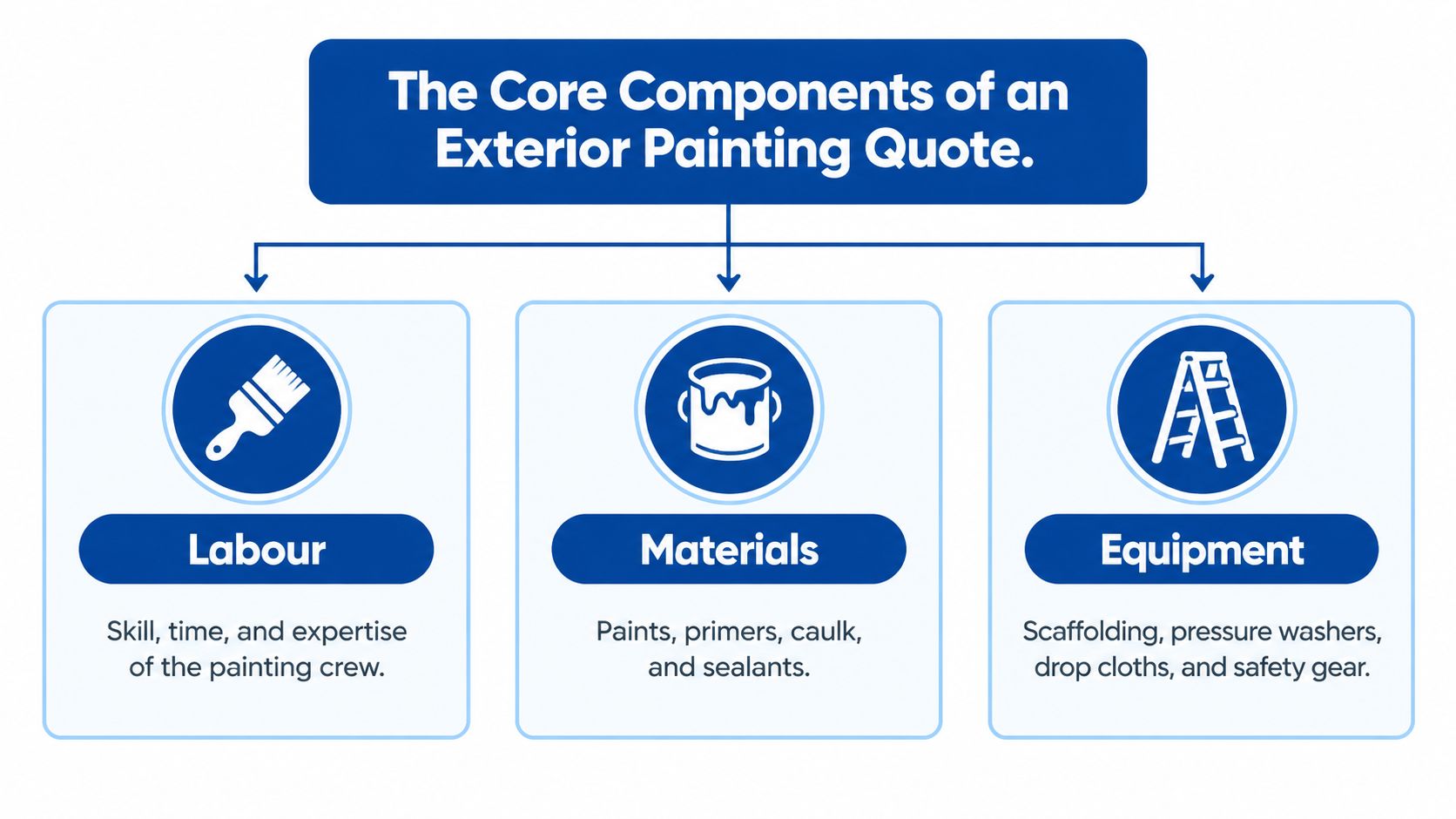
A North Shore exterior painting quote is built around three connected components: labour, materials, and equipment. Each reflects a different cost decision. Coastal exposure, older villa detailing, and difficult access usually increase more than the paint quantity alone.
Labour includes preparation, not just application
The visible paintwork is only one part of the job. Labour may cover washing salt and grime from the surface, scraping loose coatings, sanding edges, filling holes, repairing damaged timber, treating affected areas, sealing joints, spot priming, masking, and applying the finish coats.
Preparation time depends on what the crew finds. Powdery paint, damp areas, failed sealant, and exposed timber cannot provide a dependable base for new topcoat. On weatherboards, loose edges need to be feathered or removed, exposed timber needs suitable primer, and repairs must be sound and dry enough to coat. Cutting preparation short can make the repaint look finished while leaving the substrate vulnerable.
Materials need to suit the substrate
Materials commonly include cleaning products, fillers, sealants, primers, undercoats, and exterior topcoats. Resene and Dulux offer exterior systems, but the appropriate combination depends on the cladding, existing coating, moisture movement, exposure, and desired finish.
A higher-priced coating will not correct poor preparation. It can support a longer-lasting system when the surface has been cleaned, repaired, sealed, and primed properly. For coastal homes, weather resistance and compatibility with the existing substrate matter more than selecting a colour for appearance alone.
Villas often require more than a flat wall coating. Weatherboards, timber trim, sash windows, and repaired sections may each need different preparation or product treatment, which adds labour and materials without necessarily increasing the building's floor area.
Equipment controls safety and finish quality
Equipment may include pressure washers, sanding tools, ladders, masking systems, drop cloths, harnesses, platforms, and scaffolding. Safe access is part of the work whenever painters must reach upper walls, rooflines, or awkward elevations.
Scaffolding can also improve the finish. A stable platform gives painters time to prepare edges, inspect details, and apply coatings consistently instead of working hurriedly from a ladder. Setup, relocation, site protection, and removal all contribute to the quote, particularly on multi-storey homes or properties with narrow side access.
Published Auckland guidance gives façade-based rates of NZ$70 to NZ$140 per m² excluding GST. Weatherboard is listed around NZ$70 to NZ$105 per m², brick and concrete masonry around NZ$90 to NZ$125 per m², and plaster or stucco around NZ$95 to NZ$140 per m² in New Zealand exterior painting cost guidance by surface area.
Treat those figures as a comparison point, not a complete quote. One painter may include washing, moderate sanding, primer, two finish coats, and standard access. Another may price application separately from timber repairs, scaffolding, or extensive removal of failed coatings.
Ask for a written scope showing the measurable wall area, preparation tasks, product system, coat numbers, access equipment, GST treatment, and exclusions. Homeowners arranging an assessment can review this house painting quotation service to see the details a quote should address.
Key Factors That Drive Your Final Painting Cost
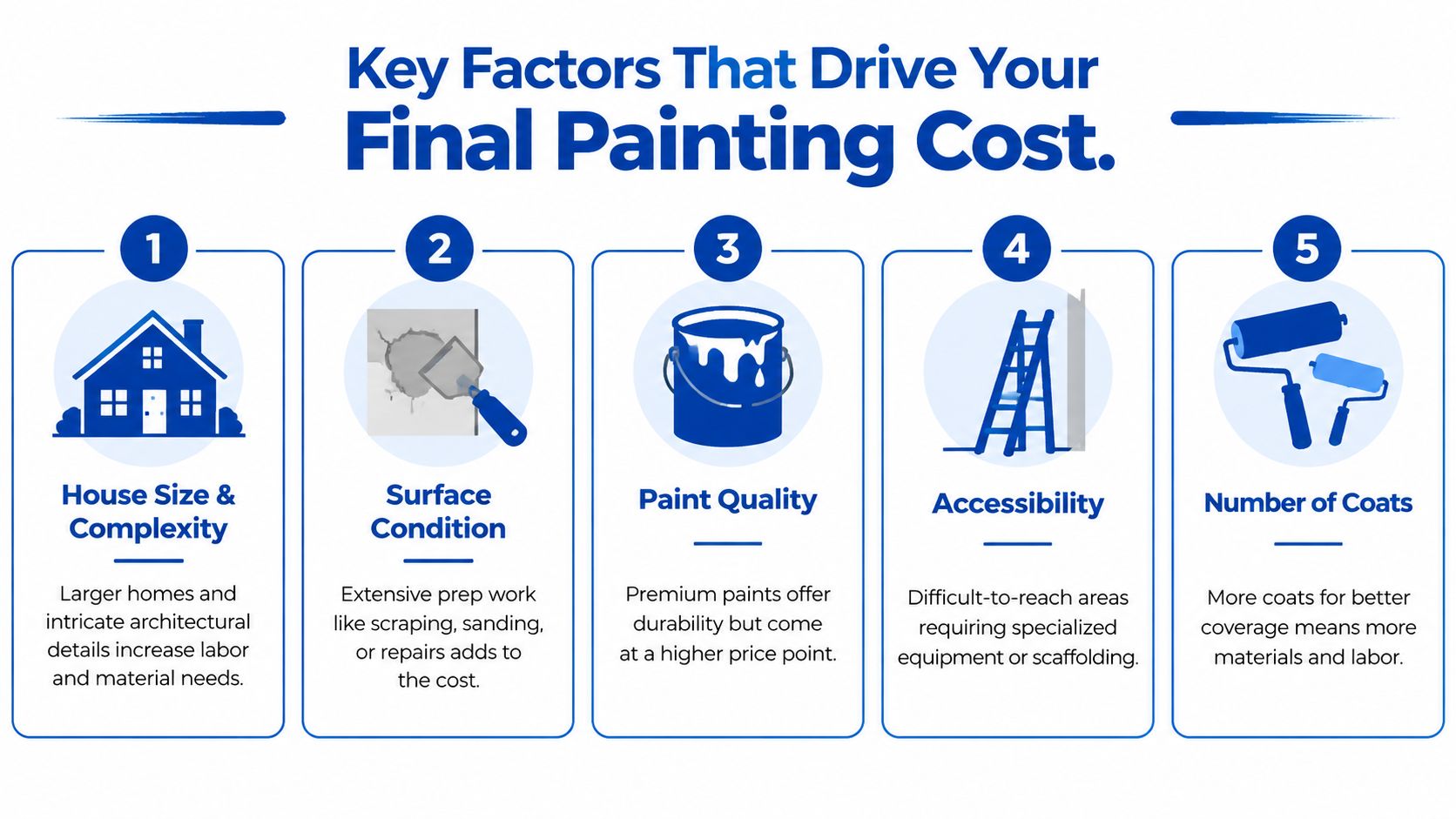
A small North Shore villa can cost more to repaint than a larger, simpler home. The difference usually comes from access, trim, surface failure, and the amount of preparation required, not the floor area shown on a property plan.
Painters price the exterior surfaces they must wash, repair, prime, and coat. Steep sections, ornate villa details, several roof levels, and failing coatings all add labour. A larger single-storey property with sound paint may therefore be more straightforward than a compact home exposed to weather and difficult to reach.
Size, height, and access
Every wall, gable, dormer, bay window, and detailed trim section creates more preparation and cutting-in work. Height adds safe-access requirements, which may include scaffolding or other equipment.
North Shore homes often have narrow side passages, retaining walls, decks, or dense planting. Protecting those areas and moving equipment between elevations takes time. Multi-storey plaster homes are affected twice, because the crew must manage both height and a substrate that may need more detailed repairs.
Cladding changes the method
Weatherboard is common on North Shore villas and bungalows, but each board still needs attention around joins, end grain, nail holes, trims, and previous coatings. Brick and concrete masonry need compatible primers and coatings. Plaster or stucco may require crack repairs, texture control, and products suited to movement across the surface.
Published Auckland guidance places plaster and stucco towards the upper end of typical cladding rates, at around NZ$95 to NZ$140 per m², compared with approximately NZ$70 to NZ$105 per m² for weatherboard. The difference reflects the preparation and application method, rather than the paint alone. This cladding-specific exterior painting guidance explains why comparing surfaces is more useful than relying on one house-wide average.
Surface condition is usually the major multiplier
A weatherboard exterior with stable paint may cost around $60 to $80 per m² including GST to repaint. Where the coating is failing and requires full stripping, the cost can rise to approximately $105 to $145 per m² including GST, according to 2026 New Zealand weatherboard painting cost guidance.
The finished house hides much of this work. Painters may need to remove unstable layers, feather sanding edges, repair timber, prime exposed areas, and make the surface consistent before applying finish coats. Washing and rolling over flaking paint does not correct the cause of the failure.
Cleaning can also be priced separately. Homeowners can understand pressure washing costs by looking at how access, surface type, and preparation affect the scope. For the painting work, this practical guide to preparing walls for painting helps homeowners check whether the quote allows enough time for the substrate.
Coastal exposure affects durability
Salt air can accelerate coating breakdown and leave contaminants that must be removed before priming. North Shore properties near the water, or those exposed to prevailing winds, may need more thorough washing, drying time, and inspection than sheltered inland homes.
The practical answer is a suitable coating system, not only the most expensive paint. The system should include a clean substrate, compatible primer, sound timber repairs, sealed joints, and weather-resistant topcoats applied in suitable conditions. Reducing preparation may lower the initial quote, but it can shorten the repaint's service life and leave the underlying substrate vulnerable.
Sample Exterior Painting Prices in Auckland
A small, accessible home with sound paint can sit near the lower end of Auckland's repainting ranges. A North Shore weatherboard bungalow with failing coatings, exposed timber, or difficult access can cost considerably more, even with a similar floor area. The examples below show why preparation and building type matter as much as paint quantity.
| Property Type | Typical Size | Estimated Cost Range |
|---|---|---|
| Small single-storey home or unit | Small footprint | NZ$6,500 to NZ$9,500 |
| Standard weatherboard bungalow | Three-bedroom style | NZ$8,500 to NZ$15,000 |
| Large two-storey plaster or stucco home | Larger, complex exterior | NZ$20,500 to NZ$29,000 |
These Auckland benchmarks are scenarios, not fixed prices. The final quote depends on measured façade area, access, the number of elevations, and the condition of the existing coating.
A small single-storey property
Clear access and reasonably stable paint can keep a small property near the lower range. Extensive trim, narrow side access, or repairs around windows and doors can push the cost higher. Check whether the quote includes washing, preparation, spot repairs, priming, finish coats, and ordinary access equipment. A low total may leave some of those tasks outside the stated scope.
A North Shore weatherboard bungalow
Weatherboard homes often show the widest pricing variation. One may need cleaning, light sanding, spot priming, and finish coats. Another may have several failing layers, soft timber, brittle sealant, and salt-exposed elevations. Similar floor areas do not make these equivalent painting projects.
A complete repaint of an average three-bedroom weatherboard home has also been estimated at $18,000 to $28,000 including GST in New Zealand guidance, based on weatherboard exterior repainting cost data. That higher range demonstrates how strip-back work, timber repairs, joint sealing, and a full preparation system can sit well above a simpler maintenance repaint.
For coastal North Shore properties, preparation protects the substrate as well as the finish. Salt deposits and wind-driven exposure can require more thorough washing, drying, inspection, and priming before the topcoats are applied.
A large two-storey plaster home
The upper range reflects more than additional paint. Height increases access requirements, while plaster or stucco may need specialised preparation. Large elevations also take longer to wash, repair, mask, prime, and coat. A low quote for this type of home should state how access and substrate defects are handled, because omitted work can reappear later as variations.
How to Get an Accurate and Fair Painting Quote
A fair quote gives you enough detail to understand what the painter will do, what products they'll use, and what remains outside the agreed price. A vague total may be quick to produce, but it makes two contractors difficult to compare.
Start with an on-site assessment. Photos can help a painter prepare, but they rarely show every failing edge, access restriction, soft timber area, or previous coating problem. A proper inspection should look at each elevation, trims, windows, doors, eaves, decks, roof junctions, and areas where water or salt exposure may be concentrated.
Check the measurement
Quotes use different units, which creates confusion. Some Auckland guides use $28 to $50 per m² of wall area, while others use $70 to $140 per façade m² depending on cladding and preparation. Separate guidance places a 150m² home at $7,000 to $15,500, showing why the quoted unit and scope must be stated clearly. These comparisons are outlined in the Auckland exterior painting cost calculator guidance.
Ask whether the measurement refers to:
- Floor area: The internal or building footprint, which doesn't directly represent the exterior surface.
- Paintable wall area: The actual façade area after accounting for openings and elevations.
- Façade area: A measurement that may include cladding surfaces and details differently from wall area.
A contractor doesn't need to use the same pricing unit as another contractor, but both quotes should define the area and scope. If one quote excludes windows, trims, doors, or difficult elevations, its headline rate won't be comparable.
Read the preparation schedule
Look for specific wording rather than “prepare as required”. The quote should identify whether the work includes washing, scraping, sanding, filling, repairs, sealant removal and replacement, spot priming, full priming, and treatment of exposed timber.
This is also where you should ask what happens if painters uncover more damage. A sensible quote explains which repairs are included and how additional work will be priced and approved. You shouldn't be left deciding on expensive variations while scaffolding is already in place.
Confirm the coating system
Ask for the brand, product range, primer, undercoat where relevant, finish coat, sheen, and planned number of coats. Resene and Dulux both have exterior systems, but the product must be matched to the surface and existing coating rather than selected solely by brand familiarity.
Clarify whether the price includes GST, scaffolding, protection of paths and planting, cleanup, and disposal. If the property has old timber elements or nearby stumps affecting access, a separate essential guide to Perth stump grinding illustrates the broader principle of checking site obstacles before work begins, even though its location and trade focus differ from an Auckland painting project.
Questions worth asking each painter
- What condition is the existing coating in? Ask the painter to identify failing areas and explain the proposed remedy.
- What preparation is included? Request a written sequence, not a general promise.
- What surface area are you pricing? Confirm whether the figure uses floor area, wall area, or façade area.
- Which products will be applied? Check primer, topcoat, colour, sheen, and coat allowances.
- How will access be handled? Confirm scaffolding, ladders, platforms, protection, and removal.
- How are variations approved? Get the process in writing before work starts.
- What is excluded? Look for repairs, rotten timber, extensive stripping, and difficult access items.
- What workmanship assurance is provided? Ask what happens if a coating issue appears after completion.
The lowest exterior painting cost isn't necessarily the lowest total cost. A detailed quote may initially look higher because it includes the work required to make the finish durable.
Protecting Your Investment with a Quality Finish
Exterior painting protects the building envelope as well as improving appearance. On a North Shore home, the finish needs to cope with rain, ultraviolet exposure, movement in timber, moisture around joints, and, in coastal locations, salt contamination.
Auckland exterior repaints commonly run 15% to 25% above the New Zealand average, with higher labour costs and the additional preparation required for coastal homes contributing to that premium. This regional context is discussed in New Zealand exterior painting costs by city.
The durable approach is straightforward, although it isn't always the cheapest at the quoting stage:
- Wash the substrate properly: Remove dirt, salt, chalk, and biological growth before coating.
- Stabilise the surface: Scrape, sand, repair, and prime areas where the old coating has failed.
- Seal vulnerable joints: Address gaps and deteriorated sealant around trims, windows, and penetrations.
- Use a compatible system: Match primers and topcoats to weatherboard, plaster, brick, cedar, or other cladding.
- Plan for maintenance: Exterior timber and adjacent outdoor surfaces need regular attention, as explained in this timber deck maintenance guide.
Paint choice matters, but preparation determines whether the coating has a reliable foundation. A local contractor familiar with North Shore villas, weatherboard homes, plaster exteriors, and coastal exposure can identify where the budget should go before the first tin is opened. Homeowners can review options for paint for a house while comparing the product system with the property's actual substrate and exposure.
For a preparation-led exterior repaint, Painters North Shore provides on-site assessments, itemised written quotations, and coating systems suited to weatherboard, plaster, brick, and other North Shore exteriors. Visit Painters North Shore to request a quote and discuss the preparation, access, and durability requirements of your home.