A homeowner on the North Shore usually asks this question after looking at a fence that has gone grey, patchy, or tired on the harbour-facing side. The neighbour may have brushed their fence, while a contractor has suggested an airless sprayer, and both options can sound convincing. The right choice depends less on which tool is fashionable and more on the timber profile, access, wind, surrounding surfaces, and required finish.
Spraying can transform a long, repetitive fence job into a much faster operation. It can also put paint on the garden, driveway, paving, or a neighbour's property if the site isn't properly protected. Brushing takes longer, but it gives the applicator more control over rough grain, end grain, gaps, edges, and detailed joinery.
| Decision area | Spray | Brush or roller |
|---|---|---|
| Long, repetitive fence runs | Usually fastest | Slower |
| Rough-sawn timber | Needs back-brushing or back-rolling | Good penetration and control |
| Detailed pickets and rails | More masking and fiddly work | Usually easier |
| Overspray risk | Higher, especially in wind | Low |
| Paint efficiency | Uses about 20% more paint than brushing, according to Resene's fence and gate guidance | More economical with the coating |
| Best overall use | Large areas with good access | Detailed work and tight boundaries |
Why North Shore Homeowners Ask This Question
A fence in Devonport, Takapuna, Browns Bay, or Albany doesn't face the same conditions on every side. A boundary near the harbour may receive salt-laden wind, while a sheltered rear fence may mainly deal with rain, dampness, and strong summer UV. These conditions affect the coating, but they also affect how safely and evenly that coating can be applied.
An owner looking at an older pine paling fence often sees a simple painting job. A painter sees weathered end grain, open joints, knots, areas that absorb coating at different rates, and plants or neighbouring buildings that need protection. If the fence sits beside a narrow path or a shared boundary, the applicator may spend substantial time masking before the first coat reaches the timber.
The site changes the answer
Spraying makes sense when the fence has a long, uninterrupted run and the surrounding area can be isolated. A clear lawn or open driveway gives the operator room to establish a spray pattern, protect nearby surfaces, and maintain a steady distance from the boards.
A tight East Coast Bays boundary is different. Wind can carry fine droplets beyond the fence, and a nearby garden can make masking slow and exacting. On those sites, the brush may be slower in theory but quicker overall because the crew can begin coating without building a large containment system.
The North Shore's coastal exposure also makes preparation important. Salt, moisture, dirt, and weathered fibres can interfere with adhesion, regardless of the applicator. A fast spray pass won't compensate for a fence that hasn't been cleaned, allowed to dry, and checked for failing or contaminated timber.
Practical rule: Choose the method only after inspecting the fence face, the opposite side, the ground below it, and the wind exposure.
What homeowners are really comparing
The question isn't really, “Which tool applies paint faster?” It's closer to this:
- Will the coating reach the timber properly?
- Can the applicator control overspray on this site?
- Will the finish look even from the house, street, and neighbour's side?
- Does the job require a single application method, or a spray-and-back-brush combination?
- Will the extra masking and paint usage cancel out the speed advantage?
A reputable quote should answer those questions rather than list “spray” as an automatic upgrade. On a broad, rough fence with easy access, spraying can pay off. On a decorative fence beside a prized garden, a controlled brush application can produce the better finished job with less risk.
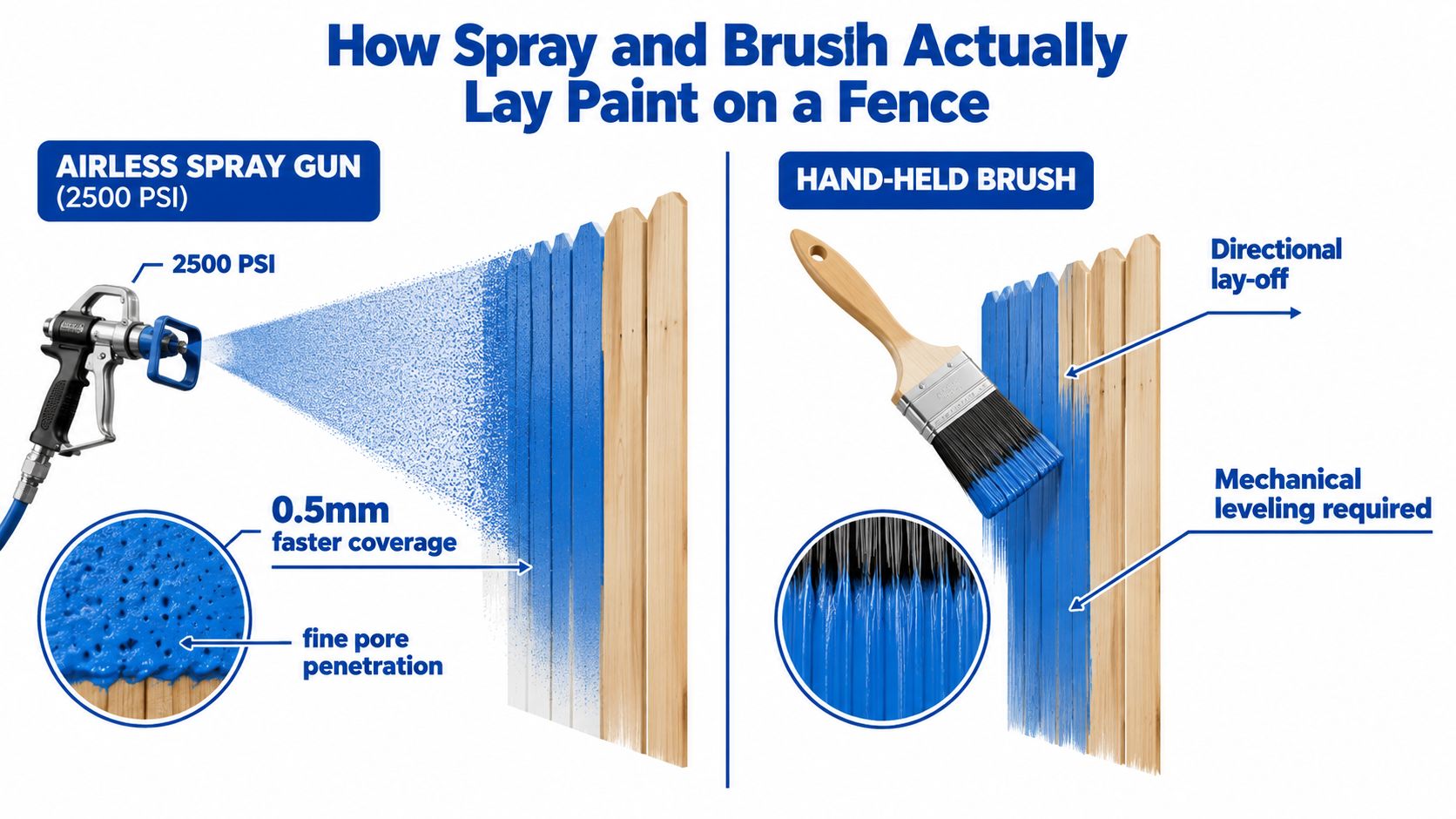
How Spray and Brush Actually Lay Paint on a Fence
An airless sprayer pumps coating through a small tip at high pressure and breaks it into a controlled fan of droplets. The operator moves the gun steadily across the fence, overlapping each pass so the film doesn't become visibly striped or thin. This process covers repetitive boards efficiently, but it also creates airborne mist that must be managed.
A brush and roller apply a wet film through direct contact. The brush works coating into grain, knots, corners, joints, and end grain, while a roller can distribute material across broader faces. The operator can alter pressure immediately when the timber changes from smooth to porous, which makes manual application particularly useful on weathered or irregular boards.
Spray needs control, not just speed
The spray fan should remain consistent, and the gun shouldn't pause over one board. Resene's guidance recommends a 50% overlap on each pass, along with steady, slow movement. It also warns that wind can cause overspray, a particularly important consideration on exposed coastal properties.
Spraying can lay coating across the surface quickly, but rough-sawn timber may absorb it unevenly. A painter may therefore spray a manageable area and immediately back-brush or back-roll it. This action works the coating into the profile and helps prevent dry-looking hollows, missed joints, and weak coverage around knots.
Dulux NZ's Timbacryl information shows why product instructions matter. It specifies a high-quality synthetic filament brush, a 10 to 12 mm synthetic roller, or an airless spray setup using a 15 to 17 thou tip at 1500 to 2000 psi, as set out in the Dulux NZ Timbacryl technical information. The correct tool and settings depend on the product, so a contractor shouldn't treat every exterior coating as interchangeable.
Brush work builds control into the process
A brush doesn't create a cloud of droplets, so the operator can work closer to gates, plants, walls, and neighbouring surfaces. It also allows immediate attention to end grain, board edges, screw holes, and places where the fence profile changes.
That control comes with a labour cost. Every board, joint, and picket requires physical contact, and a roller may struggle to reach narrow gaps or uneven grain. For homeowners comparing methods, the important distinction is that spray is not automatically a complete system. On porous timber, the most reliable result often comes from spray application followed by mechanical working-in.
For practical guidance on difficult gaps and fence profiles, see this guide to spray painting a fence with gaps.
Spray vs Brush on Speed, Finish, and Durability
Spray wins the raw-speed contest on long, repetitive paling runs. A New Zealand trade source reports that spray painting can be about two to three times faster than brushing on paling fences, while its example of a 10 metre section compares roughly 30 minutes by spray with two to three hours by brush. Those figures come from New Zealand fence painting cost guidance, and they describe application speed, not the complete job from preparation to clean-up.
Masking changes the calculation. Gardens, paving, cars, neighbouring walls, and the other side of the boundary may all need protection. If the site is windy, the crew may need more containment, slower passes, or a change to brush and roller. A brush takes longer to cover boards but avoids most airborne coating, so less time goes into protecting everything around the fence.
| Criterion | Spray | Brush |
|---|---|---|
| Surface preparation | Still requires cleaning, repairs, and dry timber | Same preparation requirement |
| Application speed | Strong advantage on long, repetitive runs | Slower across broad areas |
| Finish quality | Uniform when controlled, but can look thin on porous timber | Strong control over edges, gaps, and film build |
| Material usage | Resene advises about 20% more paint than brushing because of overspray and atomisation losses | More efficient use of coating |
| Cost per metre | Can reduce application labour, but masking and waste add cost | More labour, less masking and waste |
| Coastal durability | Depends on adequate film build and back-brushing where needed | Good control on rough timber and vulnerable details |
| Best fit | Open, accessible fences with manageable overspray risk | Detailed, tight, windy, or high-visibility sites |
Finish quality depends on film build
The common mistake is to judge a sprayed fence immediately after the pass. The surface may look evenly coloured while the coating has not properly wetted rough grain, knots, gaps, or end grain. That matters because exposed end grain can draw in moisture and contribute to later cracking or timber deterioration.
Back-brushing changes the result. It pushes wet coating into the irregular surface instead of leaving it sitting mainly on the high points. On a weathered paling fence, this hybrid method often provides the best balance between production speed and substrate coverage.
Brush application has its own failure mode. An inexperienced applicator may spread the coating too thin to make it travel further, leave visible brush marks, or miss the back edges of boards. Manual control only helps when the painter applies enough material and works systematically across the fence.
Coastal exposure raises the standard
A fence near the Waitematā Harbour or an exposed beachside road may face salt, moisture, wind, and intense sunlight. A thin or uneven film can deteriorate sooner, whether it was sprayed or brushed. Local guidance also warns that spraying in coastal areas can be risky when salt and moisture affect adhesion, which makes dry conditions and thorough preparation central to the result. Kiwi Painting Tips discusses spray and roller choices for NZ fence conditions.
The practical conclusion is clear. Spray is a productivity method, not a durability guarantee. Durability comes from a clean and sound substrate, suitable coating, adequate film build, attention to end grain, and application in suitable weather.
Matching the Method to Common North Shore Fences
The same crew may use different tools on one property. A boundary fence, a picket gate, and a steel side panel don't present the same surface, even when the owner wants one colour throughout.
Long standard paling runs
A straight paling fence with consistent board spacing is the natural spray candidate. The repetitive profile allows the operator to maintain a steady fan and work in logical sections. If access is open on the spray side and nearby surfaces can be protected, airless application usually gives the strongest productivity benefit.
The operator still needs to check the reverse side, posts, cap rails, and board ends. Spraying only the broad face can leave the vulnerable details undercoated. A light back-brush on absorbent areas is more useful than applying another fast pass that merely builds colour on the surface.
Rough-sawn and treated pine
Rough-sawn timber often looks like an ideal spray surface because it covers quickly, but its texture makes technique more important. The grain, knots, and gaps can take coating unevenly, particularly when the boards have aged or dried out.
For this fence, the practical choice is usually spray plus back-brush or back-roll. The sprayer distributes material across the profile, then the brush works it into the texture. A brush-only approach remains suitable where access is restricted or the section is too small to justify spray setup.
Decorative pickets and detailed rails
Pointed pickets, caps, rails, returns, and gate hardware create many edges where a spray fan can create runs or overspray. Masking each adjoining surface can take away the time saved during application.
A quality brush, supported by a small roller on broader faces, gives better control. The painter can follow the profile, coat the cut ends, and keep the finish tidy around hinges and latches. This is especially important where the fence forms part of the home's street presentation.
Steel gates and Colorsteel panels
Flat steel panels can accept a sprayed finish when the product and preparation system are suitable. Spray helps produce an even appearance across broad faces, while a brush remains useful for welds, joins, fasteners, and small repairs.
The surface still needs correct cleaning and preparation. A sprayer won't hide corrosion, loose coating, grease, or poorly prepared joins. On a mixed fence, the most efficient approach may be spray for the open metal panels and brush touch-up for the details.
| Fence type | Best method | Why it works |
|---|---|---|
| Standard paling boundary | Airless spray | Repetitive boards allow fast, consistent coverage |
| Rough-sawn or weathered timber | Spray plus back-brush | Combines broad coverage with penetration into texture |
| Decorative picket fence | Brush and small roller | Gives control around points, rails, caps, and gates |
| Steel gate or flat metal panel | Spray with brush touch-up | Produces an even face while allowing detail work at joins |
What Resene, Dulux, and British Paints Recommend
Manufacturer guidance points to a site decision, not a universal winner. Match the coating and application tool to the surface, then follow the product instructions for preparation, application, thinning, and recoating. A sprayer cannot compensate for damp timber, loose paint, poor preparation, or unsuitable weather.
Resene's fence guidance supports spraying broad, accessible surfaces, provided the operator uses overlapping passes, controlled movement, and suitable wind conditions. Coastal wind on the North Shore can carry fine droplets onto paving, cars, planting, and neighbouring property. Masking and containment may remove much of the time gained on application. Spray pays off most on long, open runs where those controls are practical.
Dulux NZ gives a technical example through Timbacryl. Its instructions set out separate brush, roller, and spray options, including the relevant roller size, spray tip range, and pressure range. That detail matters because equipment settings are product-specific. The data sheet should determine whether the coating is ready to use, requires thinning, or needs a particular interval before recoating.
Turn the guidance into a site decision
Assess the fence and its surroundings before choosing the applicator:
- Choose spray for long, repetitive faces with straightforward access and safe masking space.
- Choose brush or roller for pickets, rails, narrow returns, gates, hinges, and high-visibility edges.
- Choose spray plus back-brush for rough-sawn, porous, weathered, or knotty timber. Back-brushing works the coating into the profile instead of leaving a thin layer over the high points.
- Follow the product data sheet for tip size, pressure, roller type, thinning requirements, drying time, and recoat conditions.
British Paints guidance reinforces the need to judge coverage by product and timber condition. Coverage can vary with porosity and application method. One product lists up to 10 square metres, while another lists 6 to 8 square metres, as described in British Paints NZ fence painting guidance. These are product-specific figures, not a promise for every fence.
Avoid the shortcut that causes thin coating
Over-thinning can make paint easier to spray while reducing the film left on the timber. Use the manufacturer's instructions, test the spray pattern, and check that the coating wets the surface rather than arriving as a dry, dusty mist.
For a North Shore fence, the practical order is preparation, suitable weather, and adequate coating thickness. The method comes after those requirements. Further guidance on exterior coating systems is available in this Resene exterior paints guide.
Cost per Metre in Coastal Conditions
A spray job can cover an open fence quickly, but the installed cost depends on everything around the spray pass. A narrow boundary beside gardens, paving, vehicles, or a neighbour's house may need more protection than a longer run with clear access. Timber porosity, repairs, the number of coats, access from both sides, and the required finish also affect the final price.
Spraying can reduce repetitive application labour on broad, straight sections. It can also increase coating use and preparation time. Resene guidance treats higher paint consumption as a planning consideration for spraying compared with brushing, so a faster application does not automatically produce the lower-cost job. On porous or weathered timber, the quote may also need to allow for back-brushing or back-rolling.
| Cost item | Spray | Brush or roller |
|---|---|---|
| Coating consumption | Often higher, particularly where overspray or back-brushing is involved | Usually less material loss |
| Application labour | Lower on long, open runs | Higher across broad repetitive fences |
| Masking | Can be substantial around gardens, paving, vehicles, and neighbours | Usually more limited |
| Back-brushing | May be required on rough or porous timber | Included in the application |
| Wind management | Can add containment, delays, or a change of method | Less affected by airborne overspray |
| Rework risk | Missed edges, thin areas, and overspray can add work | More labour, but immediate control |
| Best cost fit | Large fence with clear access | Small, detailed, or enclosed fence |
Site protection changes the price
A spray quotation should include more than time holding the gun. The crew may need plastic, drop sheets, tape, temporary barriers, and careful protection for plants and neighbouring property. Strong coastal winds can require extra containment or make spraying unsuitable for part of the boundary. Removing protection takes time as well, while overspray on paving, cladding, or vehicles can create cleaning and repair costs.
These details matter on North Shore properties where fences often sit close to driveways, established planting, homes, and shared boundaries. A brush or roller may take longer on the timber but reduce setup and cleanup when the work area is tight.
Compare the complete scope
A brush quote can appear higher because it includes more application labour. A spray quote can appear lower because the fence face is covered quickly. Compare the full work scope instead:
- Preparation and cleaning.
- Repairs and treatment of failing timber.
- Masking and protection.
- Coating volume and likely waste.
- Back-brushing or back-rolling where required.
- Touch-ups and cleanup.
- Access from each side of the boundary.
Ask whether the price includes both sides where required, end-grain coverage, masking, cleanup, and the specified number of coats. Also ask what happens if wind prevents safe spraying on the booked day. Fence painting services in Auckland can then be compared by the work included, rather than by the equipment used or the quickest initial application.
The practical measure is cost per finished metre, not cost per pass. A method that needs less masking, produces fewer touch-ups, and leaves the required film thickness may cost less overall, even if it takes longer to apply.
Which Method Painters North Shore Would Choose
The practical verdict is situational. For a long, straight paling run with good access and manageable masking, an airless sprayer is usually the sensible starting point. It reduces repetitive application time and can produce a consistent appearance across broad faces.
For rough-sawn or weathered timber, the preferred system is generally spray followed by back-brushing or back-rolling. The spray places coating into the profile quickly, while the manual pass works it into grain, gaps, knots, and end grain. Spray alone is not the method to choose when the timber is absorbent and the coating needs help reaching the surface properly.
A brush and roller remain the better choice for detailed pickets, small repairs, narrow side passages, and fences close to delicate gardens or neighbouring buildings. They also make sense when the weather is unsettled and a spray plume can't be controlled safely.
Conditions that change the recommendation
Salt-laden locations near the harbour or beaches deserve a conservative approach. The coating needs to adhere to a properly prepared surface, and rough timber needs sufficient film build rather than a quick cosmetic mist. Windy sections near the Waitematā can also make spray containment impractical, particularly where neighbours' homes, vehicles, or established gardens sit close to the boundary.
Heritage character areas create another challenge. Picket profiles, decorative rails, older timber, and close property lines favour accuracy over production speed. A painter may still spray selected broad sections, but brush application often gives better control around the features people notice most.
The decision rule
Use spray for a long run with good access. Use brush for complex detail, a tight boundary, or a windy day. Use spray plus back-brush when rough or weathered timber needs both productivity and proper penetration.
The method should be selected after an on-site inspection, not copied from a neighbour's project. Painters North Shore provides preparation-led exterior work, including fence painting, staining, and spray application, with the coating method matched to the fence and surrounding site. The crew's assessment should identify surface condition, access, masking requirements, and the finish standard before the quote is accepted.
A fence inspection is the quickest way to resolve the spray-versus-brush question accurately. If you're on the North Shore, Painters North Shore can assess the timber, recommend the appropriate application method, and quote for the preparation, masking, coating, and finishing work rather than just the visible spray time.