Low-VOC paint is a useful first step in reducing indoor solvent emissions, but it isn't a magic solution for air quality. New Zealanders spend approximately 75–90% of their time indoors, so the practical result depends on pairing lower-emission paint with good ventilation and enough curing time.
The situation is familiar across Auckland's North Shore. A family finishes repainting a bedroom, opens the door, notices the clean new colour and assumes the job is complete. The room may look ready, but that noticeable paint smell means substances are still escaping into the air. For a nursery, living room, rental turnover or home office, the sensible question isn't just whether the paint says “low VOC”. It's whether the whole repainting process reduces exposure before people move back in.
Why Low VOC Paint Matters for Your Home
A freshly painted North Shore bedroom can look finished long before it's ready for normal use. A child may want to sleep in it that night, or an older family member may need to use the room while the rest of the house is being renovated. The strong smell isn't the VOC itself, but it can signal that volatile ingredients are evaporating from the coating as it dries.
New Zealand Building Performance guidance identifies paint as a contributor to indoor volatile organic compounds, or VOCs. These chemicals become airborne at room temperature and can be inhaled. Because people spend approximately 75–90% of their time indoors, reducing emissions in occupied rooms is a practical indoor-air-quality measure, not just an environmental preference. New Zealand Building Performance guidance also notes that infants and older people often spend even more time inside.

Source reduction rather than a promise of zero emissions
Low VOC doesn't mean VOC-free. It means the product is formulated to release fewer volatile solvents than a higher-solvent alternative, usually by using water as the main solvent and limiting hydrocarbon content. Water-based acrylic paint can still contain VOCs, additives and other ingredients that off-gas during drying and curing.
That distinction matters for families. Choosing a lower-emission coating reduces the quantity of solvent available to enter the room air, while ventilation removes what does escape. Neither measure replaces the other. A low-VOC product applied in a sealed bedroom can still create an unpleasant indoor environment, just as strong ventilation can't make a high-solvent product behave like a low-emission coating.
Practical rule: Choose the lower-emission product first, then plan airflow and re-entry around the manufacturer's instructions.
For a typical interior repaint, product selection should also sit alongside proper preparation and application. Washing, sanding, filling and priming help the new coating bond to the surface, which reduces avoidable recoats and touch-ups. Homeowners arranging interior wall painting on the North Shore should ask what product system will be used, how long the rooms need to ventilate and when normal occupancy can resume.
The benefit is straightforward. A family gets a durable finish while reducing the solvent load released into rooms where people sleep, play and work. The result isn't a chemical-free home. It's a more controlled and sensible approach to indoor air.
What Are VOCs and How Do They Escape Paint?
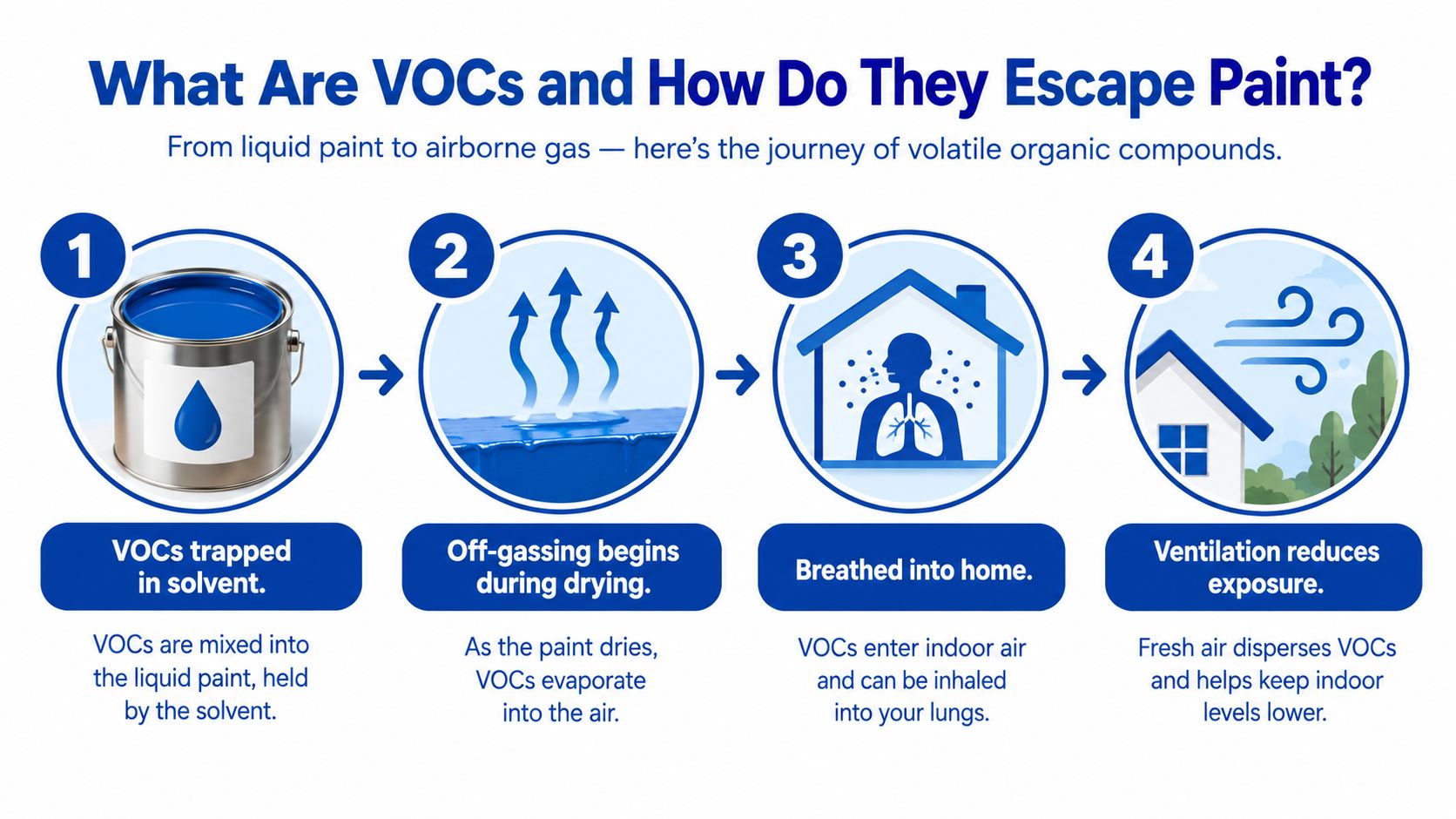
Volatile organic compounds are carbon-based chemicals that can evaporate into the air under normal indoor conditions. In paint, some VOCs act as solvents. They keep the coating workable in the tin, help it spread across the wall and then leave the film as the paint dries.
A simple comparison is water evaporating from a hot pan. The water starts as a liquid, turns into vapour and disperses into the surrounding air. Paint solvents follow a similar path, although the timing and quantity depend on the formulation, the room conditions and the coating thickness.
What happens after the tin is opened
With a solvent-based enamel or varnish, hydrocarbons and other solvents can make a substantial contribution to the vapours released during application and drying. Water-based paint uses water as its main solvent, so it generally produces lower solvent emissions. That doesn't make every water-based product identical, and it doesn't prove that a label claiming “water-based” is VOC-free.
New Zealand guidance specifically recommends checking the product label for VOC concentration or hydrocarbon-solvent content. The MBIE guidance on materials inside the home advises renovators to select products that use water as the solvent and are classified as low or zero VOC, while warning that water-based acrylics can still contain VOCs.
The useful distinction is between VOC content and actual emissions:
- VOC content describes the volatile material present in the ready-to-use product.
- Emissions describe what the coating releases into the air during application, drying and curing.
- Re-entry conditions determine how much exposure occupants may face after the work is complete.
Those measures overlap, but they aren't interchangeable. A paint with low VOC content can still release measurable emissions from other ingredients. A room with poor airflow can also retain vapours for longer than a room with effective cross-ventilation.
Why application conditions matter
Temperature, humidity, coating thickness and airflow all influence how a painted surface dries. Applying heavy coats, closing every window or placing furniture hard against a wet wall can slow drying and extend the period when the room smells strongly.
Preparation matters too. Dust, grease, chalking paint or an unsealed repair can force a painter to apply extra coats. More product on the wall means more material has to dry. A careful surface assessment, suitable primer and controlled application help the coating form the intended film without unnecessary rework.
A homeowner who wants additional air-cleaning support can also browse VOC air purifiers for options designed to address airborne pollutants. An air purifier is a supplement, not a substitute for low-emission product selection, fresh-air ventilation and the cure time specified by the manufacturer.
The practical sequence is simple: select the coating by its technical information, apply it to a properly prepared surface and keep air moving while it dries. That approach works better than relying on a prominent marketing phrase on the front of the tin.
The Health and Environmental Impact of Low VOC Paints
A freshly painted bedroom can smell strong enough to keep a family out of the house. That odour usually reflects volatile material evaporating from the coating, particularly where a higher-solvent product has been used. Selecting a lower-emission paint reduces the amount of volatile material available to enter the indoor air during application and curing.
The distinction between VOC content and actual emissions matters. A low VOC figure describes the amount present in the product, while emissions depend on the formulation, tint, application rate, drying conditions and curing time. Low VOC paint can reduce exposure, but it does not guarantee zero emissions or an odour-free room.
New Zealand Building Performance guidance recognises paint as an indoor VOC source. The practical response is to reduce the source at the product level, ventilate the room during curing and delay re-entry until the manufacturer's guidance is met.
The indoor benefit is mainly exposure management
A bedroom, nursery or living area has a different exposure pattern from an empty workshop because people spend longer periods there. Risk increases when a room is painted, sealed with windows and doors closed, and occupied again while the coating is still releasing vapours.
Low- or no-VOC coatings can reduce solvent vapours during the post-painting period, especially when the product is applied correctly and the room has effective air exchange. The result should be practical: less intense odour, less contact with evaporating solvents and a more comfortable space once the recommended curing period has passed.
Product choice still requires care. Formulations vary, and some occupants react to odours or ingredients that a simple VOC figure does not describe. Anyone with a known sensitivity should review the technical data, safety information and re-entry guidance with the painter before work begins.
For an occupied home, guidance on clearing VOCs after painting offers further context on residual odours and airborne emissions. Air cleaners may provide additional support, but they do not replace lower-emission product selection, outdoor-air ventilation or the manufacturer's cure time.
A dry surface is not necessarily a fully cured coating. The family should return only after the specified guidance has been met, particularly if someone is sensitive to odours or respiratory irritants.
Auckland's wider emissions picture
Paint also contributes to outdoor air pollution. Auckland's historical emissions inventory estimated total regional VOC emissions at approximately 65,000 tonnes in 1993. Domestic and commercial surface-coating operations accounted for 3.7%, while industrial coating operations contributed 5.3%. Together, coating activities represented about 9.0%, or approximately 5,850 tonnes when those percentages are applied to the total. The Auckland VOC emissions inventory also attributed 63% to motor vehicles and 13% to domestic solid-fuel combustion.
Those figures place paint in context. Coating work was not Auckland's dominant VOC source, but it was a measurable contributor. Emissions can occur during mixing, application, drying and curing, so the environmental effect extends beyond the time a painter is using a roller or brush.
Why repeated repainting choices matter
A single household repaint will not transform Auckland's air. Residential, commercial and industrial properties are painted repeatedly, however, and each project provides an opportunity to replace a higher-solvent system with a lower-emission option.
For a North Shore homeowner, the environmental gain starts with a clear specification. Ask the painter to identify the ready-to-use coating, confirm its VOC content and solvent type, and state the ventilation and re-entry requirements. Choose a water-based or low-emission product where the substrate and finish requirements allow it, estimate quantities accurately, and dispose of leftover materials responsibly.
The indoor benefit reaches the family immediately. The regional benefit builds across many painting projects. Low VOC paint works as one part of the control plan, alongside sensible scheduling, ventilation and careful application.
Decoding New Zealand Paint Labels and Certifications
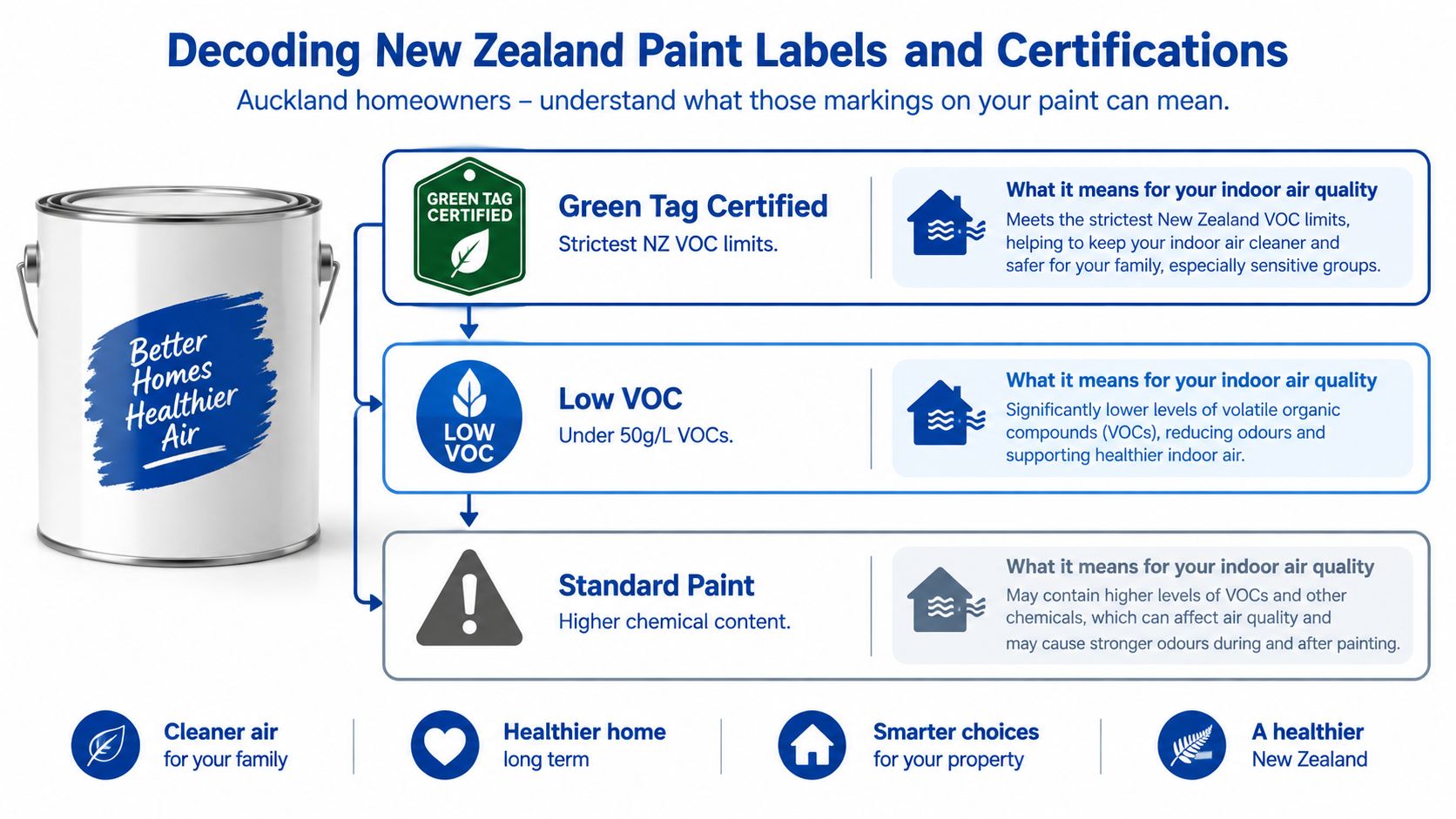
Paint packaging often makes the decision appear easier than it is. Words such as “eco”, “green”, “low odour” and “water-based” can be useful clues, but they don't provide enough information to compare products accurately. The technical data sheet is more reliable than the front of the tin.
Start with the ready-to-use product, not the base paint before tinting or any mixture created on site. Ask for the VOC content, the solvent type and any available emissions testing. If a painter can't explain what the label means in practical terms, ask for the manufacturer's product documentation before approving the specification.
The local benchmark homeowners can verify
Environmental Choice Aotearoa provides a measurable New Zealand reference point. Paints carrying the label must contain no more than 20% hydrocarbon solvents by weight, according to New Zealand Building Performance guidance.
That limit doesn't mean the product has no emissions. It does give a homeowner a defined benchmark for selecting a lower-solvent coating instead of relying only on colour cards or broad environmental language.
What to ask for before approving the paint
Use this checklist when comparing Resene, Dulux or another product available in New Zealand:
- Ready-to-use VOC content: Ask for the figure after the product has been prepared for application, including any stated tinting or mixing conditions.
- Solvent information: Confirm whether the coating is water-based or solvent-based and ask what hydrocarbon solvents remain.
- Certification: Check whether the exact product, not merely the brand range, carries Environmental Choice Aotearoa or another relevant certification.
- Emissions testing: Request low-emission test results where available, because VOC content and total chemical emissions measure different things.
- Re-entry guidance: Ask when bedrooms, nurseries, offices or shared areas can be occupied under the manufacturer's instructions.
- Finish requirements: Confirm that the selected product suits the surface, sheen, washability requirements and expected wear.
Terms such as “low odour” deserve careful handling. Odour is something people detect, while VOC content is a technical property. A product can smell mild and still contain ingredients that require ventilation, or smell noticeable while releasing a relatively limited amount of solvent.
A written specification prevents confusion between the product shown in the quote and the product finally applied. For homeowners wanting a more environmentally considered system, environmentally friendly paint options can be discussed alongside substrate preparation, finish and room-use requirements. The right choice must still perform on the wall.
Low VOC vs Standard Paint and Performance Comparison
The old assumption that lower-emission paint must be weak, difficult to apply or unsuitable for busy homes no longer reflects every modern product. Water-based acrylic systems can provide attractive coverage, practical washability and straightforward clean-up, while solvent-based coatings still have a place where their specific hardness, flow or substrate performance is required.
The decision should be based on the complete system, including primer, topcoat, surface condition and room use. A low-VOC wall paint intended for a living room isn't automatically the right product for a high-wear door, timber trim or specialist exterior surface.
| Feature | Standard Solvent-Based Paint | Low VOC Water-Based Paint |
|---|---|---|
| Odour during application | Usually more noticeable because of solvent content | Generally less pronounced, although the product isn't necessarily odour-free |
| Drying and curing | Can continue releasing solvent vapours after application | Often releases less solvent, but still needs ventilation and cure time |
| Clean-up | Commonly requires the specified solvent or cleaner | Often allows water-based clean-up, subject to the product instructions |
| Interior wall suitability | May be unnecessary for many occupied interior rooms | Often a practical choice for walls and ceilings when compatible with the surface |
| Durability | Can perform strongly in selected high-wear applications | Modern systems can provide durable finishes when correctly specified and applied |
| Application | May offer useful flow or hardness for particular trim systems | Can be convenient for interior work, but surface preparation remains critical |
| Cost | Varies by formulation and application | Varies by product grade, coverage and the number of coats required |
Where the trade-offs appear
Some premium low-VOC products may require an additional coat or a longer period before full hardness develops. That isn't a reason to reject them, but it should be included in the programme and quote. A cheaper tin can become the more expensive option if it provides poor coverage, fails to hide repairs or needs early touch-ups.
A low-emission coating also doesn't correct a failing substrate. Flaking paint, dampness, grease or movement in a repair must be dealt with first. Applying a supposedly healthier product over an unstable surface won't produce a durable or healthy result.
A useful comparison: Evaluate the paint by its finished system, not by the label alone. The best product is the one that meets the room's emission, appearance, durability and maintenance requirements together.
For most occupied interior spaces, the sensible choice is to specify a compatible low-VOC water-based system, confirm its performance data and have it applied to a properly prepared surface. For trims, cabinetry or demanding areas, the painter may recommend a different coating after assessing the substrate. Lower VOC remains an important criterion, but it shouldn't override technical suitability.
How to Specify and Apply Low VOC Paint Successfully
Buying a low-VOC tin is only one part of the job. The painter's preparation, application method, ventilation plan and re-entry advice determine how much benefit the household receives.
Start with a written specification. It should identify the rooms, surfaces, primer, topcoat, sheen, colour, VOC information and manufacturer's re-entry guidance. If the project includes a nursery, bedroom, rental turnover or commercial space, state that occupancy timing matters before the quote is accepted.
A practical North Shore specification checklist
Identify the room use. Tell the painter whether the space is a bedroom, childcare area, living room, office, retail space or common area. Occupancy changes the ventilation and scheduling requirements.
Request the product data. Ask for ready-to-use VOC content, solvent information, certification details and low-emission test results where available. Don't rely on “water-based” as proof that the product is VOC-free.
Confirm the surface system. A painter should assess the existing coating, repairs, stains, gloss level and substrate before choosing primer and topcoat. The system must adhere properly and withstand the room's cleaning demands.
Plan preparation before colour selection. Washing, sanding, filling and priming remove the causes of uneven coverage and premature failure. Homeowners can review practical steps for preparing walls for painting before the crew arrives.
Set the airflow plan. Use cross-ventilation where safe, keep suitable mechanical ventilation operating and avoid closing the room immediately after application. Don't direct fans in a way that blows dust onto wet paint or creates unsafe conditions.
Agree on re-entry. Follow the manufacturer's instructions rather than using smell alone as the test. New Zealand guidance for commercial interiors recommends completing painting at least two days before occupancy and flushing the building with open windows or operating ventilation for two days, as described in MBIE's painting and decorating guidance.
The same principle applies to homes, although the exact timing depends on the product, room conditions and the manufacturer's instructions. A room can feel dry while the coating continues curing. Keep children, older occupants and pets away until the agreed re-entry point, particularly where ventilation is limited.
Preparation-led contractors, including Painters North Shore, can assess the substrate and specify low-VOC options for residential, rental and small commercial repaints. The useful question isn't “Do you use healthy paint?” Ask which product system is proposed, what the technical data says, how the room will be ventilated and when people can safely return.
Painters North Shore provides interior and commercial repainting with surface preparation, product specification and low-VOC coating options suited to the room and substrate. Visit Painters North Shore to arrange a North Shore assessment and discuss a repainting plan that combines lower-emission paint, proper preparation and realistic ventilation time.