A family in Browns Bay has just reached the point where repainting can't wait. The children are back at school, trestles are set up on the deck, one parent is working from a back bedroom, and the other is keeping a close eye on a baby who'll soon be crawling across freshly painted skirting. They want less chemical smell indoors, but they also need a finish that will survive family life and Auckland weather.
That's the core question behind environmental friendly paint. It isn't just whether a tin carries a green label. The practical decision includes VOC emissions, primer compatibility, surface preparation, coastal exposure, cure time, cleaning, and what happens to leftover paint. A low-emission coating applied to a poorly prepared salty weatherboard can still fail early. A well-prepared waterborne system can deliver a clean-looking, durable finish without relying on high-solvent products.
Why More North Shore Homes Are Switching to Environmental Friendly Paint
North Shore homeowners are asking for lower-odour products earlier in the conversation than they used to. The request often comes from a bedroom repaint, a nursery, a home office, or a rental property that needs to be ready for new tenants without leaving a strong paint smell behind.
A waterborne acrylic system is now a practical first option for many interior walls. It generally gives decorators an easier working environment than a solvent-heavy coating, while modern products can still provide a consistent sheen and a washable surface when the right grade is selected. That doesn't mean every waterborne paint behaves identically, or that ventilation can be ignored.
The local conditions change the decision
Auckland's damp coastal climate makes timing important. High humidity can slow drying and extend the period between coats, particularly in bathrooms, shaded rooms, and houses with limited airflow. On exterior work, salt deposits, wind-driven moisture, UV exposure, and changing weather can place more pressure on the complete paint system than the topcoat label suggests.
Indoor air quality is another reason families are paying attention. New-build owners and renovators commonly want to reduce solvent exposure in rooms that are occupied soon after painting. People may report that a bedroom feels more comfortable sooner after a low-odour product is applied, but odour alone doesn't prove that a paint has the lowest emissions. The specification and final tinted product still matter.
Practical rule: Choose the coating for the room and substrate first, then use the lowest-emission system that can handle the cleaning, moisture, movement, and exposure involved.
Property managers face a similar balance. A low-odour interior system can make a turnover less disruptive, but a cheap coating that marks easily creates extra maintenance. For a family home, the sensible approach is usually a low-VOC wall finish, compatible primer where required, controlled ventilation, and enough time for the coating to cure before the room is closed up.
What Environmental Friendly and Low-VOC Paint Mean
Environmental friendly paint describes a coating intended to reduce environmental or health impacts across its life cycle. That can include solvent emissions, hazardous ingredients, manufacturing, application, and disposal. Low-VOC paint addresses a narrower issue, the volatile organic compounds released while the coating is applied and cures.
For a North Shore job, the useful question is not whether the label sounds green. Check the specification for the complete system, including primer, sealer, colourant, stain, and varnish. Eco Choice Aotearoa's New Zealand criteria set maximum VOC limits by product type. Current limits include 50 g/L for low-sheen interior and exterior paints and flat paints, 60 g/L for semi-gloss paints, 65 g/L for gloss paints, and 85 g/L for stains and varnishes. Several primers and sealers fall within a 45–50 g/L range, while tinters are limited to 5 g/L, according to New Zealand's building guidance on environmentally preferable painting products.
These figures apply to more than the base wall coating. On exterior work, the primer and topcoat must also suit salt air, UV exposure, weather movement, and the substrate. A low-VOC product is not a substitute for removing chalk, treating mould, repairing failed sealant, or allowing damp surfaces to dry before painting.
Building guidance also states that paint carrying the Eco Choice Aotearoa label must contain no more than 20% hydrocarbon solvents by weight. That supports the shift away from high-solvent formulations, while still leaving performance and preparation as separate decisions.
Read the label beyond “zero VOC”
“Zero VOC” may describe an untinted base. The finished colour can change after tinting, so ask for VOC information for the tinted product, not only the white base. Low odour can make occupied rooms more comfortable, but it does not verify the lowest emissions.
Natural ingredients need the same care. Plant oils, casein, and mineral ingredients may suit particular finishes, yet natural origin does not guarantee zero emissions, zero sensitivity, or reliable exterior hold-out. Product data sheets and safety documentation give a sounder basis for comparison. If indoor pollutants are a concern, VOC air purifiers can provide another layer of support during and after the work, but they do not replace ventilation or responsible product selection.
| Paint type | Eco Choice limit | Green Label Plus | Typical conventional |
|---|---|---|---|
| Low-sheen or flat paint | 50 g/L | Refer to Green Label Plus published VOC limits | Varies by product |
| Semi-gloss paint | 60 g/L | Refer to the published limits for the specific product | Varies by product |
| Gloss paint | 65 g/L | Confirm the product's Green Label Plus emissions data | Varies by product |
| Stains and varnishes | 85 g/L | Check the applicable Green Label Plus criteria | Varies by product |
| Primers and sealers | 45–50 g/L for several categories | Verify the individual product certification and limits | Varies by product |
For bedrooms, nurseries, and rentals, choose a documented low-emission system, plan ventilation, and allow realistic curing time before reoccupation. A certification narrows the choices. It cannot correct a damp surface, incompatible primer, poor preparation, or early disposal of leftover paint.
NZ Certifications and Eco Paint Types Worth Knowing
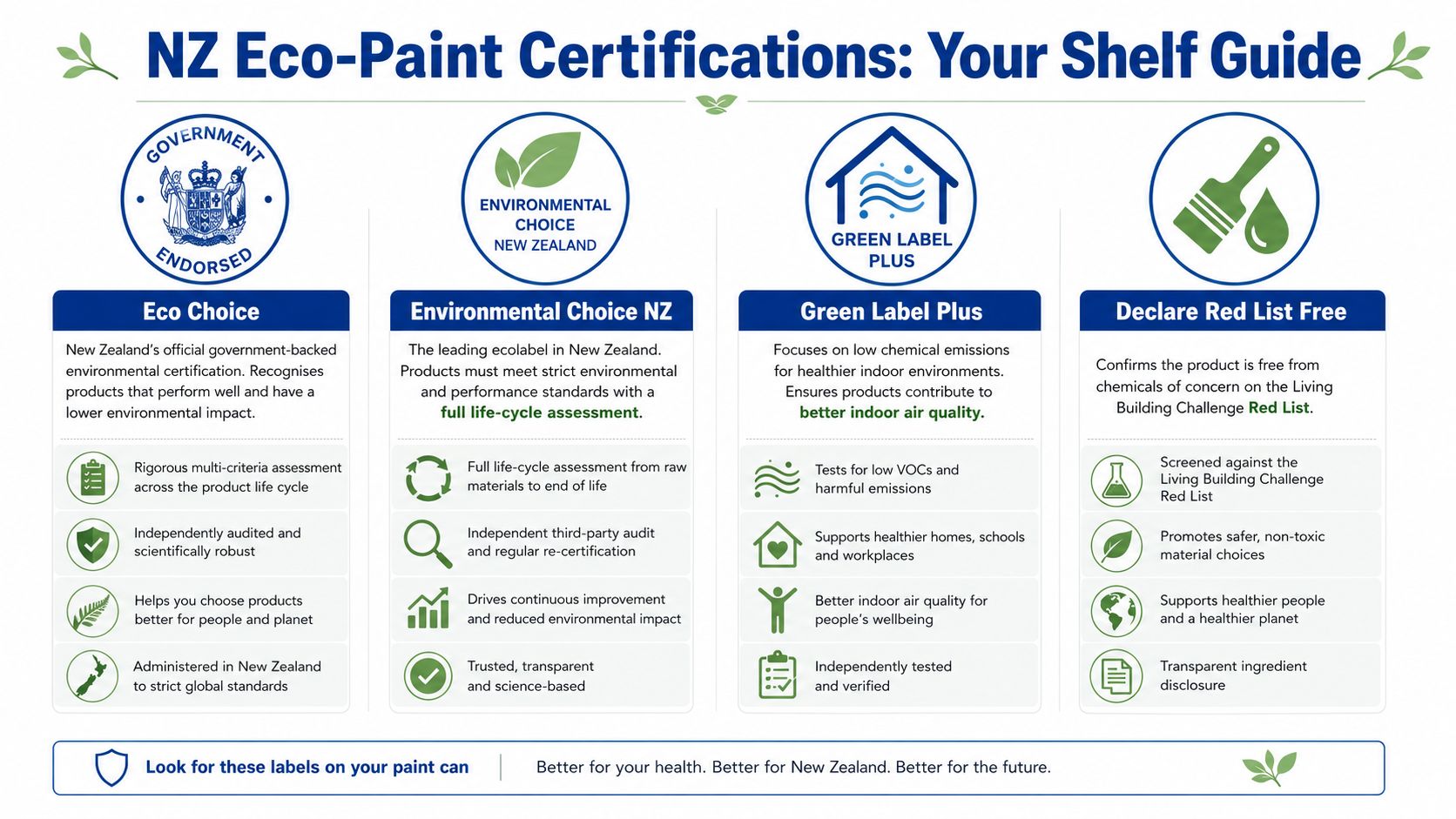
Labels answer different questions, so they shouldn't be treated as interchangeable. Eco Choice Aotearoa is valuable when you want an environmental specification covering product impacts and defined VOC limits. The current criteria include 50 g/L for low-sheen and flat paints, 60 g/L for semi-gloss, 65 g/L for gloss, and 50 g/L for exterior timber primer and latex undercoat, as set out in the Eco Choice Aotearoa paint criteria.
Green Label Plus is generally used as an indoor-air emissions reference, particularly on imported products. It can help compare emissions from coatings intended for interior environments, but homeowners should still confirm the New Zealand product data, tint, finish, and substrate recommendations. APAS appears on some Australian or imported lines and is more closely associated with product performance and suitability than with the full environmental scope of Eco Choice Aotearoa. Declare and Red List Free disclosures focus on ingredient transparency. They can reveal what a product contains or excludes, but they don't automatically promise scrub resistance, weather hold-out, or easy application.
Match the coating family to the building
Waterborne acrylic is the everyday workhorse. It suits most interior walls, ceilings, trims, and many exterior applications when the manufacturer specifies the system. It dries with less solvent odour than traditional solventborne products, but it still needs adequate airflow and correct recoat timing.
Natural or plant-based finishes can be attractive on joinery, furniture, and feature surfaces where a softer, more tactile appearance is wanted. They may cure more slowly and can require gentler cleaning, so they're not automatically the best choice for a busy hallway or rental kitchen.
Mineral silicate paint is a strong option for compatible masonry, solid plaster, and some heritage surfaces because it can preserve a more breathable finish. It isn't a universal timber product. Flexible weatherboards and moving joinery need a coating designed to tolerate movement.
Ultra-low or zero-VOC emulsions can suit nurseries, bedrooms, and quick interior turnovers, provided the final colour and product documentation support the claim. The right question isn't “Which label is greenest?” It's “Which verified label and coating family fit this surface and use?”
How Eco Paints Compare to Conventional Options in Real Use
The old assumption that environmentally friendlier paint must be fragile no longer reflects every modern waterborne product. On interior walls, a good acrylic can provide a clean finish and practical washability, particularly when the surface is sound and the film build is correct. Solventborne enamels can still have a role where flow, hardness, or a particular joinery specification demands them, but they bring a different odour and solvent profile.
Exterior work is more conditional. Premium waterborne acrylics can perform well on weatherboard and cedar when the timber is dry, the salt is removed, the primer is compatible, and the exposed edges are properly coated. Mineral silicate products can outperform standard film-forming paint on suitable masonry because they bond differently and allow vapour movement, but they're a poor choice for flexible timber that expands and contracts.
The trade-offs show up during the job
Low-emission products aren't magic shortcuts. Cold or humid conditions may extend drying and curing, and a decorator who recoats too soon can trap moisture or create an uneven sheen. Natural finishes may need more careful handling and can show marks sooner in high-contact areas. Some premium products cost more per litre, but the relevant comparison is the complete system, including preparation, coverage, maintenance, and repaint timing.
| Paint category | Best-fit rooms | Suitable substrates | Durability notes | Finish |
|---|---|---|---|---|
| Waterborne acrylic | Living rooms, bedrooms, offices | Plasterboard, previously painted walls, sound timber | Practical everyday durability when correctly specified | Consistent matt, low-sheen, or washable sheen |
| Waterborne enamel | Kitchens, bathrooms, trims, doors | Prepared timber, metal, sound painted surfaces | Better suited to cleaning and moisture than basic wall paint | Smooth satin or semi-gloss |
| Natural or plant-based finish | Joinery, furniture, feature walls | Stable timber and prepared interior surfaces | May need gentler cleaning and longer curing | Soft, natural, often more tactile |
| Mineral silicate | Solid plaster, masonry, heritage surfaces | Compatible mineral substrates | Breathable and well suited to masonry, not flexible timber | Mineral, matt, textured appearance |
| Solventborne enamel | Selected trims and specialist surfaces | Properly prepared timber or metal | Hard-wearing in suitable applications, with greater solvent considerations | Flowing gloss or semi-gloss |
For a coastal North Shore exterior, preparation usually matters more than the marketing difference between two decent topcoats. For an interior rental, cleanability and turnaround may matter more than choosing the absolute lowest VOC figure. The most reliable result comes from matching emissions, performance, and substrate behaviour rather than choosing on one claim alone.
Choosing the Right Eco System for Your Home or Property
Buy a system, not just a topcoat. The primer, sealer, undercoat, and finish need to work together. A low-VOC wall paint over a failing solventborne coating may still peel if the surface wasn't deglossed or the new product wasn't designed for that substrate.
Interior rooms need different priorities
Living areas and bedrooms generally suit low-VOC waterborne acrylics with the sheen selected around cleaning and appearance. Flat or low-sheen products hide minor wall variation, while a more washable finish can be sensible in hallways and family rooms. Kitchens and bathrooms need stronger moisture management, sound ventilation, and a coating intended for repeated cleaning. Paint alone won't solve a leak, condensation problem, or mould source.
For exterior timber, use a compatible primer and a premium acrylic or breathable system specified for the existing coating and timber species. Cedar and weatherboard need attention at end grain, joins, nail holes, exposed edges, and areas where old paint has chalked. Salt residue must be washed away before priming. If it remains under the coating, adhesion can suffer even when the topcoat is technically suitable.
Coastal North Shore homes need honest scheduling
A home close to the sea may look sound from the street while carrying salt on sheltered faces and fine mould at shaded junctions. North-facing and wind-exposed elevations often weather differently from protected walls, so one product and one preparation assumption may not suit every side of the building.
Commercial and rental properties add programme pressure. The coating needs to tolerate cleaning, the work needs to be staged safely, and rooms may need to return to use quickly. For larger scopes, Painters North Shore's house painting service uses a specification-led approach that considers preparation, substrate, coating selection, and the practical requirements of the property.
Specification check: Confirm the primer, undercoat, topcoat, final tinted VOC information, surface condition, and weather window before buying materials.
A professional assessment is particularly useful where old coatings, moisture, salt, or access make the risk difficult to judge from a sample pot. It's cheaper to correct the system before application than to diagnose adhesion failure after the exterior has been completed.
Applying Eco Paint Well and Knowing When to Call a Pro
A low-VOC label cannot compensate for a dirty, damp, or poorly prepared surface. Wash away salt and chalk, treat mould, sand glossy areas, fill defects, and let the substrate dry fully. For a practical preparation sequence, see our guide on how to prep walls for painting. On coastal North Shore properties, salt removal gives the primer a clean surface to grip, particularly on exposed exterior walls.
Check primer compatibility before committing to the full job. Test an inconspicuous area where the existing coating is unknown, especially over old enamel, stained timber, powdery plaster, or patched surfaces. Use the specified film build rather than spreading the paint too far. Too little material can leave weak coverage and uneven sheen. Excessive application can slow curing and cause runs.
Respect the environment while the coating cures
Ventilate occupied rooms during and after application, while avoiding airflow that dries the surface unevenly. Cold, damp air can extend curing. Exterior work also depends on rain, dew point, shaded elevations, and overnight moisture. A surface that feels dry may still be too soft for another coat.
Common DIY mistakes include:
- Recoating too soon: The outer skin may feel dry while the coating underneath continues to cure.
- Skipping the primer test: An incompatible primer can cause poor adhesion or an uneven finish.
- Leaving salt or mould in place: Contamination can remain beneath an otherwise neat coating.
- Painting in marginal weather: Damp timber, dew, or rain can compromise the finish.
- Underestimating access: Ladders and temporary platforms do not make work at height safe by themselves.
For a visual reminder of preparation and timing, watch this eco-paint application video.
Call a professional when the work involves multi-storey access, a complete exterior system, weatherboard restoration, heritage mineral surfaces, or a commercial tenancy with a fixed handover date. These jobs require substrate diagnosis, protection of surrounding areas, weather planning, and controlled application, not just rolling on paint. Painters North Shore provides residential and small commercial painting services for preparation-led interior and exterior projects.
Maintenance, Longevity, and Responsible Paint Disposal
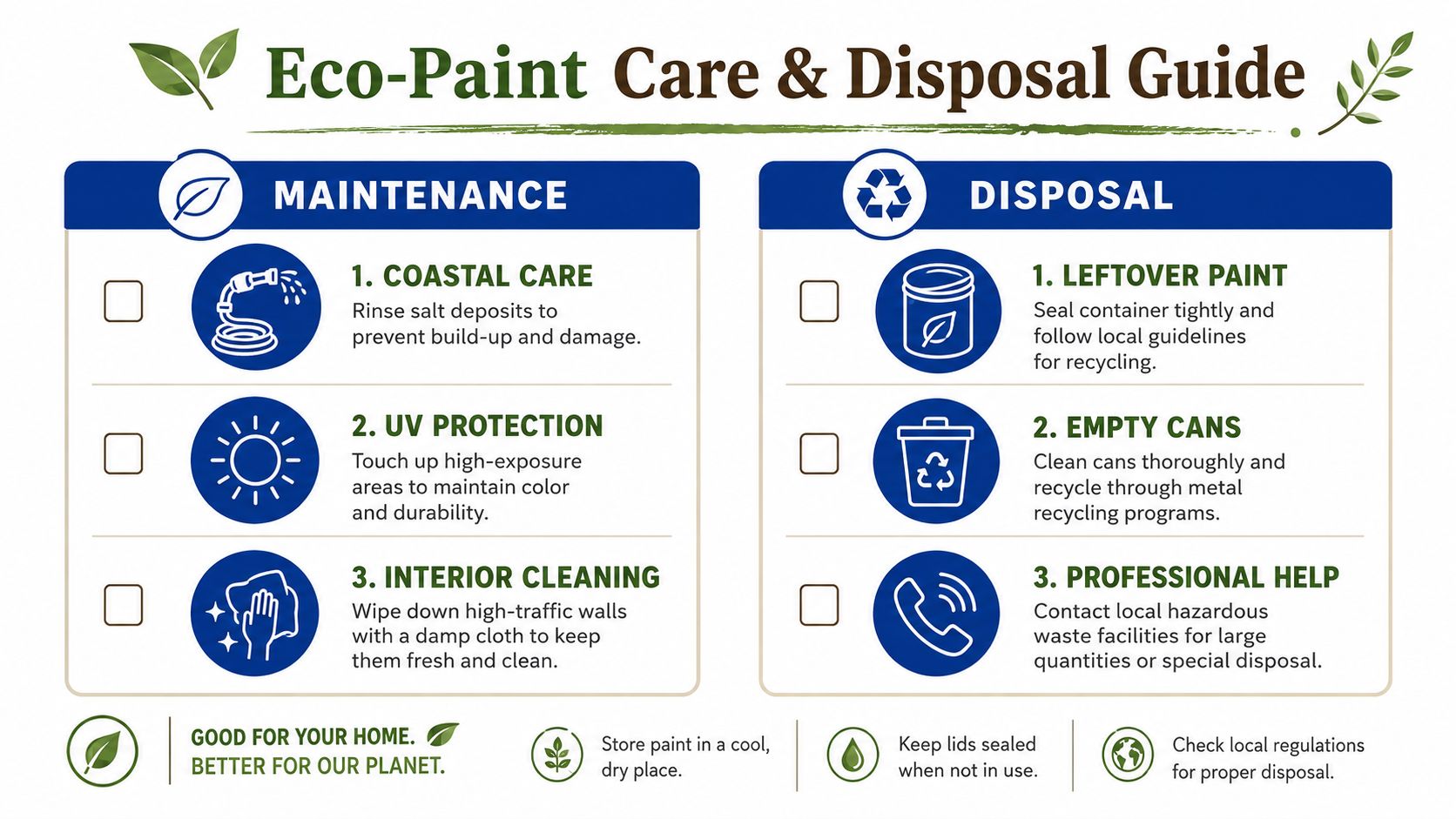
Maintenance should be light, regular, and matched to the coating. Wash exterior painted surfaces using the method recommended by the manufacturer, then inspect for chalking, peeling, failed sealant, or exposed edges. Avoid aggressive scrubbing, which can wear the film and create a patchy sheen before repainting is needed.
Inside, wipe high-traffic walls with a soft cloth and a mild cleaner suitable for the finish. Deal with marks early, before grime becomes embedded. Keep a small, clearly labelled amount of the original paint for repairs. Match the product family, colour, and sheen where possible. A chemically compatible waterborne paint can still leave an obvious patch if its texture or reflectivity differs.
Deal with leftovers before they become waste
Never pour paint into a drain, onto soil, or into a stormwater system. Water-based leftovers should remain in their sealed container and go through an approved household paint take-back or collection pathway. Solvent-based paint, thinners, and contaminated materials require a different hazardous-waste route. Keep them separate, labelled, and away from heat. Do not combine products to make disposal easier.
Auckland Council states that standard household paint should not go into rubbish or recycling bins. Its household paint disposal guidance explains whether a retailer take-back service or approved facility suits the product and local requirements.
Store usable leftovers with the lid firmly sealed and the rim clean. Record the colour, room, finish, and date of purchase on the container. Order accurately for future work, and contact the retailer, council, or an approved collection service when a large quantity remains.
If old layers must be removed, particularly from timber or complex surfaces, professional paint removal in New Zealand can help assess whether stripping, sanding, encapsulation, or local repair creates the safest waste pathway.
Putting It All Together for a Healthier, Longer-Lasting Finish
Start with the room's health and use requirements. For a bedroom or nursery, look for a documented low-VOC interior system, check the final tinted product, ventilate properly, and allow enough curing time before regular occupation. For a kitchen, bathroom, hallway, or rental, give equal weight to washability and moisture resistance. The lowest number on a label isn't useful if the coating needs early replacement.
Next, match certification to the question you're asking. Eco Choice Aotearoa provides New Zealand criteria with defined VOC limits and environmental requirements. Indoor-air labels can help with imported products, while ingredient disclosures can make formulation choices clearer. Always read the product data sheet and safety data sheet rather than relying on “natural”, “green”, or “zero-VOC” wording alone.
Then assess the substrate. Interior plasterboard, painted timber, cedar, solid plaster, masonry, and flexible weatherboard each need different preparation and coating behaviour. On the North Shore, salt, UV, dampness, mould, and access can decide the outcome before the first topcoat is opened.
The environmental choice that lasts is often the one that avoids premature repainting, uses only the material required, and leaves a responsible disposal route for what remains.
Confident DIYers can handle a well-ventilated interior feature wall or furniture project with careful preparation. Whole-home exteriors, multi-storey access, heritage weatherboards, and coastal restoration are different jobs. An experienced local contractor brings the assessment, access planning, preparation, compatible system selection, and application control needed to make the low-emission choice perform properly.
Painters North Shore can assess your interior, exterior, rental, or small commercial repaint and specify a low-VOC system around the substrate, coastal exposure, and required finish. Visit Painters North Shore to arrange a practical quote focused on preparation, product suitability, ventilation, and responsible paint use from the outset.