A storm has just pushed water through a North Shore commercial building. The tenant wants an answer before opening, the landlord is looking at damaged ceiling tiles and flooring, and the property manager is already asking whether the work belongs in outgoings, operating expenditure, capital expenditure, or a make-good claim. That decision can't wait until every invoice arrives.
Commercial property repair on the North Shore is rarely just a trade call-out. It's a building-condition problem and a lease-economics problem, shaped by coastal exposure, tenant obligations, compliance requirements, tax treatment, and the cost of disrupting a working business. The right response starts with evidence, then turns that evidence into a prioritised programme.
Why Commercial Property Repair Matters on the North Shore
A roof outlet blocks during a wet afternoon in Takapuna. By opening time, ceiling tiles are stained, stock has been moved, and the tenant wants to know who is paying. The visible damage is only part of the decision. The owner also needs to assess business disruption, lease obligations, make-good exposure, and whether the work is a repair or a wider renewal.
Takapuna, Albany, and Glenfield buildings face conditions that turn minor defects into expensive work. Salt-laden air accelerates corrosion on exposed steel. Strong UV breaks down paint films and sealants. Wind-driven rain tests roof penetrations, cladding joints, flashings, and aluminium joinery. A building can look serviceable from the car park while moisture is already travelling behind a lining.
A skipped repair can then become internal water damage, tenant disruption, mould risk, damaged stock, and a dispute over responsibility. I've seen owners focus on a ceiling stain while the failure sat higher up in a gutter outlet, parapet joint, or poorly sealed penetration.
Practical rule: Treat the first sign of water as an investigation trigger, not a painting job.
The scale of the local trade sector means contractor availability is not the only issue. New Zealand's repair and maintenance industry employed 31,200 people in February 2025, compared with 20,200 in February 2000, an increase of about 54.5% over 25 years. Auckland recorded 4,035 geographic units in this activity in February 2025, ahead of Canterbury at 1,638 and Waikato at 1,422, according to New Zealand repair and maintenance industry data. Owners still need to match the contractor to the failure, define the scope, and allow for coastal preparation rather than choosing the first available crew.
The lease and tax decisions sit beside the defect
Repair work changes the financial position of both landlord and tenant. Auckland office buildings reported average outgoings of $137 per square metre in 2025, up 6.8% year-on-year, with repairs and maintenance among the important cost categories. Those pressures make each scope relevant to budgeting, tenant communication, and lease interpretation.
Tax treatment needs a separate check. Inland Revenue's 2026 interpretation statement says work that reconstructs, replaces, or renews an asset entirely or substantially is capital expenditure rather than a deductible repair expense. Replacing a component can still be a repair to the larger building where the work does not change the building's character or become a broader renewal project, as explained in Inland Revenue's repairs and maintenance guidance.
Lease expiry creates another cost decision. Ordinary wear can become a make-good programme involving paint, flooring, joinery, ceilings, and damaged fittings. If inspection starts at handover, there is less time to separate tenant damage from base-building deterioration and to schedule work before the next tenancy. A repair that is manageable during occupation may become a larger reinstatement claim when several trades must work at once.
| Repair Ignored | Typical Initial Cost (NZD) | Typical Cost 12 Months Later | Cost Multiplier |
|---|---|---|---|
| Gutters, roof outlets, or minor leaks | Qualitatively modest | Potentially substantial internal and tenant damage | Can rise sharply |
| Failing sealants around joinery | Qualitatively modest | Broader moisture remediation | Often multiples higher |
| Flaking exterior coating | Planned maintenance cost | Substrate preparation and repair | Scope expands |
| Minor flooring or joinery damage | Localised make-good | Full tenancy reinstatement | Exposure increases at lease end |
The practical question is not who can attend fastest. It is which failure carries the greatest safety, operational, lease, and asset risk if it remains unresolved. That answer should set the inspection scope, repair order, budget allowance, and communication plan.
Inspecting Your Commercial Building Before You Spend Anything
Start with a documented inspection before requesting quotes. A short, disciplined walk-through produces better scopes than sending several contractors a photograph of a stain and asking for a price. Take wide shots, close-ups, location notes, and photographs that show scale.
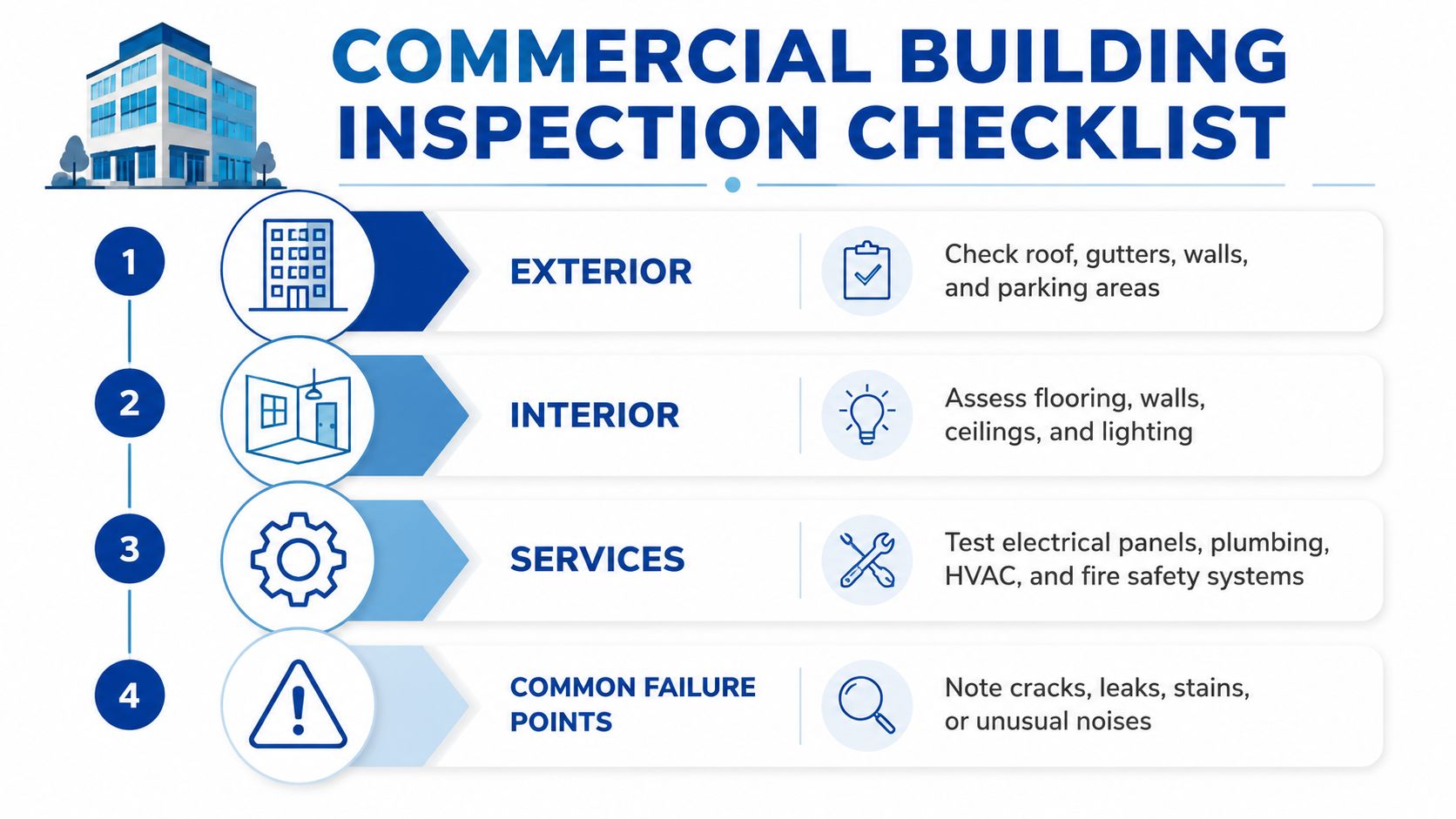
Pass one covers the exterior envelope
Walk the building from high-risk interfaces down to ground level. Check roof penetrations, gutters, outlets, parapets, cladding seams, sealant joints around aluminium joinery, exposed brackets, and the condition of the paint film. On coastal sites, look closely for rust staining, bubbling coatings, chalking, open joints, and failed sealant adhesion.
Don't rely on distance. A coating can appear intact across a wall while failing around fixings, corners, slab edges, and service penetrations. Note whether staining follows a vertical path, spreads horizontally, or appears only after particular weather. Those patterns help distinguish a roof leak from condensation, plumbing failure, or wind-driven rain.
For a useful comparison of how inspection work should identify defects before repair decisions, the visual reference on South Florida roof inspection shows why roof condition needs to be assessed systematically rather than guessed from the interior.
Pass two moves inside the tenancy
Look above and below the obvious damage. Check ceiling stains beneath penetrations, sagging tiles, swollen skirtings, separated trims at slab edges, lifting vinyl, damp odours, and patch repairs that don't match surrounding finishes. HVAC condensation deserves special attention, particularly where drain lines, fan-coil units, or poorly insulated pipework sit above suspended ceilings.
Speak with the tenant or facilities contact. Ask when the issue first appeared, whether it follows rain or HVAC operation, whether equipment has tripped, and whether anyone has moved stock or furniture to avoid damage. Their timeline can be more valuable than a single inspection photograph.
Pass three tests the services
Services failures can create immediate operational risk. Confirm that switchboards are labelled, record any unusual heat or damage visible without opening equipment, note RCD trips under normal use, and identify plumbing isolation valves. Check HVAC discharge, condensate drainage, access panels, and areas where water could fall onto electrical equipment.
Don't undertake electrical or mechanical testing beyond your competence. Record the symptom and bring in the appropriately licensed trade. The inspection is for evidence and prioritisation, not for improvising repairs.
Pass four checks grounds and access
Inspect downpipes, stormwater grates, retaining edges, paving falls, loading areas, car parks, landscaping contact with walls, and vegetation near rooflines. Poor drainage can make a sound wall appear defective, while soil or garden beds built up against cladding can hold moisture against the substrate.
Finish with three outputs:
- A photo log: Number each image and record the building elevation, tenancy, room, and approximate location.
- A condition summary: State the observed issue, likely causes, immediate controls, and whether specialist testing is required.
- A location-based punch list: Group items by roof, west elevation, tenancy, plant room, or car park rather than by trade.
NZ weathertightness guidance recommends visual investigation, non-invasive testing, invasive testing, sampling, and leak-source identification before design. It also distinguishes complete recladding, targeted repairs, and hybrid solutions, while stressing that moisture readings need their testing conditions recorded because wet and dry states can change results, as set out in the ABCS remediation guidance. That evidence-gathering stage is where owners avoid paying for the wrong scope.
Prioritising Repairs by Urgency and Lease Impact
A useful triage system has four bands. It prevents the loudest tenant complaint from automatically displacing the most dangerous defect.
Band one covers safety and compliance
A cracked balustrade at a Takapuna boardwalk café belongs here regardless of price. So do unstable façade elements, exposed electrical hazards, unsafe access routes, serious fire-safety defects, and active structural concerns. Control the risk first, then investigate and price the permanent solution.
The Health and Safety at Work Act lens matters because the landlord, tenant, contractor, and other parties may each hold duties depending on their control and involvement. Don't wait for a lease argument before isolating an unsafe area.
Band two deals with water ingress
Active leaks, failed roof outlets, saturated linings, and moisture entering occupied areas need rapid investigation. Water can damage finishes, stock, equipment, and records while also creating disputes about rent abatement, access, insurance, and responsibility.
NZ building-survey guidance says owners should first investigate the extent and causes of defective or leaky-building problems, followed by detailed investigation and destructive testing where necessary. A commercial weathertightness and structural repair guide makes the same practical connection between condition assessment, maintenance planning, budgeting, and compliance.
Band three protects operations
This band includes failing HVAC, plumbing faults that restrict a tenancy, damaged doors and joinery, flooring that creates a trip risk, and building elements that threaten business continuity without presenting an immediate life-safety issue. Schedule these around trading patterns, tenant access, and replacement lead times.
Band four covers cosmetic and make-good work
Flaking paint, worn finishes, damaged partitions, and tired joinery may sit here, but “cosmetic” doesn't mean irrelevant. An Albany warehouse with visibly failing exterior paint can generate tenant complaints, weaken presentation at renewal, and increase the amount of work required when a tenant leaves.
Rank every item against three questions:
- What is the safety or compliance exposure?
- What lease event could it trigger?
- Is the work likely to be a deductible repair or capital expenditure?
Inland Revenue's distinction is not a substitute for professional tax advice, but it should shape the brief sent to the accountant. A repair that preserves the existing asset is different from work that substantially renews or changes it.
| Priority Band | Typical Repairs | Lease Trigger | Typical Tax Treatment |
|---|---|---|---|
| Safety and compliance | Balustrades, unsafe access, electrical hazards, fire-safety defects | Immediate access controls, liability, possible disruption | Depends on whether work repairs or improves the asset |
| Water ingress | Roof outlets, flashings, failed joints, wet linings | Damage claims, access disputes, possible abatement | Repair may be deductible if the asset's character remains unchanged |
| Operational risk | HVAC, plumbing, doors, flooring, services | Business interruption, service obligations | Depends on scope and asset treatment |
| Cosmetic and make-good | Paint, partitions, joinery, worn finishes | Renewal, handover, make-good obligations | Often repair or reinstatement, but assess the actual work |
The matrix should sit beside the maintenance budget. Score each defect, assign an owner, set a due date, and place the expenditure in the quarter where the building and lease risk justify it.
Building a Repair Budget That Survives Contact with Reality
A commercial repair budget is tested when the first opening reveals wet framing, corroded fixings, or a tenant cannot release the area as planned. A single rate per square metre will not account for coastal exposure, height, access, staging, substrate condition, compliance requirements, or lease obligations. Build the budget around those variables before approving the work.
Use local benchmarks as planning indicators, not fixed quotes. RLB's 2025 New Zealand Riders Digest places office fit-out make-good at about $210 per square metre for open-plan space and $275 per square metre for partitioned space, as shown in the RLB New Zealand Riders Digest. Forecast that liability before the tenant approaches lease expiry. Otherwise, reinstatement can arrive as an unplanned call on cash.
Build the budget in separate work packages
Keep urgent defects, planned maintenance, tenant make-good, compliance work, and improvement projects in separate budget lines. For each package, record the location, assumed scope, access method, responsible party, likely timing, and whether the lease may allow recovery from the tenant.
Separate renewal from repair. Inland Revenue distinguishes work that preserves an existing asset from work that substantially reconstructs, replaces, or renews it. Have the accountant review the scope before the owner or manager promises an outgoings recovery position. A repair classification can depend on the actual work, not the label used in the budget.
Occupancy costs also affect lease discussions. Auckland office outgoings were reported at $137 per square metre in 2025, following a 6.8% year-on-year increase, according to Bayleys' commentary. That pressure makes vague repair allocations harder to defend. Give tenants a clear description of the work, the relevant lease provision, and the timing of any charge.
Reserve for the defects the first quote can't see
A contractor cannot price concealed decay accurately without opening the affected area. Include a labelled investigation and latent-defect allowance, then state what happens if testing finds a wider failure. For cladding, roof junctions, or damp interior linings, define the approval process for extra work before the project starts.
Grounds, drainage, and external access belong in the programme too. Vegetation can block inspections, roots can affect drainage, and damaged hard surfaces can create access or safety issues. Prestonwood Commercial Landscape Services provides a useful reference for treating landscaping, drainage interfaces, and presentation as connected maintenance responsibilities.
For coating or recladding, record whether the proposal is localised repair, over-cladding, or broader renewal. The North Shore recladding guide can help separate those scopes before prices are requested. That distinction changes investigation time, consent requirements, tenant disruption, and the amount held in reserve.
| Repair Category | Cost Range (NZD per m²) | Notes |
|---|---|---|
| Office make-good, open-plan | About $210 | RLB benchmark for office fit-out make-good |
| Office make-good, partitioned | About $275 | RLB benchmark where partitioning increases reinstatement scope |
| Routine maintenance | Qualitatively lower | Plan by condition, access, and lease responsibility |
| Weathertightness remediation | Project-specific | Scope depends on testing, decay, cladding, and design |
| Capital renewal | Project-specific | Review separately from deductible repair expenditure |
Assign each major package to a realistic financial period, with an owner, approval threshold, and review date. The result is a budget that supports cash-flow planning and gives the property manager evidence for discussing timing and cost recovery with tenants.
Choosing the Right Contractor for the Job
A low tender can hide the work that protects a commercial building. On an exposed North Shore exterior, skipped washing may leave salt contamination behind, while painting over loose coating, damp substrate, or corroded steel can produce an early failure at joints, edges, and fixings. The completed surface may look acceptable at handover, then deteriorate before the lease economics support another repair cycle.
Choose a contractor by evidence, scope, and the consequences for the tenant and owner.
- Preparation method: Require a written sequence for washing, scraping, sanding, filling, corrosion treatment, masking, priming, and topcoats.
- Coating system: Ask why the specified primer and finish suit the substrate, coastal exposure, existing coating, and expected movement.
- Moisture controls: Staining or weathertightness concerns require investigation before repainting. A contractor who skips moisture checks is leaving the owner to fund the diagnosis later.
- Insurance and guarantees: Confirm current public liability cover, relevant trade qualifications, and written workmanship terms. Check membership claims with the named industry body.
- Local evidence: Request recent North Shore references and inspect a completed job. Examine edge detailing, cut lines, sealant transitions, coating uniformity, and less visible areas.
- Method statement: The programme should address wind, humidity, overspray, tenant access, dust control, curing, and weather delays.
Put two quotes beside one another
A sound quote explains what happens before the first coat. A weak one may promise “two coats to existing surface” while leaving the building's condition unresolved. The detailed quote can cost more at tender stage, but it gives the owner a clearer risk position and makes later variations easier to test.
Ask every bidder to list exclusions. Scaffold, access equipment, moisture testing, substrate repairs, lead-paint procedures, after-hours work, waste removal, and protection of tenant contents can change the final account. If one contractor includes these items and another excludes them, the prices are not comparable.
For offices, retail spaces, warehouses, and managed buildings, include commercial painters in Auckland in the comparison set only after testing their proposed scope against the same site requirements as every other tender.
The right contractor will challenge an unrealistic programme, identify compliance concerns, and explain why repair is preferable to replacement. That resistance protects both the building budget and the lease position. A contractor who accepts every assumption may be easy to appoint, but difficult to manage once the substrate differs from the quotation.
Scheduling Repairs to Minimise Business Disruption
A repair programme should protect the tenant's ability to trade while preserving the order of construction. Start with the building envelope and roof, then address joinery and glazing, followed by carpentry, plastering, services, and clean finishes. Painting before dusty or wet trades finish guarantees damage, touch-ups, and repeat visits.
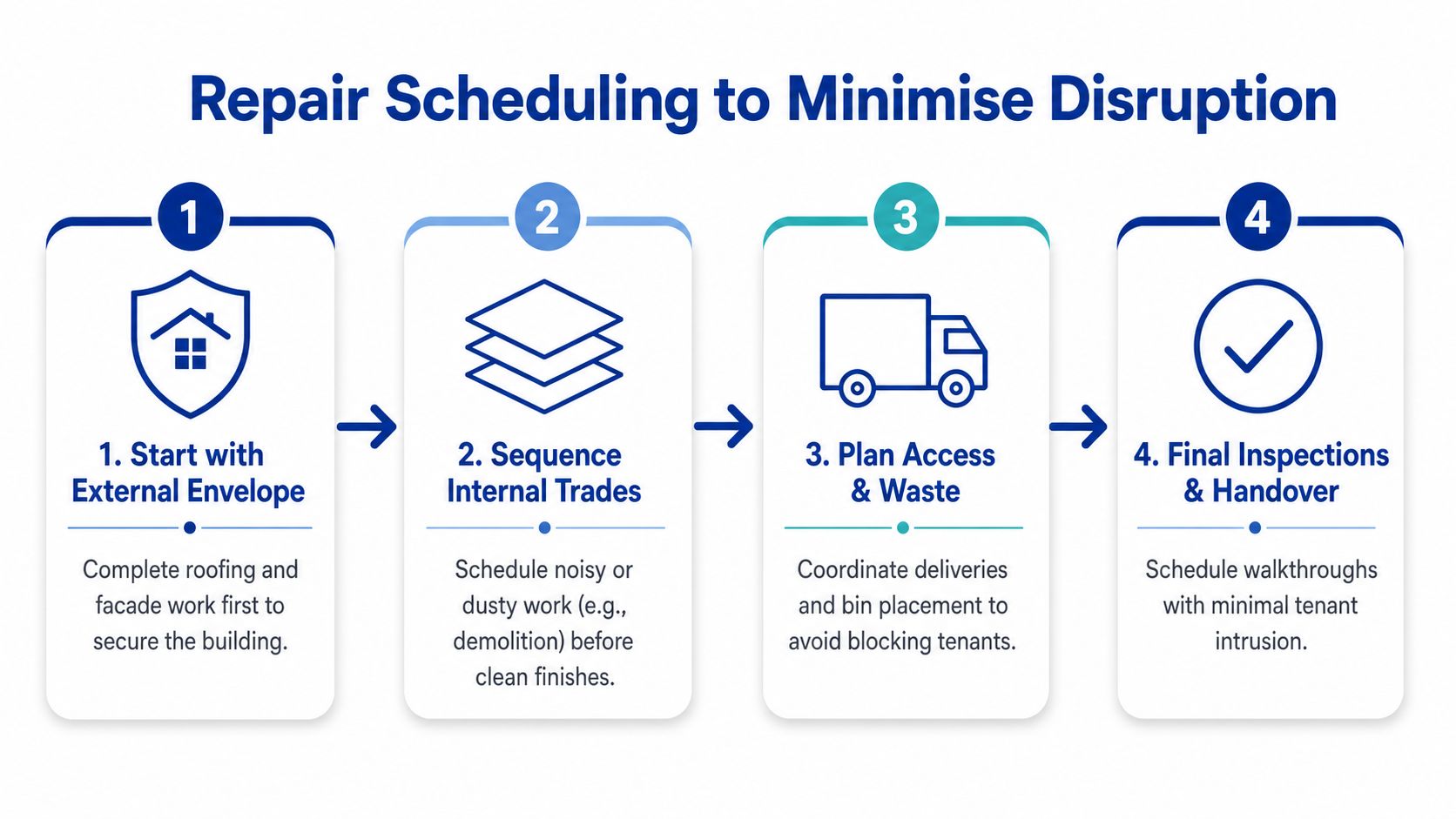
Protect the tenant's operating hours
Agree the noisy-work window in writing. For many businesses, weekday daytime work can be managed if access, deliveries, and customer routes remain clear, while sensitive fit-outs may need evening or weekend staging. Retail foot traffic, school-zone congestion, loading requirements, and shared-lobby access should all influence the programme.
Use barriers, floor protection, sealed work zones, and negative-pressure air scrubbers where painting or demolition could spread dust or odour into adjacent tenancies. Don't promise “no disruption” when the work plainly creates noise or access restrictions. Promise a controlled plan, named contacts, daily housekeeping, and prompt escalation when conditions change.
Sequence the trades properly
Roof and façade work should secure the building before interior finishes are renewed. Carpenters and plasterers need to complete repairs before painters arrive, and electrical or HVAC contractors must finish above-ceiling work before ceiling tiles and final decorations are installed.
Give tenants a written programme at least two weeks before work begins, with dates for access restrictions, noisy tasks, shutdowns, deliveries, waste collection, and final inspections. For a useful reference on reducing disruption through planned internal painting, see the guidance on commercial interior painting.
The handover should include photographs, product information, defect notes, cleaning confirmation, and any maintenance actions that remain. That record helps settle later questions about whether a mark, leak, or damaged finish existed before occupation.
A short visual overview of sequencing can be useful for tenant briefings:
Keep one person responsible for daily coordination. When the tenant, property manager, contractor, and building owner all assume someone else is handling access, small scheduling errors become missed appointments, unsafe entry points, and avoidable complaints.
A 12-Month Maintenance Plan That Protects Asset Value
A twelve-month plan turns inspection findings into assigned actions. It should show what the owner funds, what the property manager administers, what the contractor maintains, and which costs the lease may allow the landlord to recover. The exact recoverability depends on the lease wording and the nature of the work, so each package needs a documented review.
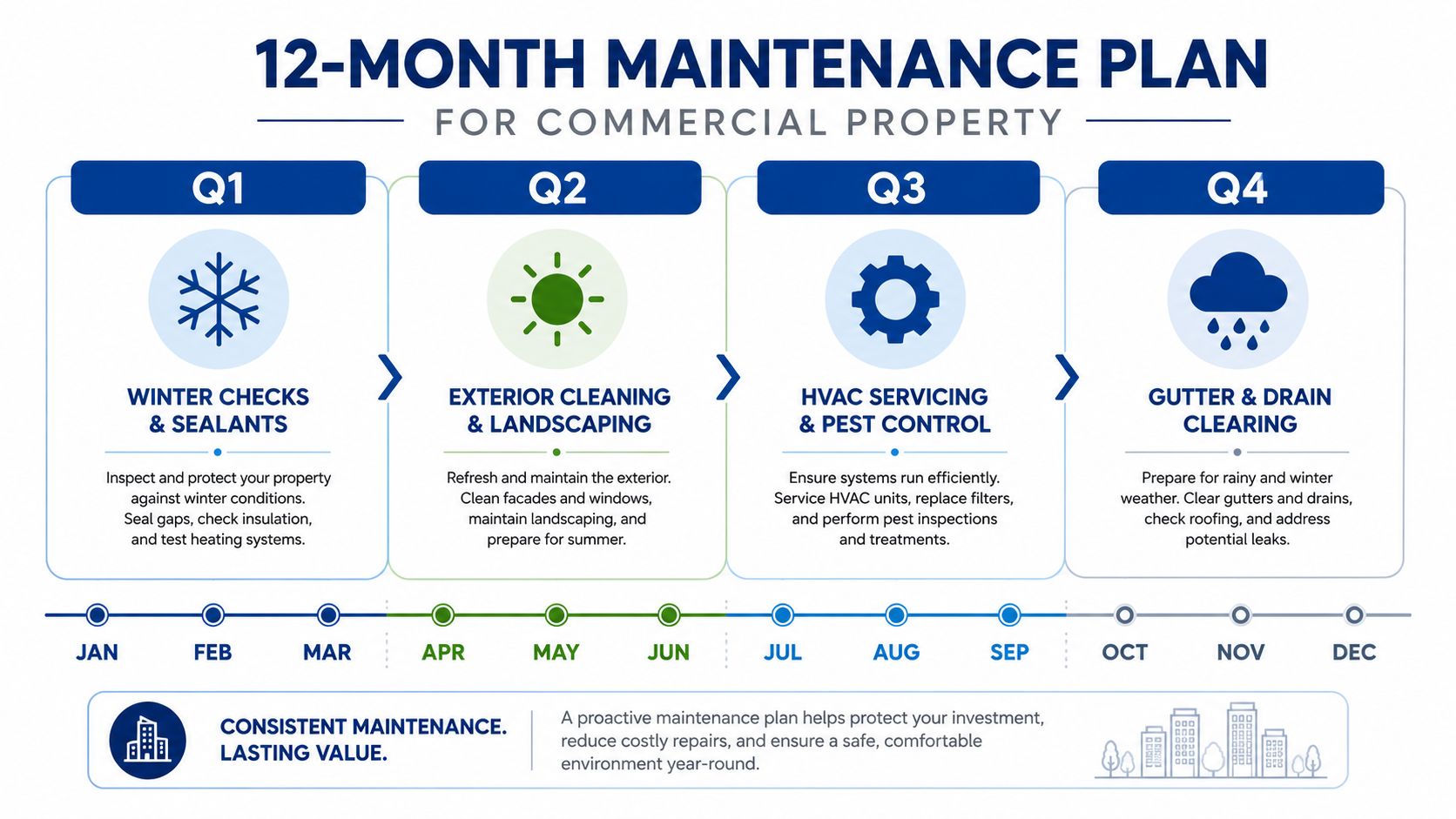
January to March
Use the late-summer period to complete the annual exterior condition review. Inspect roof penetrations, gutters, downpipes, sealants, cladding joints, exposed steel, paint films, drainage, and access routes before the wetter months. The property manager should update the defect register, while the owner approves urgent scopes and the contractor confirms access and weather constraints.
This is also a practical time to arrange electrical and lighting checks before winter demand increases. The commercial electrical maintenance guidance from Access Electrical and Lighting can support a separate services checklist.
April to June
Align make-good inspections with lease milestones rather than waiting for keys to be returned. Record existing condition, tenant alterations, damaged flooring, paint wear, joinery changes, and any work that might be landlord maintenance rather than tenant reinstatement.
Schedule roof, gutter, and envelope repairs before the most difficult weather. If invasive testing is needed, complete it before finalising the permanent design. Keep tenant communication factual, with clear responsibility for access, temporary protection, and reinstatement.
July to September
Use the colder period for controlled interior works, deep cleaning, minor joinery repairs, ceiling replacement, floor repairs, and service-room maintenance. Staged work can keep occupied areas functioning, but the programme should allow for ventilation, curing, drying, and safe reoccupation.
Review the maintenance budget against actual invoices. Separate reactive defects from planned work, then update the following year's allowance. A recurring leak or repeated coating failure deserves a root-cause review, not another identical patch.
October to December
Complete pre-summer repainting, weatherproofing, sealant renewals, and external presentation work when conditions support reliable coating performance. Confirm that all roof outlets and ground-level drainage are clear before holiday shutdowns and reduced staffing periods.
The most valuable habit is a written annual condition log updated after every repair. Store photographs, reports, invoices, product details, warranties, tenant notices, and completion records together. North Shore's coastal climate punishes owners who rely on memory when negotiating make-good, reviewing insurance events, approving capital work, or explaining outgoings.
Painters North Shore provides preparation-led commercial painting for offices, retail spaces, warehouses, and managed properties, with staged or after-hours scheduling available to reduce disruption. Visit Painters North Shore to arrange a site assessment and receive a written scope that separates surface preparation, repairs, coatings, access, and programme timing.